
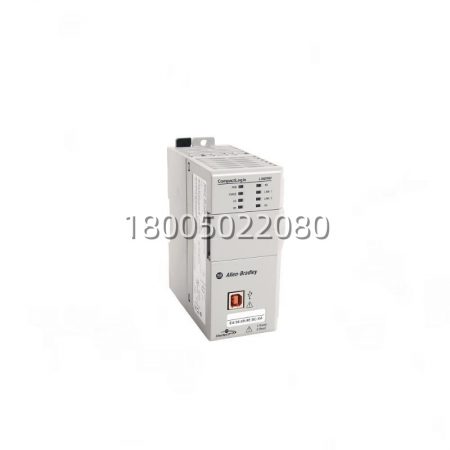
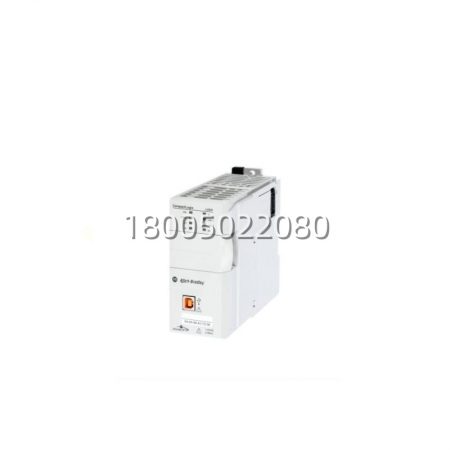
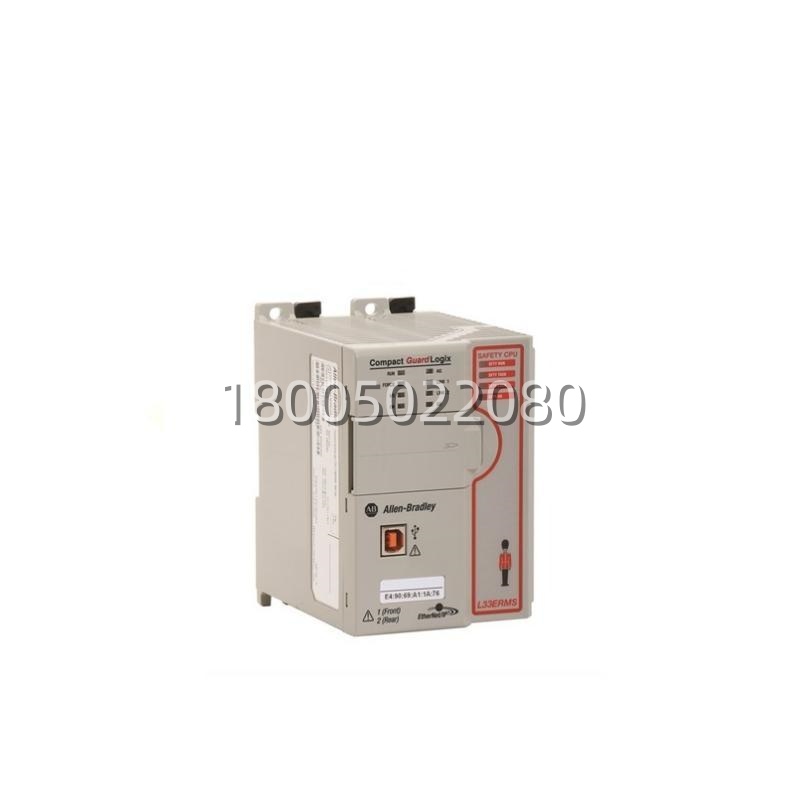
Application Scenarios:In a high-speed automotive assembly line, robotic cells must operate with precision while ensuring human operator safety. The 1769-L37ERMS serves as the unified brain, controlling the sequential logic of conveyors and robots while simultaneously monitoring safety light curtains, emergency stops, and door interlocks. Its integrated safety function allows it to execute a Safe Torque Off (STO) command to the drives in milliseconds if a breach is detected, preventing accidents without stopping the entire production line unnecessarily. This addresses the key pain points of system complexity, high wiring costs from using separate controllers, and the risk of spurious trips that plague non-integrated safety systems.
Parameter:
| Main Parameters | Value/Description |
|---|---|
| Product Model | 1769-L37ERMS |
| Manufacturer | Allen‑Bradley (Rockwell Automation) |
| Product Category | Compact GuardLogix 5370 L3 Controller |
| Memory Configuration | 4 MB Standard + 1.5 MB Safety Memory |
| Safety Certification | SIL 3 (IEC 61508), PL e / Cat. 4 (ISO 13849-1) |
| Integrated Ports | Dual Ethernet/IP (supports DLR), 1x USB |
| Motion Control | Up to 16 axes CIP Motion, Kinematics support |
| I/O Expansion | Up to 30 local 1769 modules |
| Network Nodes | 64 EtherNet/IP connections |
| Non-Volatile Memory | 1 GB SD card (supports up to 2 GB) |
| Power Supply | 24V DC (via 1769 power module) |
| Operating Temperature | 0 to 60 °C |
Technical Principles and Innovative Values:The 1769-L37ERMS is built on a multi-core processor architecture that physically separates standard control tasks from safety-critical logic execution.
- Innovation Point 1: Unified Safety and Standard Control: Unlike traditional setups requiring a separate safety relay or safety PLC, the 1769-L37ERMS executes both standard logic and safety logic (CIP Safety) within the same chassis. This reduces hardware footprint, simplifies wiring, and allows for more sophisticated safety interlocks that are tightly coupled with process logic.
- Innovation Point 2: Deterministic Motion over EtherNet/IP: The controller leverages CIP Sync and CIP Motion protocols to synchronize multi-axis motion control directly over the standard EtherNet/IP network. This eliminates the need for proprietary motion networks, reducing hardware costs and enabling complex kinematics for applications like flying shears or robotic pick-and-place.
- Innovation Point 3: Device Level Ring (DLR) Network Resilience: The dual embedded Ethernet ports support DLR topology, allowing the controller to form a redundant ring network. If a cable is cut, the network recovers in under 3 ms, ensuring continuous communication with I/O and HMIs without the cost of a full controller redundancy setup.
Reviews
There are no reviews yet.