
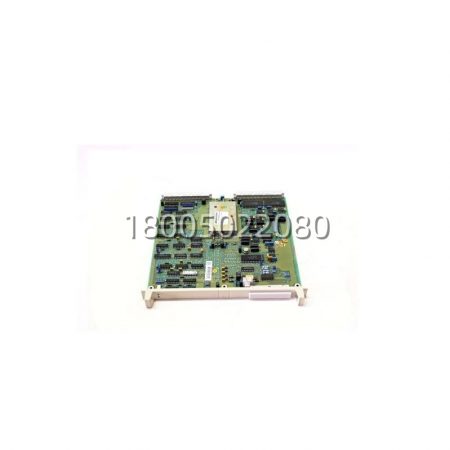
Technical Specifications
| Parameter | Value |
|---|---|
| Product Model | 7944831D (also seen as 7944831D-D / 7944831D-DE) |
| Manufacturer | ABB |
| Product Type | Processor Module (Control Computing Core) |
| Processor | 32-bit RISC, 1 GHz |
| RAM | 2 GB |
| Flash Storage | 16 GB |
| Operating Voltage | 24 V DC (typical; some references cite 12–36 V DC envelope) |
| Power Consumption | ~1.5 W (typical) |
| Load Capacity | 256 I/O points (reference) |
| Communication Interfaces | Ethernet, CAN, RS-485 |
| Supported Protocols | Modbus RTU/TCP, Profibus DP (platform-dependent) |
| Operating Temperature | -20°C to +60°C |
| Storage Temperature | -40°C to +85°C |
| Humidity | 5%–95% RH, non-condensing |
| Dimensions (approx.) | 115 × 105 × 50 mm (reference; alternate source cites 85 × 95 × 20 mm) |
| Weight | 0.25 kg (reference) |
| Protection Class | IP20 (cabinet installation) |
| Mounting | Rack / DIN rail (per carrier) |
| Country of Origin | Sweden |
| HS Code (ref.) | 8537101190 |
Main Features and Advantages
Dedicated DCS-class compute, not a repackaged IPC: The ABB 7944831D is built around a 1 GHz 32-bit RISC core with 2 GB of RAM and 16 GB of Flash—numbers that look modest next to a desktop, but are sized precisely for the real-time control loops, I/O scan tables, and communication scheduling that an ABB DCS node actually does. There is no OS boot delay, no desktop-grade thermal envelope to manage, and no surprise Windows update. The RISC pipeline and the firmware pair give deterministic scan behavior, which is what matters when a PID loop on a paper machine dry end or a boiler drum level expects a fixed-cycle answer.Tri-interface communication without gateways: Ethernet + CAN + RS-485 on a single processor board is unusual in the general PLC world and purposeful here. Ethernet lands the 7944831D on the plant network for HMI, historian, and 800xA-layer connectivity. CAN handles the fast, deterministic chatter between rack mates and local I/O clusters. RS-485 keeps legacy drives, analyzers, and third-party skids online without an extra protocol converter eating panel space and power. For retrofit projects where “keep the field wiring” is a hard constraint, this mix is the 7944831D‘s strongest selling point.24 V DC industrial power and low dissipation: At ~1.5 W typical, the module draws from the same 24 V DC distribution that already feeds the I/O carriers. No separate supply rail, no fan, no heatsink tower. In a dense DCS cabinet that might hold a dozen processor and I/O boards, that matters—heat budget stays manageable, and a failed 7944831D does not cascade into thermal stress on neighbors.Drop-in sparing for Advant Master / MasterPiece-adjacent nodes: Plants running AC450, AC410, MP200/200/1, or the broader Advant OCS family know the pain of end-of-life processor boards. The 7944831D is positioned in ABB’s spare-channel catalog for exactly these architectures. Mechanical envelope, connector footprint, and backplane signaling are aligned so that—provided the carrier and firmware revision match—the swap does not trigger a re-rack or a re-map. That is the difference between a two-hour planned outage and an unplanned overnight.Status LED visibility and diagnostics: Power, Run, Communication, and Fault LEDs on the faceplate let a technician at the cabinet front tell “dead supply,” “booted but off-bus,” or “I/O mismatch” without a laptop. In a plant where the DCS cabinet is three buildings away from the control room, that saves the walk back.Sweden-origin build consistency: Like the Accuray and Advant families it serves, the ABB 7944831D benefits from ABB’s Nordic manufacturing discipline—component grading, conformal coating, and solder-joint longevity aimed at 15–20 year service life. For asset managers writing spare-parts justification to finance, “Sweden origin, DCS-matched spare” carries more weight than “compatible third-party CPU board.”
Application Field
The ABB 7944831D lives where an ABB DCS or Advant-migration node is the control backbone and the processor board has become the single point of failure that can’t be allowed to stay failed. Its natural habitats span the same industries that standardized on ABB MasterPiece and Advant OCS from the late 1980s through the 2000s.In pulp & paper, the 7944831D shows up in distributed nodes along paper machines, digesters, and stock-prep lines where the original MP200/AC450 class CPU has been retired and the 7944831D is the approved spare or staggered-upgrade path. Wet-end and dry-end loops carry long-deadtime PID plus ratio/override strategies that were written once in the 1990s and never touched again—swapping the processor underneath them without touching the application code is the value prop.In power generation (auxiliary boilers, balance-of-plant, hydro governor nodes), ABB DCS footprints are common, and the 7944831D serves as the compute in localized control clusters—burner management sequencers, feedwater trim loops, turbine lube-oil skid controllers—where Ethernet talks up to the plant DCS and RS-485 or CAN talks down to the local actuators.In cement & minerals, S400 remote I/O + MasterPiece-style CPUs were a classic ABB play; the 7944831D appears in MCC-adjacent cabinets where motor sequencing, kiln drive auxiliaries, and crusher lube skids need a DCS-matched processor that survives dust, vibration, and temperature swing. The -20°C to +60°C envelope and IP20 (cabinet) rating match these environments when the enclosure is specified correctly.In oil & gas auxiliary and chemical batch skids—especially skid-mounted packages supplied by OEMs who standardized on ABB controls—the 7944831D is the spare the OEM name-drops when the original CPU goes NRND. The tri-interface comms let the skid talk Modbus TCP up to the plant DCS and Profibus/RS-485 down to drives and analyzers without extra gateway panels.Across all of these, the common thread is not greenfield innovation—it is keeping a proven ABB control narrative running while the processor hardware behind it rotates. The 7944831D is the quiet enabler of that continuity.

Reviews
There are no reviews yet.