
Application Scenarios
A water-treatment works in northern China had four SLC 500 pump panels scattered across a site that had grown one building at a time. The original design was honest: each panel was a self-contained island, and the operator walked to it. Then the county mandated remote telemetry, and the cheapest available backbone was already in the ground — an old blue-hose RIO trunk left over from a PLC-5 installation that still carried the SCADA scan.Ripping out four SLC programs was not an option; two of the panels had undocumented hand-off logic that nobody alive had traced. The solution was a 1747-DCM in each chassis, each set to a unique octal rack address with the I/O group and rack size dialed in on the DIP banks. The upstream scanner saw four new “racks” and mapped them into the telemetry word. The SLC programs never changed — not one rung, not one address. Commissioning took an afternoon, the SCADA screens lit up that evening, and the only drama was the panel tech discovering that the trunk’s far-end terminator had been missing since 2004.That is the 1747-DCM in its natural habitat: it does not modernize the machine. It respects the machine, and modernizes the conversation around it.
Parameter
| Main Parameters | Value / Description |
|---|---|
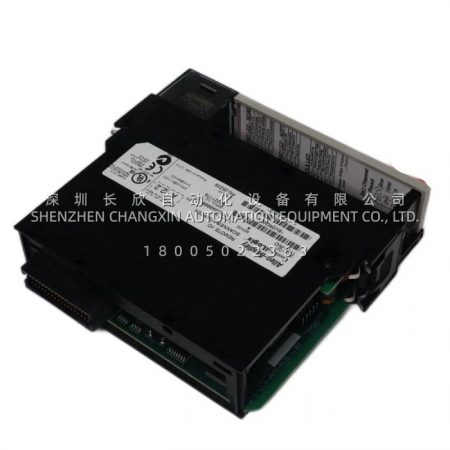
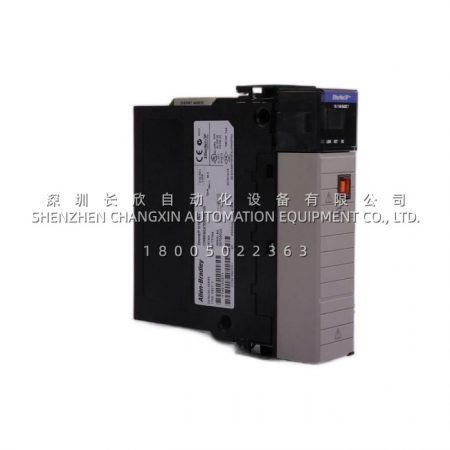
| Product Model | 1747-DCM — Direct Communication Module, Series A (A/B/C revisions carry the same core function; match the exact Series letter on the asset label) |
| Manufacturer | Allen-Bradley, Rockwell Automation — USA design origin, SLC 500 platform |
| Product Category | Communication module / RIO adapter (single-slot chassis resident) |
| Network Role | RIO adapter by default; the module family supports both scanner and adapter personalities depending on configuration and slot context — confirm the topology before ordering |
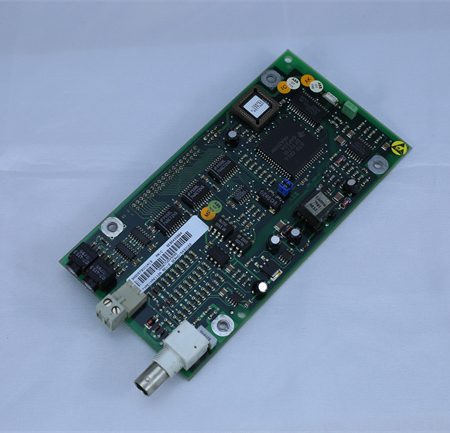
| Physical Link | 1 × RIO link port, 6-pin Phoenix-style connector; blue-hose coax topology, Belden 9463 or certified equivalent |
| Backplane Load | 360 mA @ 5 VDC, 0 mA @ 24 VDC — roughly 1.8 W dissipated, so the chassis power budget is rarely the constraint |
| Standard Baud / Distance | 57.6 kbps @ 3048 m (10,000 ft); 115.2 kbps @ 1524 m (5000 ft); 230.4 kbps @ 762 m (2500 ft) with the correct terminator |
| Extended-Node Option | Same three baud steps, but with 82 Ω ½ W termination at both physical ends the distance doubles at the lower rates — a genuine tool for long, sparse trunk lines |
| Termination | 150 Ω ½ W for standard node, 82 Ω ½ W for extended node; 1770-SC style terminators at the two physical ends only, never on every drop |
| Logical Addressing | Rack address 0–77 octal, plus I/O group and rack-size DIP settings; up to 32 logical rack addresses on a trunk |
| Backplane Data Map | 256 words reserved each for input (I:1.0 → I:16.15) and output (O:1.0 → O:16.15) across the SLC backplane image |
| Module Data Footprint | 2 to 8 words per module direction, handled like an analog I/O block — small, predictable, and easy to audit in the scanner schedule |
| Indicators | FAULT (red) = module or configuration fault; COMM (green) = link healthy — no laptop required for a first-pass diagnosis |
| Configuration | Two 8-way DIP banks on the board edge; no user program, no download, no firmware file. Power cycle to re-read the switches |
| Firmware | Fixed, revision-stamped on the label; capability changes mean a hardware swap, so the Series letter is part of the spare number |
| Environmental | 0 to +60 °C (32 to 140 °F), −40 to +85 °C storage, 5–95% RH non-condensing; IP20 open-frame, pollution degree 2 |
| Mechanical | 111 × 35 × 87 mm (4.37 × 1.38 × 3.43 in), approx. 170 g; removable front door with label, cable-tie slots, DIP access from the side |
| Immunity & Approvals | UL 508, CSA C22.2 No. 142, CE (EMC 2014/30/EU, LVD 2014/35/EU), NEMA ICS 2-230, EN 50081-2 Class A, IEC 61000-4-2 / 4-3; vibration 2 to 2.5 g, operating shock 30 g |
Technical Principles and Innovative Values
Innovation Point 1 — The network is invisible to the program. The 1747-DCM does not ask the SLC for a MSG instruction, a communications routine, or a single line of new ladder. It sits on the backplane, watches the I/O image, and serializes that image onto the RIO scan. To the SLC, the far-end pump status is just another input bit; to the scanner, the SLC is just another rack. That separation is the product’s real cleverness — the control logic and the network topology are allowed to age independently.Innovation Point 2 — DIP switches as a configuration language. In an era of web pages and unsigned firmware, the 1747-DCM is almost defiantly simple: rack address, I/O group, rack size, standard or extended node — sixteen little switches and the job is done. There is no version conflict, no corrupted configuration file, no “which laptop has the project?” A night-shift tech with a flat-blade screwdriver and a torch can re-address a 1747-DCM faster than a laptop boots.Innovation Point 3 — Distance bought with physics, not repeaters. The standard/extended-node choice is a termination-resistor trade-off, and it pays well: 57.6 kbps for three kilometres on a single coax run, or 230.4 kbps if the drop is short. Plants that would otherwise need a repeater, a powered cabinet and a maintenance contract get by with a terminator and a continuity check. The 1747-DCM makes the cable do the work.Innovation Point 4 — Deterministic I/O, not store-and-forward. RIO is a scheduled scan, not a mailbox protocol. Once the 1747-DCM is placed in the scanner’s high-priority rack list, its data moves on a fixed cadence, and the latency is bounded by the scan schedule rather than by collisions or a Windows stack. For safety-interlock and trip-feedback paths that must arrive on time every time, that predictability is worth more than a faster protocol.Innovation Point 5 — A migration hinge, not a dead end. Put a 1747-DCM on the old SLC, leave the program alone, and let the new ControlLogix or CompactLogix side talk to it through a 1756-RIO or 1747-SCNR bridge. The legacy machine keeps running while the rest of the plant moves on. When the SLC finally retires, the 1747-DCM retires with it — no half-converted logic left behind, no “temporary” gateway that becomes permanent.
Application Cases and Industry Value
Case 1 — Bottling line, three-leg interlock. A regional bottler ran three SLC 500s on filler, capper and labeller, with a PLC-5/40 acting as the line coordinator over RIO. The labeller’s original hardwired interlock cable had been chewed by a conveyor install and was due for replacement anyway. Rather than re-run a multiconductor cable through a wet floor, the plant fitted a 1747-DCM in the labeller SLC chassis and added the adapter to the PLC-5 scanner’s high-priority rack list. The interlock moved onto the RIO scan in under two hours. More importantly, the line coordinator could now see the labeller’s mode word, fault word and product-count register without a separate HMI link — and the labeller’s program was untouched. Maintenance’s report was understated: “We replaced a cable with a module, and now we can see the machine from the control room.”Case 2 — Steel-plant utility tie-in, 2.4 km apart. Two SLC 500 pump houses sat at opposite ends of a cooling-water loop, linked only by a single-mode fiber pair that the operations team refused to trust for control. The existing RIO blue-hose trunk already ran along the pipe corridor, and at 57.6 kbps with extended-node termination it covered the distance comfortably. A 1747-DCM at each end put both pump houses onto the PLC-5 utility scanner as discrete racks; the start/stop permissives and flow-fault bits rode the coax, while the fiber carried only the historian traffic. When a storm took the fiber for four hours, the pump houses kept their local control and the interlock stayed valid. The 1747-DCM had given the plant a control path that was independent of the IT network — a distinction that mattered the moment the fiber went dark.
Reviews
There are no reviews yet.