
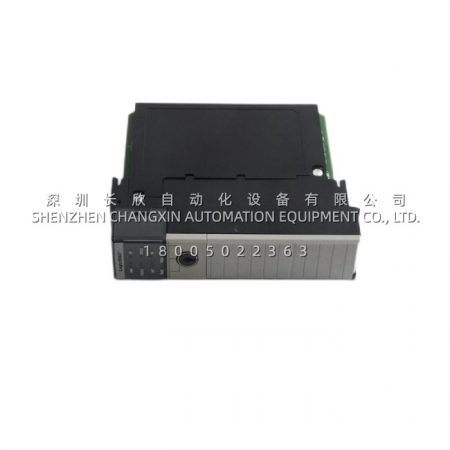
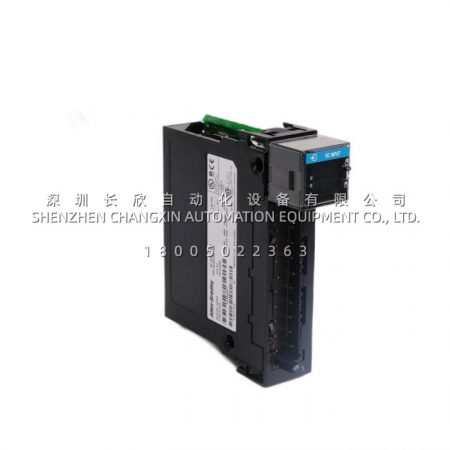
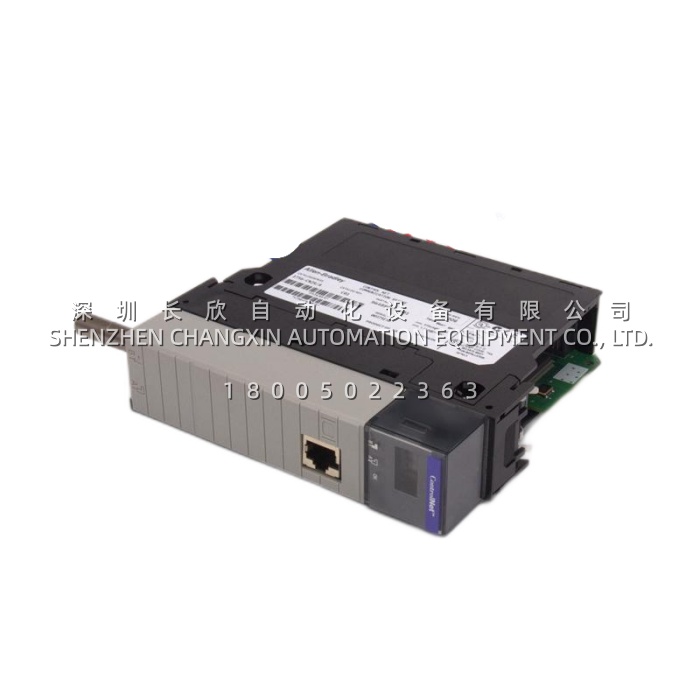
Technical Specifications
| Parameter | Value |
|---|---|
| Product Model | 1756-IB16I |
| Manufacturer | Allen-Bradley / Rockwell Automation |
| Product Type | ControlLogix Isolated Digital DC Input Module |
| Product Family | 1756 ControlLogix I/O (Discrete Input) |
| Number of Channels | 16, individually isolated |
| Input Type | DC sinking (NPN), 24 VDC nominal |
| Operating Voltage Range | 10…30 VDC |
| On-State Current | 2.0 mA min @ 10 VDC; 10.0 mA max @ 30 VDC |
| Off-State Voltage / Leakage | ≤ 5 VDC; ≤ 1.5 mA max |
| Input Impedance | ≤ 3 kΩ @ 30 VDC |
| Input Inrush Current | ≤ 250 mA peak (decays to < 37% within 22 ms) |
| Isolation | 250 VDC continuous, basic insulation; input-to-input and input-to-backplane |
| Input Delay (Off→On) | ≤ 1 ms hardware + software filter |
| Input Delay (On→Off) | ≤ 4 ms hardware + software filter |
| Software Filter Selections | 0 / 1 / 2 / 9 / 18 ms (per channel, Off→On and On→Off independently) |
| Update / RPI Range | 200 µs … 750 ms; COS supported; timestamp ±200 µs |
| Backplane Current Draw | 100 mA @ 5.1 VDC; 3 mA @ 24 VDC |
| Power Dissipation | 3.0 W typ., 5.0 W max @ 60 °C |
| Thermal Dissipation | 17.05 BTU/hr max |
| Removable Terminal Block | 1756-TBCH (36-pin cage clamp) or 1756-TBS6H (36-pin spring clamp) |
| Slot Width | 1 chassis slot |
| Reverse Polarity Protection | Yes |
| Operating Temperature | 0 °C to +60 °C |
| Storage Temperature | -40 °C to +85 °C |
| Humidity | 5%…95% non-condensing (IEC 60068-2-30) |
| Vibration / Shock | 2 g @ 10–500 Hz; 30 g operating / 50 g non-operating (IEC 60068) |
| EMC | IEC 61000-6-4 emissions; ESD 6 kV contact / 8 kV air |
| Certifications | UL 508, CSA C22.2 No. 142, CE, ATEX Zone 2, IECEx, FM, RCM, CCC |
| Hazardous Location Temp Code | T4 (North American and IEC) |
| Weight | approx. 0.32 kg |
Main Features and Advantages
Isolation that changes the wiring rules:The single biggest reason to specify the Allen-Bradley 1756-IB16I over the plain 1756-IB16 is that the barriers are per channel, not per group. A grouped card forces every point in an eight-channel bank onto one return; the Allen-Bradley 1756-IB16I gives each point its own signal-and-return pair, so a 24 VDC supply from a German OEM’s PNP sensor bank, a Japanese NPN device’s 0 V-referenced output, and a dry contact pulled from a third panel can all land on the same module without sharing a millivolt of reference. The 250 V continuous rating is not there as a marketing number — it is what lets you deliberately keep those commons separate during a fault.Ground loops stop being a troubleshooting category:Anyone who has watched an input LED flicker in time with a contactor already knows the symptom. When field-device returns are bonded at more than one point through building steel or conduit, circulating current rides the common and the input reads it as state. Because each channel of the Allen-Bradley 1756-IB16I is galvanically separated from its neighbour and from the backplane, that circulating path has nowhere to close. The fix is architectural rather than procedural, which means it survives the next panel addition and the next electrician.Filtering you can tune to the device, not the cabinet:Every channel exposes independent Off→On and On→Off filter times, from unfiltered through 1, 2, 9 and 18 ms. A limit-switch cam with a hairy make-and-break gets a heavier filter; a clean solid-state sensor gets none, and the module still catches the edge. Combined with COS, the controller sees the transition immediately rather than waiting for the next RPI tick — useful on reject-station and encoder-like discrete events where “the scan caught it” is the difference between a good part and a jammed one. The Allen-Bradley 1756-IB16I also stamps the transition with a ±200 µs timestamp, which turns a mystery nuisance trip into something you can plot against the drive log.Fits the chassis you already have:It occupies one standard 1756 slot, draws 100 mA from the 5.1 V backplane rail, and is recognised natively by Studio 5000 through the standard discrete-I/O AOP. No ladder changes, no new backplane, no firmware adventure. The trade-off is physical: sixteen isolated channels mean sixteen return wires, thirty-two conductors at a fully populated RTB. Use flexible 16 or 18 AWG with proper ferrules and the 36-pin block closes cleanly; try to force stiff 14 AWG in and you will strain the connector before you ever see a fault.
Application Field
The natural use case for the Allen-Bradley 1756-IB16I is the panel that was never supposed to be one system. Packaging and converting lines are the classic example — a base machine from one OEM, a vision reject from another, a third-party palletiser, all feeding 24 VDC离散 signals into a common ControlLogix rack. Their power supplies are independent by design, and bonding the DC negatives together “just to make the inputs work” is how you buy a ground loop and a weekend of diagnostics. Wiring each device to its own channel on the Allen-Bradley 1756-IB16I keeps the references where the device makers put them and keeps the PLC logic unchanged.Automotive body shops and general assembly cells run the same pattern at larger scale: weld-gun transformers, fixture clamps, safety-door latches, part-present sensors and robot cell-interlock contacts all arrive on different voltage domains. Here the module also earns its rating the hard way, living next to contactors and weld-primary noise where an unshielded common will pick up transients. The reverse-polarity protection and 250 V barriers mean a mis-wired sensor or a swapped supply during a changeover is a correction, not a scraped card.In process and utility skids — water/wastewater lift stations, filter presses, compressor and pump houses — the Allen-Bradley 1756-IB16I is used to gather float-switch, pressure-switch, valve-end-position and local-hand/off/auto selector feedback from panels distributed across the plant. Long cable runs and multiple earth references are the norm, so group-isolated inputs are a gamble. The per-channel isolation also simplifies retrofits: when a new instrument lands on a different local supply, you add a channel, not a new card or an interposing relay.It is worth stating what the module is not. The Allen-Bradley 1756-IB16I is a standard, non-safety discrete input. It will not give you the diagnostic coverage or SIL rating of a 1756-IB16S or 1756-IB8S, and it should not be wired into a safety-function final element without the proper safety I/O and GuardLogix task. Likewise, it is not a high-speed counter and it will not accept 120 VAC contacts directly — a small 24 VDC interposing relay or a 120-to-24 VDC monitor supply handles that cleanly. Specified inside those boundaries, the card removes an entire class of electrical-integrity problems and leaves the control logic free to do its job.

Reviews
There are no reviews yet.