
Application Scenarios
In an automotive body shop, robotic weld cells and conveyor systems operate in close proximity to human workers. The safety system must reliably enforce zone guarding, safe speed limits, and emergency stops—while the same controller also manages standard weld sequencing and conveyor tracking. Historically, this meant maintaining a separate safety controller alongside the standard PLC, doubling the hardware footprint and complicating cross-communication. With the 1756-L63S, engineers consolidated both functions into one ControlLogix rack. The primary controller handles standard weld logic, while its companion safety partner executes the SIL 3 safety routines through a 1oo2 architecture. The result is a simplified panel design, reduced wiring between controllers, and a single programming environment for both standard and safety code—while maintaining the certified isolation required for personnel protection.
Parameter
| Main Parameters | Value / Description |
|---|---|
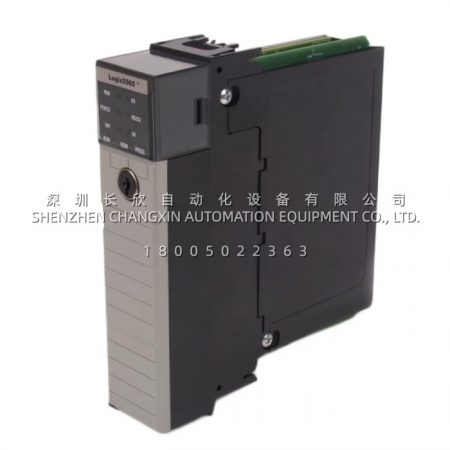
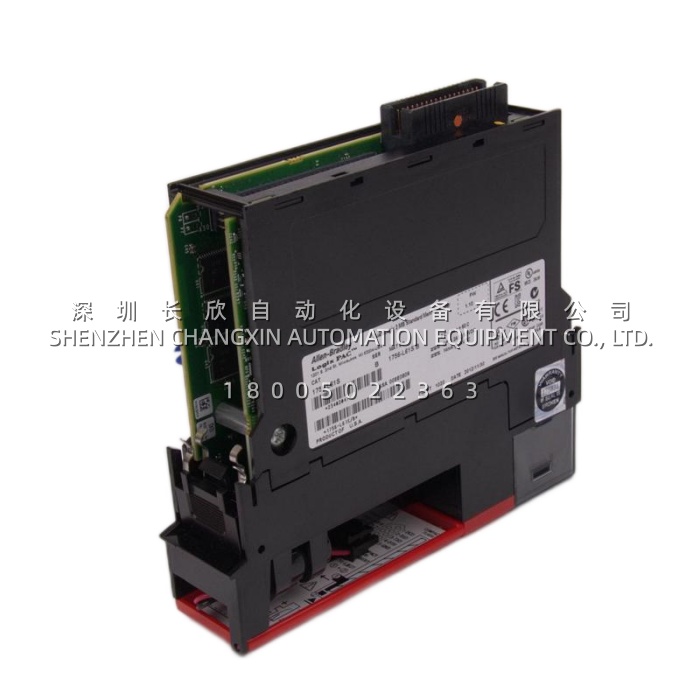
| Product Model | 1756-L63S |
| Manufacturer | Allen-Bradley / Rockwell Automation |
| Product Category | GuardLogix Safety Processor (Safety + Standard Controller) |
| User Memory | 8 MB (shared for standard and safety logic) |
| Safety Memory | 3.75 MB dedicated safety logic memory |
| Safety Architecture | 1oo2 (primary controller + 1756-LSP safety partner) |
| Safety Certification | SIL 3 (IEC 61508/62061), PL e, Cat. 4 (ISO 13849-1) |
| Maximum I/O | 128,000 total points |
| Communication | Via 1756 communication modules (EtherNet/IP, ControlNet, DeviceNet); built-in RS-232 serial port |
| Current Draw | 1,200 mA @ 5.1 VDC; 14 mA @ 24 VDC |
| Power Dissipation | 3.5 W (11.9 BTU/hr thermal) |
| Weight | Approx. 0.43 kg (0.94 lbs) |
| Status | Discontinued; critical spare for legacy GuardLogix installations |
Technical Principles and Innovative Values
- 1oo2 Safety Architecture in a Single Rack: The 1756-L63S achieves SIL 3 certification through a paired configuration: the primary controller (1756-L63S) executes both standard and safety logic, while a companion 1756-LSP safety partner provides an independent, isolated second channel for safety functions . This 1oo2 redundancy means a single fault in either channel cannot compromise the safety function—the partner channel retains the ability to bring the system to a safe state.
- Unified Programming Environment: Unlike architectures that require separate safety programming tools, the 1756-L63S is configured and programmed within RSLogix 5000 (later Studio 5000). Safety routines are clearly distinguished from standard logic, and the controller enforces strict separation between safety and non-safety tags. This reduces engineering overhead and eliminates the version-control headaches of maintaining two separate controller projects.
- Certified to the Highest Machinery Safety Standards: The 1756-L63S carries type approval against EN ISO 13849-1 (PL e, Category 4) and EN 62061 (SIL CL 3), making it suitable for the most demanding safety applications up to SIL 3 . This certification is not a self-declaration—it reflects independent assessment of the controller’s architecture, diagnostics, and failure modes.
- Legacy Value in a Discontinued Platform: The 1756-L63S is now discontinued, which makes it a strategic spare rather than a new-build choice . For facilities running GuardLogix systems in automotive, metallurgy, or plastics production, the 1756-L63S represents the difference between a quick controller swap and a full safety system migration. Its 8 MB user memory was substantial for its generation, supporting complex safety interlocks alongside standard process logic without immediate memory pressure.
Application Cases and Industry Value
A tire manufacturing plant in the Midwest operated a GuardLogix safety system controlling curing press interlocks and operator access doors across 12 production lines. When a primary 1756-L63S controller developed a persistent major fault that could not be cleared through firmware recovery, the plant faced a choice: attempt an emergency migration to a newer GuardLogix platform, or source a replacement 1756-L63S. The migration path would have required rewriting safety routines, re-validating the safety function, and recertifying the line—an estimated 6–8 week project with production losses exceeding $2 million. Sourcing a verified 1756-L63S spare allowed maintenance to perform a controller swap in under four hours, restore the safety program from a validated backup, and return the line to production the same shift. The plant subsequently mandated that every GuardLogix-controlled line maintain an on-site 1756-L63S spare, treating it as insurance against unplanned obsolescence.
Reviews
There are no reviews yet.