
Technical Specifications
| Parameter Name | Parameter Value |
|---|---|
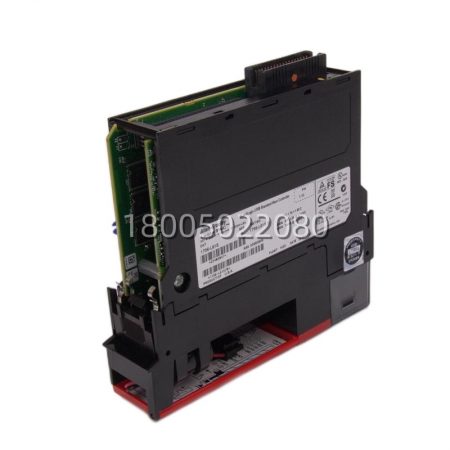
| Product Model | 1756-L63/B |
| Manufacturer | Rockwell Automation (Allen‑Bradley) |
| Product Type | ControlLogix Programmable Automation Controller (PAC) |
| Processor Core | PowerPC (800 MHz) |
| User Memory | 8 MB |
| I/O Memory | 478 KB |
| Maximum Discrete I/O Capacity | 128,000 points |
| Maximum Analog I/O Capacity | 4,000 points |
| Communication Protocols | EtherNet/IP, ControlNet, DeviceNet, DH+, Remote I/O, SynchLink |
| Serial Port | 1 × RS‑232 (DF1, DH‑485) |
| Backplane Current (5.1V DC) | 1200 mA |
| Operating Temperature | 0 °C to 60 °C (32 °F to 140 °F) |
| Relative Humidity | 5% to 95% (non‑condensing) |
Main Features and Advantages
High‑Performance Multitasking Engine: The 1756‑L63/B is built around a powerful 800 MHz PowerPC CPU capable of executing complex control algorithms with high determinism. It supports a sophisticated multitasking operating system that allows engineers to partition applications into up to 32 tasks (continuous and periodic), each containing multiple programs. This architecture enables the isolation of time‑critical processes (such as motion control or safety interlocks) from less critical background logic, ensuring reliable performance in high‑speed manufacturing and process control environments.Unified Control Platform: A key advantage of the 1756‑L63/B is its ability to unify discrete, process, drive, and motion control within a single controller. Through the integrated SERCOS interface or network‑based motion over EtherNet/IP, the controller can coordinate multi‑axis motion profiles without requiring a separate motion controller. This “one controller, multiple disciplines” approach simplifies system architecture, reduces hardware costs, and minimizes integration complexity.Robust Connectivity and Scalability: The controller serves as a communication hub for the ControlLogix system. It natively interfaces with a wide range of 1756‑series I/O modules and supports multiple industrial networks simultaneously via dedicated communication adapters (such as 1756‑ENBT, 1756‑CNB). Its support for the producer‑consumer model over EtherNet/IP allows for efficient peer‑to‑peer data exchange and integration with HMI, SCADA, and MES layers, making the 1756‑L63/B a cornerstone of modern Industrial IoT (IIoT) architectures.
Application Field
The 1756‑L63/B is engineered for large‑scale industrial applications that demand high reliability, extensive I/O handling, and complex control strategies. In the automotive manufacturing sector, it is commonly deployed in body‑in‑white assembly lines, paint shops, and powertrain assembly systems, where it manages thousands of I/O points and synchronizes robotic cells. For process industries such as oil & gas, chemical, and pharmaceuticals, the controller executes advanced regulatory control (PID), batch process management, and safety interlocks, often operating in harsh environments with wide temperature fluctuations.In material handling and logistics automation, the 1756‑L63/B controls high‑speed sortation systems, automated storage and retrieval systems (AS/RS), and conveyor networks, utilizing its high‑speed counter and motion coordination capabilities. Furthermore, its support for redundancy (when paired with a 1757‑SRM module) makes it a preferred choice for critical infrastructure applications in power generation (balance‑of‑plant control) and water/wastewater treatment facilities, where system uptime is paramount. The controller’s scalability also allows it to be used in everything from large, plant‑wide DCS‑like systems to high‑performance machine control applications.
Reviews
There are no reviews yet.