
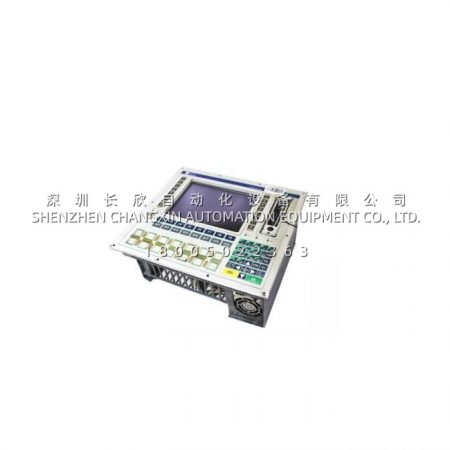
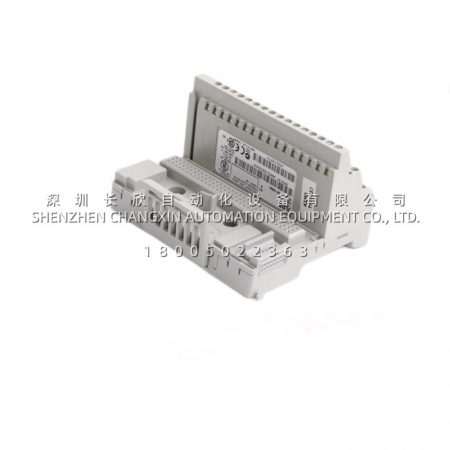
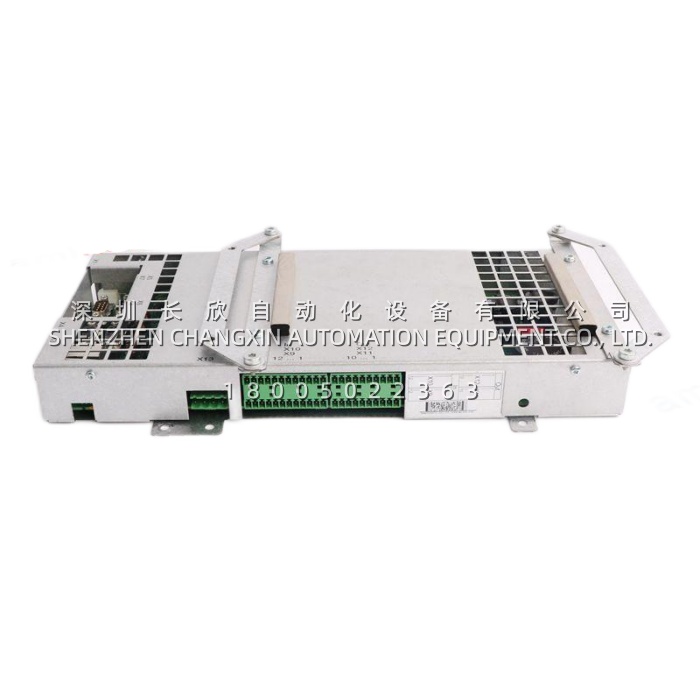
Application Scenarios:
A specialty chemicals plant has run its batch reactors on an ABB Series 200 controller for two decades, and the controller is not the problem — connectivity is. Two demands have converged on the same rack. On the process side, a new reaction skid has been installed roughly 150 metres from the control cabinet, and pulling every field cable home is both expensive and disruptive. The plant needs those remote I/O drops scanned on a predictable cycle, because a temperature-controlled exothermic reaction tolerates no jitter. On the information side, corporate has rolled out a plant-wide historian and wants one-second resolution from every reactor, but the rack has no native Ethernet path.Installing 200-CICN and 200-CIE side by side in the same rack solves both problems at once. 200-CICN becomes the I/O scanner for the remote drops: each drop is built on a 200-ACN adapter with its own local 24 V supply, connected back over coaxial ControlNet, with up to 31 such adapters on a single 200-CICN. Because ControlNet uses CTDMA rather than contention-based access, the scan time stays predictable no matter how much traffic is on the link. At the same time, 200-CIE carries the historian traffic, mapping internal process variables onto Modbus TCP tags that the historian polls over the corporate network — and because that load never touches the ControlNet segment, the information system can be as chatty as it likes without ever perturbing the deterministic I/O scan.This two-interface pattern is characteristic of ABB’s installed base, and it shows up wherever mature control hardware has to serve a modern data architecture: chemical and pharmaceutical batch plants, pulp and paper mills, cement works, and municipal water and wastewater networks.
Parameter:
| Main Parameters | Value / Description |
|---|---|
| Product Model | 200-CICN (ControlNet interface) / 200-CIE (Ethernet interface) |
| Manufacturer | ABB (SattControl / Advant OCS heritage, Sweden) |
| Product Category | Communication interface unit — central system network module |
| Host Platform | ABB Series 200: SattCon 200, SattLine, Advant Controller 250 / Advant OCS |
| Network Protocol | 200-CICN: ControlNet, single channel, CTDMA access; 200-CIE: IEEE 802.3 Ethernet, TCP/IP with Modbus TCP server, FTP and programming/online monitoring |
| Transmission Rate | 200-CICN: 5 Mbit/s fixed — deterministic by design; 200-CIE: 10 Mbit/s class (physical medium set by the external MAU/transceiver) |
| Remote I/O Capacity | 200-CICN acts as I/O scanner for up to 31 200-ACN remote adapters, each carrying up to eight I/O units — up to 248 I/O units on one segment |
| Network Reach | 500–1000 m per ControlNet segment depending on adapter count; repeaters extend to roughly 3000 m typical and 6000 m maximum |
| Physical Interface | 200-CICN: 1 × BNC 75 Ω front connector via tap and 1 m drop cable; 200-CIE: 15-pin D-type AUI port to an external Ethernet transceiver (MAU) |
| Electrical Isolation | Galvanic isolation through a signal transformer on the ControlNet transceiver — keeps trunk faults and ground-potential differences out of the backplane |
| Power Supply | Fed from the Series 200 central supply (200-PSMG master / 200-PSSG slave); 24 V DC system input (19.2–30 V, max 5% ripple); max 0.5 A internal consumption |
| Addressing & Diagnostics | 200-CICN: node address set by front-panel rotary switches — no laptop or software tool needed; 200-CIE: address by rotary switch or software. One green power LED plus three bicolour LEDs for unit OK and ControlNet channel A/B |
| Dimensions & Weight | H 163 × W 45 × D 91 mm (excluding connectors and snap locks); 0.25 kg net, 0.33 kg packaged |
| Environment & Mounting | +5 °C to +55 °C operating, −25 °C to +70 °C storage, max 90% RH non-condensing, IP20; DIN-rail on 200-BPN backplanes (two units per backplane, up to eight backplanes), mechanical key code 8 |
Lifecycle note: these units are legacy/phase-out hardware and are not RoHS 2 compliant, so they are intended for repair, reuse and life extension of existing installations rather than for brand-new builds.
Technical Principles and Innovative Values:
- Innovation Point 1 — CTDMA instead of contention. 200-CICN runs ControlNet with Concurrent Time Division Multiple Access. Every node gets a guaranteed, repeating time slot inside a Network Update Time, so data delivery is scheduled rather than fought over. Standard Ethernet uses CSMA/CD, where more traffic means more collisions and more jitter; 200-CICN behaves the same whether the segment is idle or busy. For a control loop, that difference is the whole point.
- Innovation Point 2 — Producer/consumer data model. ControlNet nodes publish a frame once and many subscribers consume it, instead of the scanner polling each device point-to-point. A single 200-CICN can therefore serve up to 31 200-ACN adapters — up to 248 I/O units — inside a predictable scan, which is why one module can replace what would otherwise be many serial home runs.
- Innovation Point 3 — Isolation as a system protection strategy. The ControlNet transceiver on 200-CICN is coupled through a signal transformer. In a plant where the remote I/O cabinet sits hundreds of metres away on a different earth reference, that barrier is what stops a trunk fault or a ground loop from propagating into the controller backplane and taking the CPU down with it.
- Innovation Point 4 — Commissioning designed for a shutdown window. Node addressing on 200-CICN is set with rotary switches and the module carries mechanical key coding, so a night-shift technician can swap a failed unit in minutes with no engineering station, no firmware handling and no risk of inserting it into the wrong slot. Module exchange on a powered rack is supported by the platform’s modular design, which is what turns a network-card failure from an outage into a short intervention.
- Innovation Point 5 — Traffic separation as an architecture. Running 200-CICN and 200-CIE in the same rack deliberately splits the two worlds: hard real-time I/O scanning on coax, open Ethernet data exchange on the AUI channel. Historian polling, OPC traffic and programming downloads stay off the deterministic segment entirely — you get modern data visibility with none of the timing risk of putting IT traffic on a control bus.
- Innovation Point 6 — Defined state on communication loss. The Series 200 platform drives I/O outputs into a defined safety state if remote I/O communication fails. 200-CICN therefore does not simply report a fault; the system fails predictably, which is exactly what process safety reviewers want to see on a remote I/O segment.

Reviews
There are no reviews yet.