
Application Scenarios
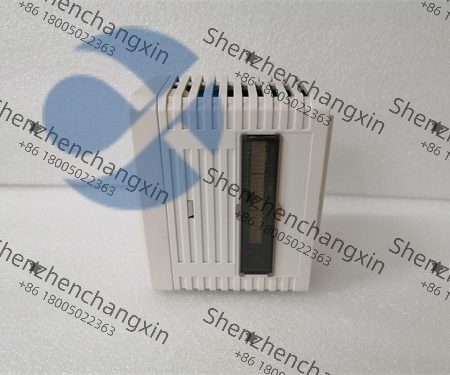
In a large chemical processing plant, monitoring the state of motor-operated valves (MOVs) and pump run status is essential for safe sequencing and interlocking. A single batch reactor might have dozens of such status points. The ABB 70EB02C-ES module is deployed in remote I/O cabinets near the process unit to gather this critical data. Each valve’s open/close limit switches and each pump’s running contact are wired to separate channels on the module. Its 24VDC wetting voltage reliably detects the state of these contacts, even in electrically noisy environments. The high density of 16 channels per module consolidates wiring, saving significant cabinet space and reducing terminal points compared to older, lower-density cards. This solves key pain points of signal reliability, cabinet density, and maintenance complexity for large-scale discrete monitoring in legacy DCS environments.
Parameter
Technical Principles and Innovative Values
The ABB 70EB02C-ES is engineered for robust signal acquisition and seamless integration within the Advant/MOD 300 architecture, focusing on reliability and serviceability.
Innovation Point 1: Universal Sink/Source Compatibility with Noise Immunity. Each input channel is designed with a robust circuit that can accept both sinking (current sinking to common) and sourcing (current sourcing from supply) field devices without requiring hardware jumpers or configuration. This universal design simplifies engineering, stocking, and maintenance. Furthermore, the input circuitry includes filtering and hysteresis to reject electrical noise commonly found in industrial settings, ensuring accurate and stable reading of field contact status and preventing false triggers.
Innovation Point 2: High-Density Design with Clear Diagnostics. Packing 16 optically or magnetically isolated input channels into a single module slot, the 70EB02C-ES maximizes I/O point density within the controller’s physical footprint. Each channel or a logical group of channels is typically equipped with a status LED, providing maintenance personnel with immediate, at-a-glance visual confirmation of the live input state. This granular diagnostics capability allows for rapid identification of field device failures (e.g., a stuck switch) versus a system fault, drastically reducing mean time to repair (MTTR).
Innovation Point 3: Seamless Integration with DCS Diagnostics. The module is fully integrated into the Advant/MOD 300 system’s comprehensive diagnostic framework. Beyond local LEDs, the module’s health and the status of each point are communicated to the station’s engineering and operator workplaces. This allows for advanced features like predictive maintenance alerts based on signal quality trends and centralized fault reporting, enabling proactive system management rather than reactive troubleshooting.
Application Cases and Industry Value
Case Study: Modernization of a Power Plant Burner Management System
A coal-fired power plant was upgrading the legacy relay-based Burner Management System (BMS) for one of its boiler units. The BMS requires monitoring hundreds of discrete points—flame scanner status, valve positions, purge damper limits—with extreme reliability. The plant chose to integrate this safety-critical function into its existing ABB MOD 300 DCS, using 70EB02C-ES modules for all digital status inputs.
Process & Improvement: Dozens of 70EB02C-ES modules were installed in redundant I/O units. All permissive and status contacts from the burner front were wired to these modules. The high channel count allowed the consolidation of a vast number of points. During commissioning, the per-channel status LEDs were invaluable for quickly verifying the entire wiring loop for each burner. During operation, the system provided unparalleled visibility: operators could see the real-time status of every interlock on their graphics. The integration allowed for advanced sequence logic and historical logging of trips, which was previously impossible. The plant reported a dramatic improvement in startup reliability and a significant reduction in nuisance trips due to the precise monitoring and diagnostics provided by the system built around the reliable 70EB02C-ES inputs.
Related Product Combination Solutions
The ABB 70EB02C-ES operates within the broader Advant Controller 410/MOD 300 ecosystem, interfacing with several key components.
ABB 70EB01C-ES: A likely companion 16-channel digital output module. It would accept commands from the controller (based on logic using inputs from the 70EB02C-ES) to actuate solenoid valves, motor starters, and alarms.
ABB 70EA01C-ES: A typical 8-channel analog input module. Works alongside the 70EB02C-ES, handling 4-20mA signals from transmitters (pressure, temperature) while the digital module monitors discrete states, providing a complete process view.
ABB Advant Controller 410 (e.g., AC410): The main process controller that executes the control logic, reading inputs from the 70EB02C-ES and writing outputs to other modules.
ABB OCS I/O Unit (e.g., EU91A): The physical I/O station chassis that houses the 70EB02C-ES and other I/O modules, providing power, communication, and termination.
ABB MOD 300 Operator Station: The human-machine interface (HMI) where operators visualize the status of all points connected to the 70EB02C-ES and interact with the process.
ABB S800 I/O (later generation): For system expansions or migrations, ABB’s S800 I/O series (e.g., DI810) represents the next-generation platform, offering similar functionality with newer technology, often interfacing with the same controllers via a communication interface.
Installation, Maintenance, and Full-Cycle Support
Installation of the ABB 70EB02C-ES is performed by trained personnel. The module is carefully inserted into its designated slot within an Advant OCS I/O unit until it locks into the backplane connector. Field wiring is terminated on the associated terminal unit or front connector, following the detailed wiring diagrams. The module requires no on-module configuration; its addressing and parameters are set in the DCS engineering software. Its industrial design ensures reliable operation in control room environments.
Maintenance is primarily proactive and diagnostic. The health of the module is continuously monitored by the DCS. The most common “maintenance” activity involves observing the status LEDs to verify field device operations. Should a module fail, the system’s design typically allows for hot swapping (following proper procedures) if supported by the specific I/O unit configuration. Replacement involves powering down the I/O unit (or leveraging redundancy), removing the old module, inserting a new one, and allowing the system to recognize it. The configuration is stored in the controller, not the module itself. We provide comprehensive lifecycle support for the 70EB02C-ES, from system documentation and spare parts supply to technical troubleshooting and migration consultancy for legacy MOD 300/Advant systems. Our expertise ensures continued support for your critical process automation investment.
Ensure the reliability of your legacy DCS digital monitoring. Contact us for genuine ABB 70EB02C-ES modules and expert technical support.


Reviews
There are no reviews yet.