
Technical Specifications
| Parameter Name | Parameter Value |
|---|---|
| Product Model | 1336-CT-SP1A |
| Manufacturer | Allen-Bradley (Rockwell Automation) |
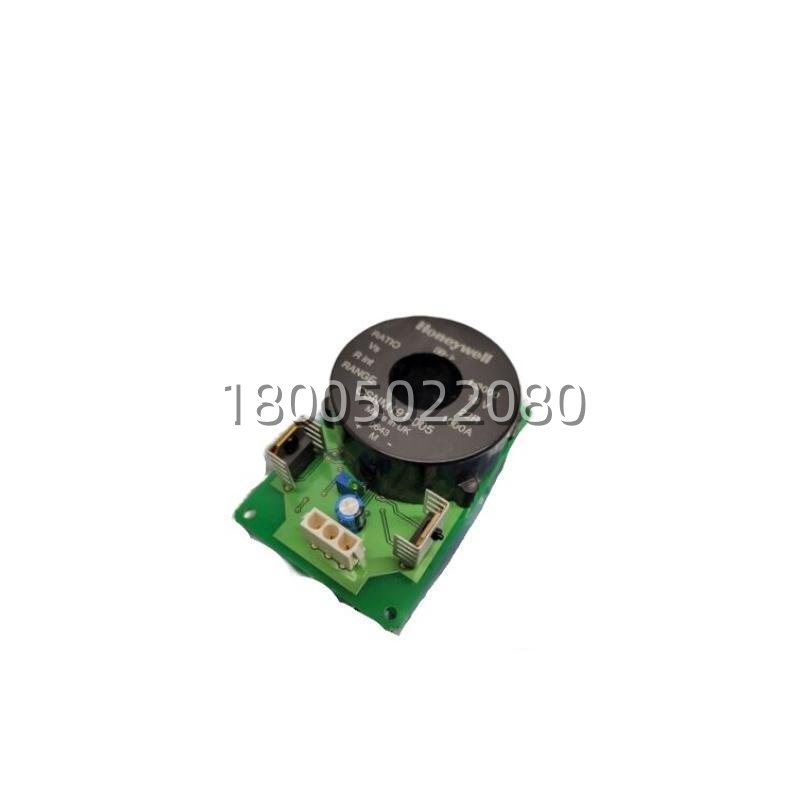
| Product Type | AC Current Transducer (Hall-Effect, Closed-Loop) |
| Compatible Series | 1336 FORCE Adjustable Frequency AC Drives |
| Primary Function | Phase Output Current Sensing for Motor Control and Protection |
| Measurement Principle | Closed-loop Hall-effect (compensated) |
| Rated Primary Current (IPN) | Specific to model (e.g., matched to a drive frame size; common values are 5A, 10A, etc.) |
| Measuring Range | Typically 0 to 2 x IPN |
| Output Signal | Isolated analog signal (e.g., 0-5V DC, 0-10V DC, or 4-20mA) proportional to primary current |
| Accuracy | Typically < ±1% of reading at 25°C |
| Response Time | Typically < 1 µs |
| Bandwidth | Typically DC to 100 kHz |
| Isolation | High-voltage isolation between primary circuit (drive output) and secondary (control electronics) |
| Supply Voltage | Typically requires ±12V to ±15V DC from the drive’s control board |
| Mounting | Typically board-mounted or chassis-mounted within the drive’s power section |
| Operating Temperature | 0°C to 70°C (32°F to 158°F) |
Main Features and Advantages
The Allen-Bradley 1336-CT-SP1A offers distinct advantages that are crucial for variable frequency drive applications. Its most significant feature is the closed-loop Hall-effect technology. This method uses a magnetic core to concentrate the field from the primary current, a Hall sensor to measure it, and a compensation winding driven by an amplifier to create a null-flux condition. This results in exceptional accuracy and linearity over a wide frequency and temperature range, with minimal phase shift—a critical requirement for the drive’s fast digital control loops. The technology also provides inherent galvanic isolation, safely separating the high-power motor circuits from the low-voltage control electronics within the drive, enhancing system safety and noise immunity.High dynamic performance is another key benefit. The 1336-CT-SP1A has an extremely fast response time, allowing it to faithfully track rapid current changes, such as those occurring during motor starting, load shocks, or during a fault condition like a short circuit. This speed enables the drive’s protection circuitry to react almost instantaneously, helping to prevent catastrophic failures. The transducer is also designed for low insertion loss, meaning it has a very low impedance and does not significantly affect the power circuit it is measuring. Its compact and robust design is engineered to withstand the challenging electrical environment inside a drive enclosure, characterized by high dV/dt switching noise from the IGBTs. The Allen-Bradley 1336-CT-SP1A is precisely calibrated and matched to the control electronics of the 1336 FORCE drive, ensuring plug-and-play compatibility and optimal system performance without the need for field adjustment or calibration. This integration guarantees that the drive’s performance specifications for torque control, current limit, and protection are reliably met.
Application Field
The application of the Allen-Bradley 1336-CT-SP1A is exclusively tied to the 1336 FORCE AC drive platform across the vast spectrum of industries that utilize this specific Rockwell Automation drive for motor control. In manufacturing, it is integral to the operation of 1336 drives controlling conveyor systems, pumps, fans, machine tool spindles, and mixers. The accurate current feedback from the 1336-CT-SP1A allows these drives to provide precise speed and torque regulation, essential for consistent product quality, synchronized motion, and energy savings. In material handling, such as on cranes, hoists, and escalators, the transducer enables the tight torque control needed for smooth starts and stops, as well as providing the critical data for overload protection to prevent mechanical damage.Within the HVAC sector, 1336 drives managing large fans, pumps, and compressors in commercial buildings rely on the Allen-Bradley 1336-CT-SP1A for efficient variable-speed operation and to protect these high-value assets from electrical faults. In water and wastewater treatment, drives controlling raw water intake pumps, aerator blowers, and chemical dosing pumps depend on the transducer’s feedback for process control and to prevent pump dead-head or motor burnout. Essentially, any application where a 1336 FORCE drive is deployed to control a three-phase AC induction motor for purposes of process optimization, energy conservation, or soft starting, the Allen-Bradley 1336-CT-SP1A is working continuously to measure motor current. Its data is the fundamental input for the drive’s current regulator loop, its torque-producing capability, and its first line of electrical defense. Its failure typically results in a drive fault, such as a “Feedback Loss” or “Overcurrent” error, halting the motor and the process it drives, underscoring its critical role in continuous operation.

Reviews
There are no reviews yet.