
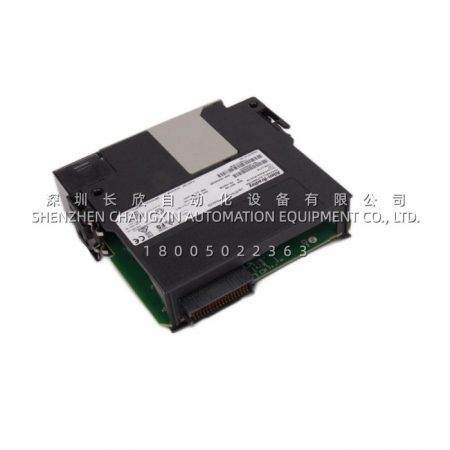
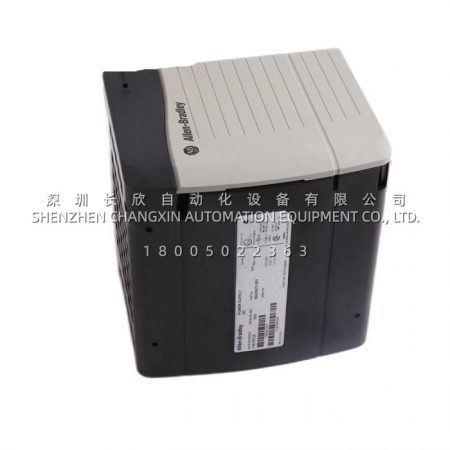
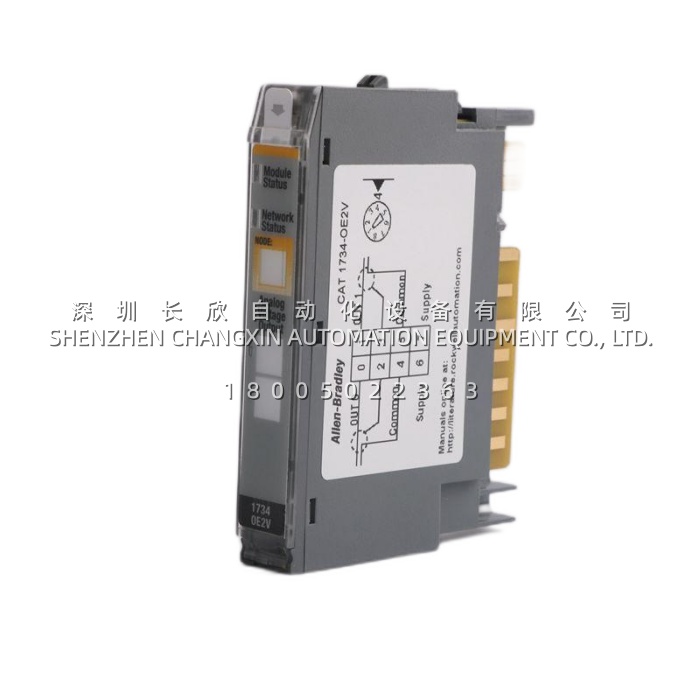
Technical Specifications
| Parameter Name | Parameter Value |
|---|---|
| Product Model | 1734-OE2V |
| Manufacturer | Allen-Bradley / Rockwell Automation |
| Product Type | Analog voltage output module |
| Product Family | POINT I/O (1734 series) |
| Number of Output Channels | 2 |
| Output Type | Voltage |
| Output Range | ±10 V |
| Resolution | 15-bit |
| Update Time | 5 ms |
| Open Circuit Detection | Yes |
| Output State on Module Fault | Held or programmed (user-selectable) |
| Bus Power Supply | 24 V DC |
| Current Consumption | 65 mA from bus + 55 mA from external source |
| Isolation | 75 V (continuous), basic internal |
| Operating Temperature | 0 … +55 °C |
| Storage Temperature | −40 … +85 °C |
| Relative Humidity | 5 … 95 % RH, non-condensing |
| Vibration | 5 g @ 10 … 500 Hz |
| Shock | 30 g operating |
| Mounting Method | POINT I/O backplane slot, DIN rail |
| Configuration | Via controller software; default config supplied |
| Certifications | CE, UL, CSA, cULus, FM, ATEX, IECEx, EtherNet/IP conformance |
| Lifecycle Status | Current / mature product, available as new or surplus spare |
Main Features and Advantages
Fifteen-bit resolution at ±10 V is the usable precision: The 1734-OE2V delivers 15-bit resolution over a ±10 V span, which gives the controller fine control over the commanded value without needing scaling tricks in the program. For a proportional valve, a variable-frequency drive, or a positioning stage, that granularity is what turns a “roughly right” command into a stable setpoint, and it does so in a module that occupies a single POINT I/O slot.Open-circuit detection catches the wiring fault: The module detects an open circuit on the output and makes that condition visible to the controller. In a voltage-output application this is unusually valuable, because a broken wire on a voltage loop produces a plausible-looking zero or an undefined value rather than an obvious alarm — the kind of fault that gets blamed on the actuator. With the 1734-OE2V, the controller can flag the broken connection immediately and the maintenance record shows where to look.Fault behavior is a choice, not a default: The output state on a module fault is programmable: the outputs can hold their last value or go to a user-defined state. In a continuous process, holding the last value prevents a transient module fault from becoming a process upset. In a safety- or quality-critical step, driving to a defined state is the correct response because it refuses to let a fault masquerade as a valid command. That decision belongs to the application, and the 1734-OE2V gives the application the choice.Default configuration means a faster swap: The module ships with a default configuration and can be reconfigured through the controller software. In practice this means a replacement 1734-OE2V can be dropped into the rack and will function correctly even before the project is downloaded, provided the application uses the standard settings. For a plant whose documentation has drifted away from the installed system, that is a genuine advantage over a module that is useless until programmed.POINT I/O integration is the real economy: Because the 1734-OE2V communicates through the 1734 backplane, it shares the rack’s network connection, power, and controller mapping with the rest of the I/O. A small local rack can therefore carry mixed digital, analogue, and specialty I/O without a separate network drop for each type, and the same engineering tools that program the controller configure the module. That consistency is what keeps the installed base maintainable years after commissioning.
Reviews
There are no reviews yet.