
Technical Specifications
| Parameter | Value |
|---|---|
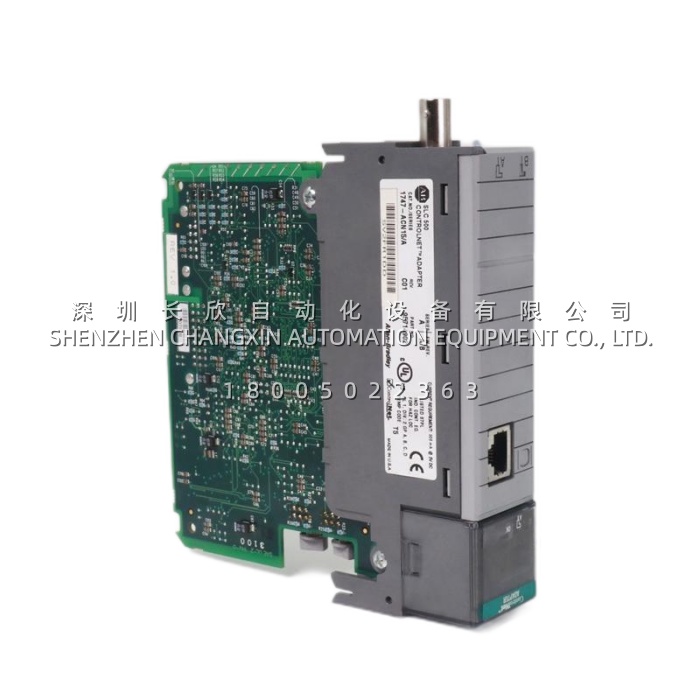
| Product Model | 1747-ACN15_A |
| Manufacturer | Allen-Bradley / Rockwell Automation |
| Product Type | ControlNet Adapter Module (SLC 500 chassis-based) |
| Series / Platform | SLC 500, 1747 family |
| Hardware Revision | Rev A |
| Network Protocol | ControlNet (CIP over ControlNet), scheduled I/O |
| Data Rate | 5 Mbps, Manchester encoded, coaxial or fibre via tap |
| Backplane Interface | SLC 500 chassis / processor backplane (module slot) |
| Addressing | Node address set by rotary switch or software, 1–99 |
| I/O Capacity | Produced and consumed data-table mapping; typical 32–128 words depending on configuration |
| Supported Processors | SLC 5/03, 5/04, 5/05 (firmware permitting); fixed and modular chassis |
| Configuration Tool | RSLogix 500 with RSNetWorx for ControlNet (network scheduling) |
| Connector | BNC coaxial tap connector (RG-6 / RG-11) |
| Isolation | Network-to-backplane galvanic isolation, transformer coupled |
| Supply Voltage | Drawn from SLC chassis backplane (5 VDC logic) |
| Current Draw | ~300 mA from backplane (typical) |
| Operating Temperature | 0 … 60 °C (32 … 140 °F) |
| Storage Temperature | -40 … 85 °C |
| Humidity | 5 … 95% non-condensing |
| Certifications | cULus, CE, KC, EAC, RCM |
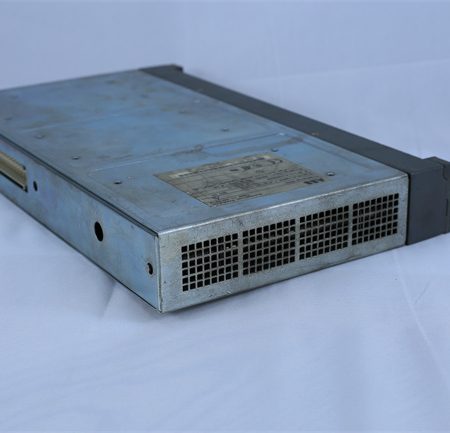
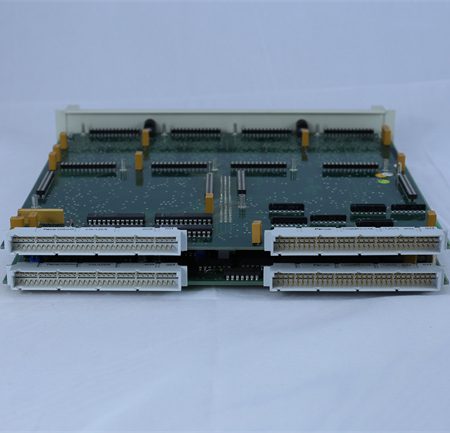
| Dimensions (approx.) | Single-slot SLC module, 140 mm H × 30 mm W × 115 mm D |
Main Features and Advantages
Deterministic bridging, not just messagingThe 1747-ACN15_A moves data on ControlNet’s scheduled time slice, which is why it is trusted for connections that cannot tolerate Ethernet’s variable latency. A drive command, a safety-status word or a fast counter value gets a reserved slot in the network scan, so update time stays bounded regardless of how many nodes are chatting. For the SLC programmer this determinism is invisible — the data appears in the file you mapped — but on the plant floor it is the reason a synchronised line stays synchronised.Native SLC feel, modern network reachWhat sets the 1747-ACN15_A apart from a generic gateway is that it lives in the SLC rack as a native module. You do not write a serial protocol handler or burn a message instruction on every scan; you move values into and out of the data table and let the module do the heavy lifting. The result is a machine that keeps its original ladder, its original HMI tags and its original validation paperwork, while suddenly becoming visible to a ControlLogix upstream. That is a very cheap modernisation compared to rewriting the cell.Drop-in recovery with no network surgeryBecause node identity and the connection schedule live in RSNetWorx rather than on the silicon of a single 1747-ACN15_A, a replacement module picks up its role the moment it is seated and the node switch matches. There is no MAC-ID binding, no licence transfer and no re-cable. We treat the rev letter as part of the compatibility check — a 1747-ACN15_A going into a system that was commissioned on a later revision may be fine, but the reverse direction is where surprises live, so we verify before we ship.
Application Field
The 1747-ACN15_A is the standard answer wherever an installed SLC 500 cell needs to join a ControlNet segment without being retired. In water and wastewater, that means a remote pump station’s SLC 5/04 reporting levels, amps and alarm words back to a ControlLogix master over a coax trunk that also carries the drive nodes. In food and beverage, it is the adapter that lets a filler or capper — still running the SLC program that was proven during the last audit — publish its cycle count and reject count to the line supervisor and historian. In metals, paper and converting, the module carries torque and speed references between SLC-controlled auxiliaries and PowerFlex drives on the same ControlNet schedule.The module also earns its keep during migrations that are staged rather than big-bang. A plant replacing controllers one cell at a time can keep the old SLCs on ControlNet through a 1747-ACN15_A while the new Logix cells come online, running both generations on one schedule until the cutover is complete. And in the spare-parts world it is the classic “one bad tap, one dead node” fix: when the HMI shows a red X on the SLC but the machine is still running locally, the 1747-ACN15_A is the first part you pull from the cabinet and the first you reach for in stores. Keeping a rev-matched spare turns a network-isolation incident into a five-minute rack swap.

Reviews
There are no reviews yet.