
Application Scenarios
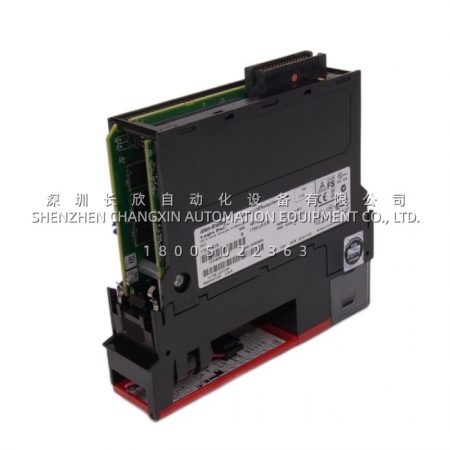
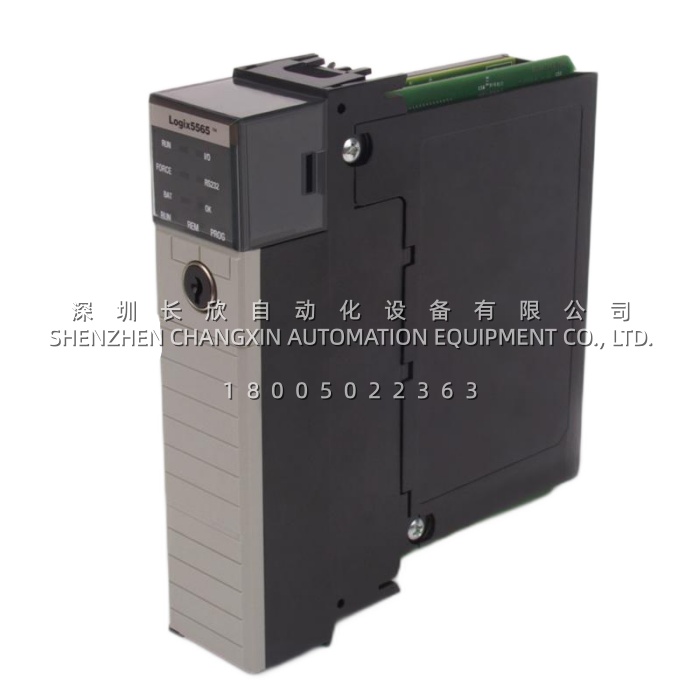
Consider a midstream natural-gas liquids pump station feeding a 400 km pipeline: two pump trains, a slug catcher, a metering skid, and an emergency-shutdown layer must all be supervised continuously, and any single-processor failure would take the station off-line and trigger a downstream delivery penalty. The classic answer on the Rockwell platform is a 1756-L65 redundancy pair — a primary and secondary Logix5565 controller in matching 1756 chassis, synchronised through a 1756-RM Redundancy Module over ControlNet, so that on primary failure the secondary assumes control bumplessly without a scan-time hiccup. This is the deployment pattern the 1756-L65 was positioned for: large enough in memory to carry a full station program with hundreds of PID loops and thousands of interlocks, yet efficient enough in chassis footprint (one slot in a 1756-A17) to leave room for the ENBT/CNBR/DNB communication mix that ties the station to the pipeline SCADA, the field DeviceNet instruments, and the local PanelView Plus HMI simultaneouslyindustrialmonitordirect.com+1.
Parameter
| Main Parameters | Value / Description |
|---|---|
| Product Model | 1756-L65 (Logix5565 Processor) |
| Manufacturer | Rockwell Automation / Allen-Bradley |
| Product Category | ControlLogix 5560 Standard Controller (CPU) |
| User Memory | 32 MB (data and logic) |
| I/O Memory | 478 KB |
| Maximum Total I/O | 128,000 points |
| Maximum Digital I/O | 128,000 points |
| Maximum Analog I/O | 4,000 points |
| Controller Tasks / Programs | 32 tasks, 100 programs per task, event tasks supported |
| Controller Connections | Up to 250 |
| Built-In Ports | RS-232 serial (DF1, ASCII, Modbus via logic, DH-485) |
| Network Support | EtherNet/IP, ControlNet, DeviceNet, Remote I/O, DH+, SynchLink |
| Compatible Memory Card | 1756-CF128 (128 MB CompactFlash) |
| Battery | 1756-BA2 lithium, field-replaceable |
| Compatible Chassis | 1756-A4, A7, A10, A13, A17 |
| Current Draw | 1200 mA @ 5.1 V DC, 14 mA @ 24 V DC |
| Power Dissipation / Heat | 3.5 W / 11.9 BTU per hour |
| Operating / Storage Temperature | 0 to 60 °C / −40 to +85 °C |
| Vibration / Shock | 2 g @ 10–500 Hz / 30 g operating, 50 g non-operating |
| Weight | ≈ 0.32 kg (Series A) / 0.35 kg (Series B) |
Technical Principles and Innovative Values
- Innovation Point 1 — Memory scaling on a common architecture. Within the 5560 family (1756-L61 through 1756-L65), the chassis, backplane, communication modules, and programming software are identical; only user memory and I/O capacity scale. Upgrading from a 1756-L61 (2 MB) to the 1756-L65 (32 MB) is a drop-in CPU swap with no change to chassis, I/O, or communication design — a deliberate Rockwell strategy that lets integrators right-size the controller to the program rather than re-architect the panel.
- Innovation Point 2 — Multi-tasking with 32 prioritised tasks. The 1756-L65 executes up to 32 tasks and 100 programs per task, so continuous, periodic, and event-driven logic run as isolated scheduling domains. Critical safety-adjacent logic can run as a 10 ms periodic task while background housekeeping runs as a lower-priority continuous task — a design that isolates worst-case scan jitter without the programming gymnastics a single-task PLC requiresplchardware.com.
- Innovation Point 3 — Bridge-module networking without CPU overload. Rather than embedding a fixed Ethernet port (as later 5580 controllers do), the 1756-L65 lets the engineer choose the communication mix — 1756-ENBT for EtherNet/IP, 1756-CNBR for redundant ControlNet, 1756-DNB for DeviceNet — and install them in the local chassis. The Logix backplane handles the bridge traffic, so the Logix5565 processor is free to scan logic while communication modules handle network protocol processing in parallelrockwellautomation.com+1.
- Innovation Point 4 — Native bumpless redundancy. Paired with a 1756-RM Redundancy Module, the 1756-L65 delivers true synchronous redundancy: either controller can act as primary, switchover is bumpless in both directions, and the configuration is a checkbox in RSLogix 5000 rather than custom logic. Compared to legacy SLC 500 redundancy via the 1747-BSN, the ControlLogix approach removes the programming burden entirely and supports EtherNet/IP and ControlNet on the redundant backboneindustrialmonitordirect.com.
- Innovation Point 5 — Battery-backed and CompactFlash non-volatile storage. A 1756-BA2 lithium battery preserves RAM contents through control-power loss, while the 1756-CF128 CompactFlash card provides non-volatile project and firmware storage for fast recovery — a two-layer persistence scheme that keeps the 1756-L65 productive in plants where an unplanned power dip cannot be allowed to wipe the running project

Reviews
There are no reviews yet.