
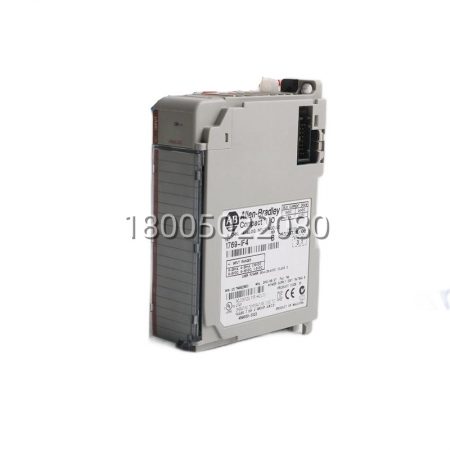
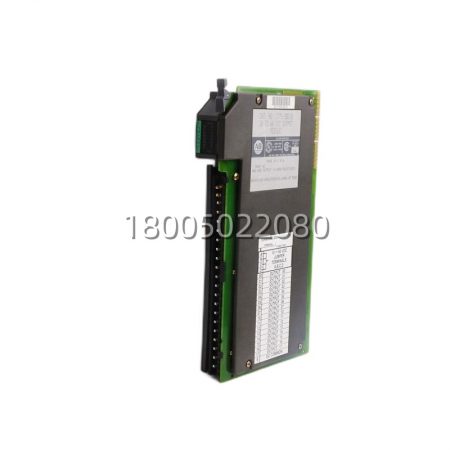
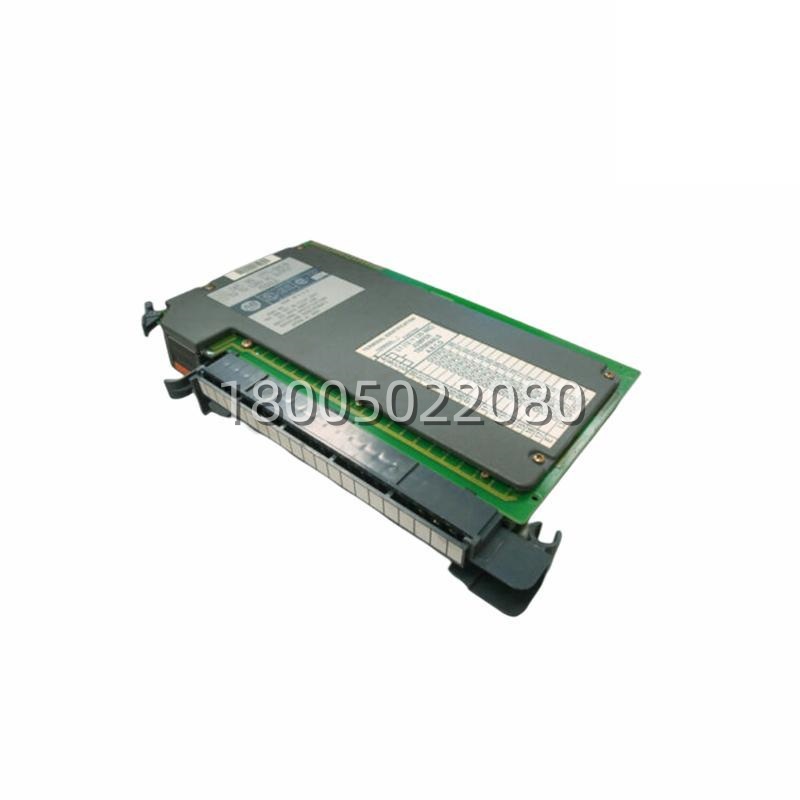
Application Scenarios:In a legacy automotive assembly line, controlling dozens of pneumatic clamps and conveyor motors traditionally required multiple relay panels with complex wiring. The 1771-OAD module solves this by integrating 16 high-power AC outputs directly into the PLC-5 rack. Each output can switch up to 2A at 120V AC, allowing it to directly drive contactor coils without intermediate relays. The zero-crossing switching minimizes electrical noise and inrush current, extending the life of the solenoids. In a typical station, the PLC-5 processor sends commands via the backplane, and the 1771-OAD executes the switching, with status LEDs providing immediate visual feedback for troubleshooting. This consolidation reduces panel space and wiring complexity for the machine builder.
Parameter:
| Parameter | Specification |
|---|---|
| Product Model | 1771-OAD (Series B) |
| Manufacturer | Allen-Bradley (Rockwell Automation) |
| Product Category | Discrete AC Output Module |
| Compatible Systems | PLC-5, 1771 I/O Chassis |
| Number of Outputs | 16 points (non-isolated groups) |
| Output Type | Triac (Solid-State Relay) |
| Voltage Range | 10 – 138V AC (Recommended 12-120V AC) |
| Frequency | 47 – 63 Hz |
| Current per Point | 2A Continuous (Max) |
| Current per Module | 8A Total (Max) |
| Leakage Current | < 3 mA (Off State) |
| Backplane Current | 295 mA @ 5V DC (from chassis) |
| Status Indicators | Per-point Green LED, Fuse Blown Red LED |
| Keying | Bands between 10-12, 20-22 |
| Wiring Arm | 1771-WH (Standard) or 1771-WHF (Fused) |
Technical Principles and Innovative Values:
- Innovation Point 1: Zero-Crossing Switching: Unlike mechanical relays, the 1771-OAD uses triac outputs that turn on when the AC voltage waveform crosses zero. This drastically reduces the initial current surge (inrush) when connecting inductive loads like motor coils. This “soft start” at the molecular level minimizes electrical noise (EMI) and prevents contact welding, significantly increasing the lifespan of both the module and the connected loads.
- Innovation Point 2: Integrated Surge Protection: Each output channel is equipped with a Metal Oxide Varistor (MOV) and an RC snubber network. When an inductive load (like a solenoid) is turned off, it generates a high-voltage reverse spike. The MOV clamps this spike, protecting the delicate triac from overvoltage damage. This built-in protection eliminates the need for external suppression modules across every load, simplifying cabinet design.
- Innovation Point 3: Fuse Blown Diagnostics: The module features a unique “Customer Side Indication (CSI)” jumper setting. When enabled, a blown fuse on the module will not only light a red LED on the card but also set all 16 corresponding bits in the PLC’s input image table. This allows the PLC program to automatically detect a hardware fault and alert operators via the HMI, enabling predictive maintenance instead of reactive troubleshooting.

Reviews
There are no reviews yet.