
Application Scenarios:
Picture a twenty-year-old reversing cold mill. The main stand is driven by a 4-quadrant SPDM converter rated above 1 MW, the line is running a tight production schedule, and suddenly the armature current starts to oscillate during acceleration. The operator sees a current-limit alarm, the strip tension fluctuates, and within minutes the line is stopped to avoid a strip break that would cost hours of re-threading. In the majority of these events the mechanical side is fine; the fault traces back to degraded auxiliary rails or unstable gate firing — precisely the functional domain of the 211QS50003B.The same pattern appears in a paper machine dryer section. A dozen DC sections must hold a fixed speed ratio, and the drive that has silently regulated its section for years starts tripping on an internal supply fault at every load change. Because the 211QS50003B both feeds the control electronics and times the firing pulses, a marginal board here does not simply stop one motor — it breaks the speed cascade of the whole machine and turns good paper into broke.These scenarios explain why the 211QS50003B matters far more than its size suggests. For plants in steel, paper, cement, mining, marine propulsion and material handling, keeping one verified 211QS50003B on the shelf converts an unplanned multi-day outage into a planned board swap measured in hours. The pain point it addresses is obsolescence risk: the converter, motor, busbar and cabinet may all have decades of life left, but without the 211QS50003B the entire asset is one failed capacitor away from a forced retrofit.
Parameter:
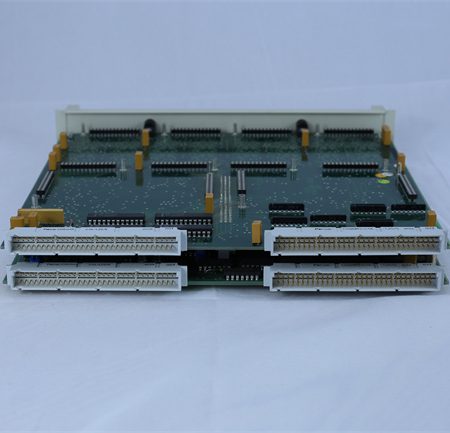
| Main Parameters | Value / Description |
|---|---|
| Product Model | 211QS50003B |
| Manufacturer | Ansaldo (Ansaldo Sistemi Industriali S.p.A., Italy; drives business now Nidec ASI / Nidec Conversion) |
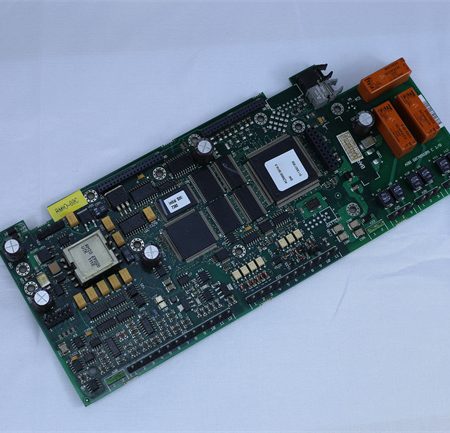
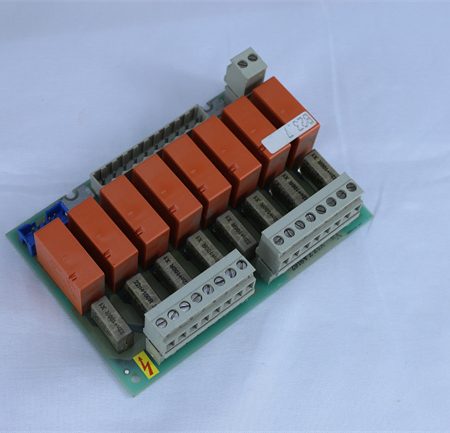
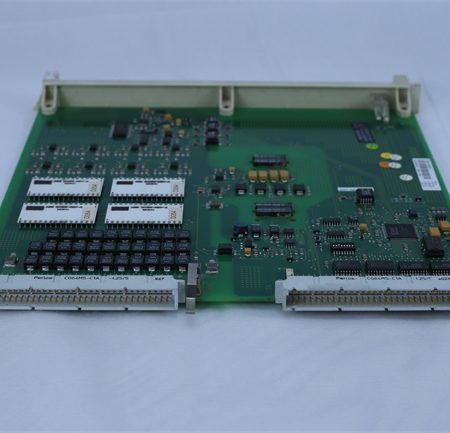
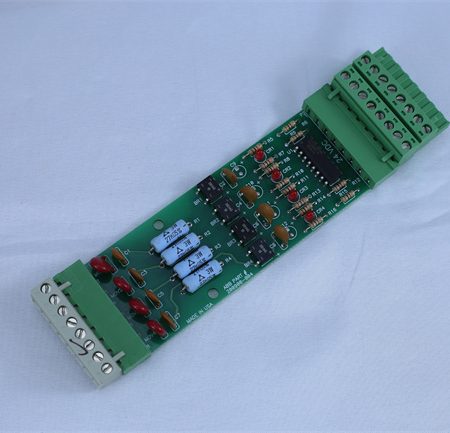
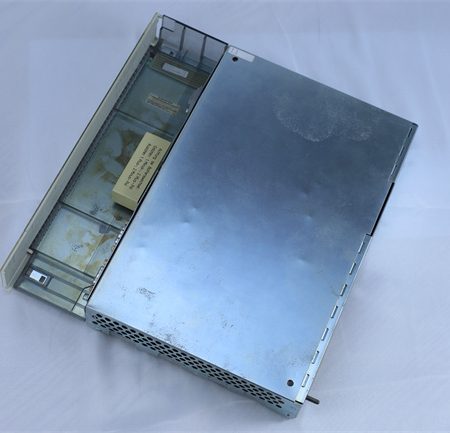
| Product Category | PLC control board / power trigger & supply board (“P board”) for DC drive control racks |
| Host Platform | Ansaldo SPDM fully digital DC converter, SILCOPAC D family — 30 A to 4000 A DC, 2- or 4-quadrant, 380–860 V DC output range |
| Control-Side Supply | DC 24 V (rack / backplane derived) — the rail that keeps logic alive; also documented as +5 V and ±15 V distributed from the board |
| Trigger-Stage Supply | ±15 V DC — bipolar rails required by the firing amplifiers and analogue sensing circuits |
| Pulse Output | 6 independent channels, 5–10 kHz, 8–15 V DC amplitude, 120°–180° width per cycle — one channel per thyristor in a 6-pulse Graetz bridge |
| I/O Capacity | 16 inputs / 16 outputs (control-board configuration) — enough local interlock points to run permissives without extra modules |
| Memory | 512 KB RAM + 1 MB Flash ROM — holds the application logic, parameter set and fault log across power cycles |
| Communication | Modbus RTU, CANopen, RS-485; Profibus-DP available through the optional SPPB2 communication kit |
| Operating / Storage Temperature | 0 °C to +70 °C operating (−10 °C to +55 °C in some control-board listings); −20 °C to +85 °C storage — industrial wide-temperature grade, no fan needed on the board itself |
| Dimensions / Weight | Approx. 100 × 84 × 45 mm, approx. 0.2 kg bare board (approx. 2.0 kg as packed for shipment) |
| Mounting | Plug-in Eurocard / proprietary rack backplane; DIN rail or screw fixing where the cabinet uses a board carrier |
| Protection & Build | Phase-loss, overcurrent and overvoltage monitoring; opto-isolation between power and control sections; conformal-coated, flame-retardant industrial PCB with thick copper; on-board LED fault indication |
Technical Principles and Innovative Values:
- Innovation Point 1 — Digital phase-locked firing instead of analogue ramp-and-pedestal: The 211QS50003B works with the SPDM’s 16-bit microcontroller control architecture, deriving its firing reference from an on-board mains synchronisation circuit rather than a fixed analogue ramp. Because the reference is re-synchronised every cycle, the firing angle does not drift when line frequency moves between 45 and 65 Hz or when the phase sequence is reversed — a real advantage on ships, on weak mine grids and on plants fed through long transformers.
- Innovation Point 2 — Six galvanically isolated gate channels: Each of the six output channels of the 211QS50003B is isolated from the logic side, so a thyristor gate short or a noisy gate lead cannot feed back into the processor. This is why the board survives in EMI-dense enclosures where contactors, welding sets and other converters share the same cabinet. Isolation is also what makes the board safe to service: the isolation barrier is a designed, tested distance, not an accident of layout.
- Innovation Point 3 — Self-generated, brown-out-proof internal rails: The 211QS50003B does not simply pass through incoming power. It regulates multiple low-voltage DC rails, monitors them, and locks out firing when a rail is outside tolerance. That supervision is the difference between a drive that shuts down cleanly and a drive that half-fires a bridge — the latter is what blows fuses and destroys thyristors.
- Innovation Point 4 — Timing precision that shows up as product quality: With a stable synchronous reference and regulated gate amplitude, the converter holds steady-state speed accuracy to roughly 0.01 % when encoder feedback is used. On a rolling mill that is gauge consistency; on a winder it is constant tension; on a printing press it is register. The 211QS50003B is upstream of all of it.
- Innovation Point 5 — Diagnostics designed for a technician with a torch, not a laptop: The 211QS50003B carries power, run and fault LED indication plus hardware watchdog supervision, and its status is reported through the drive’s diagnostic word. A fault can be localised to a board in minutes without a service tool, which is the difference between a two-hour stop and a two-shift stop.
- Innovation Point 6 — Built for a 30-year service life in a hostile cabinet: Thick-copper PCB layout, conformal coating against dust and humidity, industrial-grade temperature-rated components, and reinforced mechanical design against vibration. This is a board engineered for a hot, dirty, vibrating converter cubicle — not a commercial-grade card that happens to be mounted near one.

Reviews
There are no reviews yet.