
Technical Specifications
| Parameter Name | Parameter Value |
|---|---|
| Product Model | 990-04-XX-01-CN |
| Manufacturer | Bently Nevada (a Baker Hughes business), made in U.S.A. |
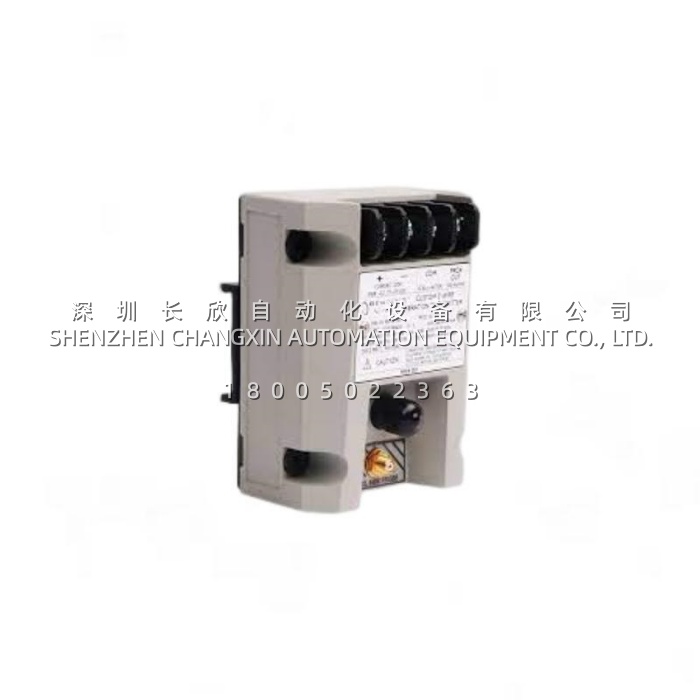
| Product Type | 2-wire, loop-powered vibration transmitter |
| Full-Scale Range | 0 to 4 mils pp (0 to 100 µm pp) shaft relative vibration |
| System Length Option | XX = 50 (5.0 m / 16.4 ft) or 70 (7.0 m / 23.0 ft), probe plus extension cable |
| Mounting Option | 01 = 35 mm DIN rail clips |
| Agency Approval Option | CN = country-specific approvals for the China market |
| Input | One non-contacting 3300 NSv proximity probe with matching extension cable |
| Output Signal | 4 to 20 mA DC proportional to peak-to-peak vibration |
| Supply Voltage | +12 to +35 Vdc at the transmitter terminal |
| Loop Accuracy | Within ±1.5 % of full-scale range (excluding probe scale factor variation) |
| Maximum Loop Resistance | 1,000 Ω including cable at 35 Vdc |
| Frequency Response | 5 Hz to 6,000 Hz, +0 / −3 dB |
| Buffered Output | PROX OUT and COM terminals plus coaxial BNC, 7.87 mV/µm (200 mV/mil) nominal |
| Fault Behaviour | Not OK / signal defeat drives output below 3.6 mA; power-up inhibit holds output below 3.6 mA for 2 to 3 s |
| Probe Installation Gap | 0.5 to 1.75 mm (20 to 55 mils) to target surface |
| Operating Temperature | −35 °C to +85 °C (−31 °F to +185 °F), storage −52 °C to +100 °C |
| Humidity | Up to 100 % condensing, non-submerged; fully potted construction |
| Dimensions / Weight | Approximately 100 × 74 × 53 mm; approximately 0.43 kg (0.9 lb) |
Main Features and Advantages
Integrated Proximitor electronics: The 990-04-XX-01-CN contains the oscillator and demodulator that would otherwise occupy a separate Proximitor box, which removes a device, a mounting plate, a power feed and three sets of terminations from the bill of materials. For an OEM building a compressor skid or a packaged pump set, this is the difference between adding a vibration point and re-designing the junction box.Not OK / signal defeat that prevents false trips: A failed probe or a loose connector is the classic source of a spurious high vibration alarm. When the 990-04-XX-01-CN detects a Not OK condition, it drives the loop current below 3.6 mA within roughly 100 µs. A control system written to treat under-range current as “instrument fault” rather than “low vibration” will therefore annunciate a bad transmitter instead of tripping the machine. A power-up inhibit circuit holds the output below 3.6 mA for two to three seconds after energising, which stops inrush-related spikes from reaching the alarm comparator during a plant restart.Diagnostics without breaking the loop: The 990-04-XX-01-CN provides a non-isolated buffered dynamic signal on PROX OUT / COM terminals and on a coaxial BNC connector, at a nominal 200 mV/mil. A portable vibration analyser or oscilloscope connected there shows the raw waveform and the gap voltage, so a technician can confirm whether high reading comes from real shaft motion or from an electrical problem. Because the buffered output is not isolated from the loop, grounded AC-powered test instruments must not be connected directly; use an isolating adapter to avoid loop interference.Calibration and environmental robustness: Zero and span are non-interacting external adjustments, and a test input pin allows the 4 to 20 mA loop to be verified with a signal generator without moving the probe. The potted housing tolerates 100 % condensing humidity, which matters on water injection pumps, cooling tower fans and outdoor compressor enclosures where a vented instrument would fail within a season.
Application Field
OEM packaged rotating equipment: The 990-04-XX-01-CN is designed for machine builders who must hand over a running unit with a vibration signal already wired to the control panel. Centrifugal air compressors, small process pumps, electric motors and induced-draft or cooling fans are the target machines, and the 0 to 4 mils pp range suits equipment where acceptable vibration is a few tens of micrometres and the alarm level sits well below the full scale.Tight mechanical envelopes: The 3300 NSv probe is a narrow side-view design that fits where a standard 8 mm probe cannot, including small shaft diameters and bearing housings with minimal clearance. Because the 990-04-XX-01-CN is factory calibrated for that probe’s electrical characteristics, it should not be paired with a standard 3300 XL 8 mm probe; doing so changes the scale factor and invalidates the measurement. This is the single most common ordering mistake with the 990 series.Hazardous and wet locations in the China market: The CN approval option exists for installations that must satisfy Chinese regulatory requirements, and these transmitters are frequently specified on petrochemical, gas processing and offshore skids built for domestic service. The potted housing and the wide −35 °C to +85 °C operating range cover unheated field junction boxes and tropical humidity alike.Overall trending rather than full diagnostics: Plants buy the 990-04-XX-01-CN to trend overall vibration and to trigger alarms and trips, not to diagnose a fault. The manufacturer’s own literature is explicit on this point: a transmitter cannot provide phase, orbits or the dynamic data captured at the moment of an alarm. Where a critical turbine or a large compressor needs root cause analysis, the 4 to 20 mA channel is normally backed by periodic portable surveys or a rack monitor on the most important machines.

Reviews
There are no reviews yet.