
Application Scenarios
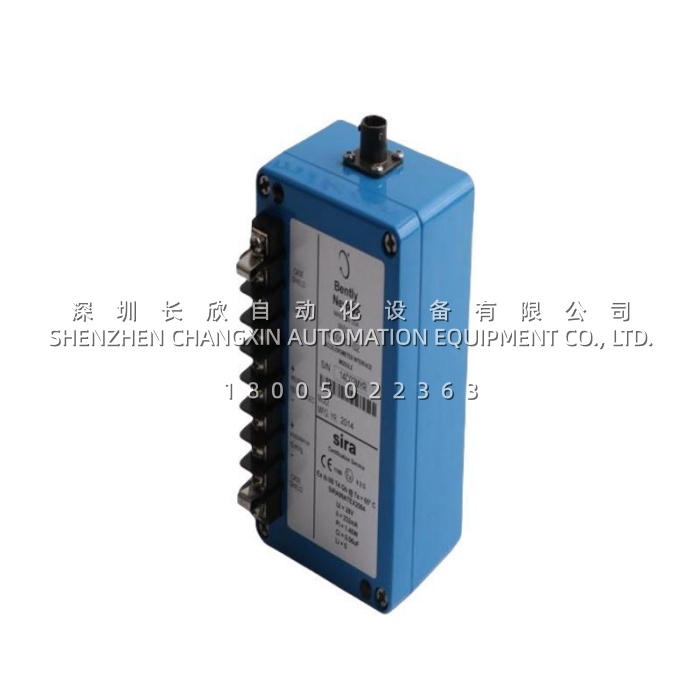
A centrifugal air compressor package leaves the OEM skid with a control panel that has one spare analogue input and no room for a monitoring rack. The machine needs shaft vibration protection, but the probe has to sit in a bearing housing where clearance is measured in millimetres, and the panel builder is under pressure to keep wiring simple.The answer in that cabinet is the 990-16-XX-01-CN. A narrow side view 3300 NSv probe fits where a standard probe will not, the transmitter holds the Proximitor electronics inside its own housing so no separate driver box is needed, and a single two-core cable carries both power and signal back to the panel. When the probe cable is later damaged during a bearing inspection, the NOT OK circuit inside the 990-16-XX-01-CN drives the output below 3.6 mA within 100 microseconds, so the control system sees a declared fault instead of a falsely healthy zero reading. That one behaviour is the difference between a planned stop and a destroyed rotor.
Parameter
| Main Parameters | Value/Description |
|---|---|
| Product Model | 990-16-XX-01-CN (document reference 106M1675-01) |
| Manufacturer | Bently Nevada, a Baker Hughes business; country of origin USA |
| Product Category | Two-wire, loop-powered vibration transmitter with integrated Proximitor sensor |
| Probe Input | 1 × 3300 NSv non-contacting proximity probe with matching extension cable — narrow side view design fits tight bearing housings |
| Output Signal | 4 to 20 mA DC proportional to peak-to-peak vibration amplitude; direct analogue input for PLC and DCS |
| Power Supply | +12 to +35 V DC at the transmitter terminal — the same two wires carry power and signal |
| Loop Accuracy | Within ±1.5 % of full scale, rated from test input to voltage across a 250 Ω loop resistance |
| Maximum Loop Resistance | 1,000 Ω including cable at 35 V DC — defines how far the transmitter can sit from the control panel |
| Full Scale Option | Code 16 in the AA position; listings differ between 0-16 mils pp (0-400 µm pp) and 0-10 mils pp (0-250 µm pp), so confirm against the nameplate |
| Probe Gap Range | 0.5 to 1.75 mm (20 to 55 mils) — outside this window the full scale range is not guaranteed |
| Frequency Response | 5 Hz to 6,000 Hz (+0, -3 dB) — covers shaft running speed through blade and gear mesh frequencies |
| Operating Temperature | -35 °C to +85 °C; storage -52 °C to +100 °C; potted for up to 100 % condensing humidity |
| Mounting / Dimensions | 35 mm DIN rail clips or bulkhead screws; approximately 10 × 7.3 × 6 cm; about 0.46 kg |
| Agency Approvals | CN suffix indicates NEPSI Chinese explosion protection approval; CSA Division 2, ATEX Zone 0/2 and ABS maritime approvals exist in the series |
Technical Principles and Innovative Values
Innovation Point 1: Proximitor integration. The 990-16-XX-01-CN carries the probe driver electronics inside the transmitter body, so an external proximitor unit is eliminated. Fewer enclosures, fewer terminations, and one less failure point between the probe and the control system.Innovation Point 2: Honest fault signalling. A failed probe usually looks like a quiet machine, which is the most dangerous failure mode in vibration monitoring. The 990-16-XX-01-CN solves this with a NOT OK / Signal Defeat circuit that collapses the output below 3.6 mA within 100 µs of a fault and restores it two to three seconds after the condition clears.Innovation Point 3: Non-interacting zero and span. Calibration adjustments sit under the transmitter label and do not shift each other, so a technician can trim the loop once at commissioning instead of iterating back and forth between two potentiometers.Innovation Point 4: Diagnostic tap without extra hardware. Non-isolated PROX OUT and COM terminals plus a coaxial connector expose the raw dynamic vibration and gap voltage. A portable analyser can be connected for diagnosis without interrupting the 4 to 20 mA loop feeding the control system.Innovation Point 5: Built for wet and tight places. The fully potted construction tolerates 100 % condensing humidity, and the 3300 NSv probe geometry suits installations with minimal clearance. Combined with -35 °C to +85 °C operation, the 990-16-XX-01-CN goes where a rack-based monitor physically cannot.
Application Cases and Industry Value
Case 1: Centrifugal air compressor OEM package. A compressor builder needed vibration protection on a skid shipped to a chemical plant with a hazardous area classification. Installing a full monitoring rack was rejected on cost and space grounds. The 990-16-XX-01-CN was mounted on DIN rail in the local panel, connected to a 3300 NSv probe at the drive-end bearing, and wired straight into a 4 to 20 mA analogue input. Commissioning was reduced to setting the probe gap and trimming zero and span. The builder reported that the CN approval removed the need for a separate compliance review at the receiving site, which shortened project handover.Case 2: Power plant induced draft fan. Large ID and FD fans run at low speed with heavy blades and generous bearing clearances, so the vibration amplitudes that are still acceptable would saturate a low-range transmitter. A high-range variant of the 990-16-XX-01-CN was specified to keep the signal inside the linear band through startup and load swings. Maintenance staff used the PROX OUT connector during routine rounds to read gap voltage and confirm the probe had not drifted, catching one loose probe locknut before it produced a false trip. Their stated benefit was fewer nuisance alarms and the ability to trend vibration through the existing DCS historian without buying a separate monitoring system.

Reviews
There are no reviews yet.