
Product Overview
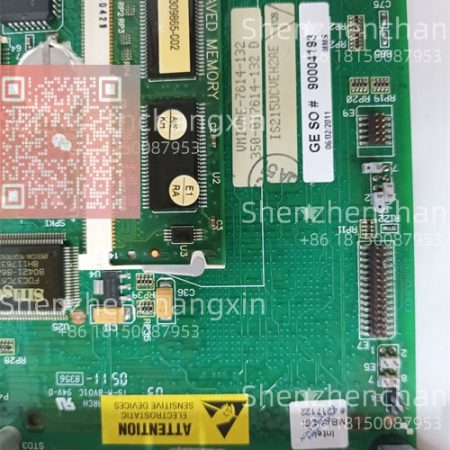
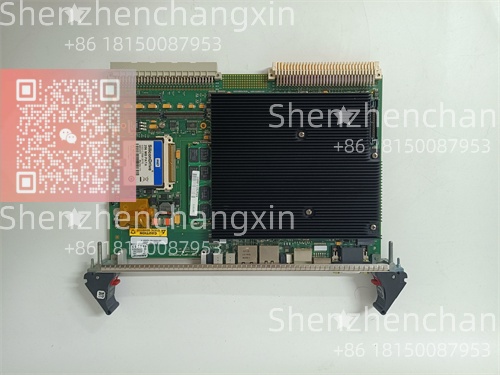
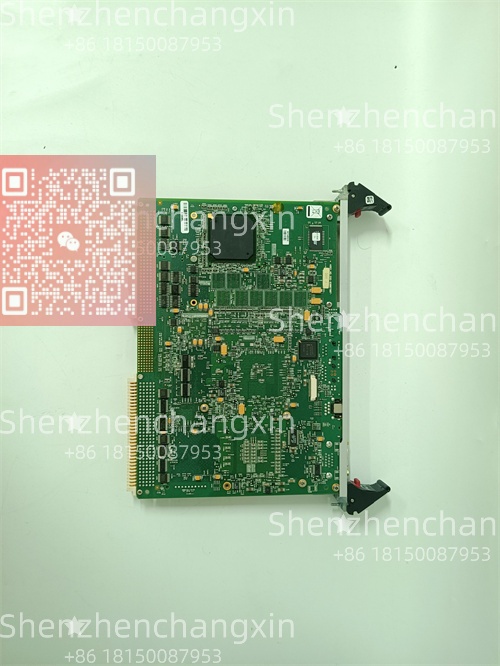
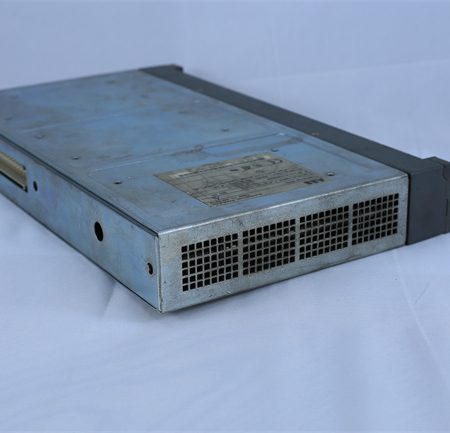
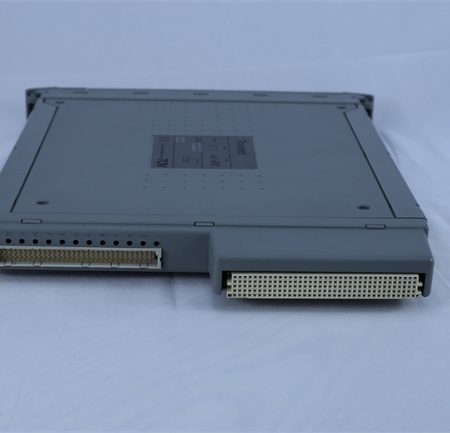
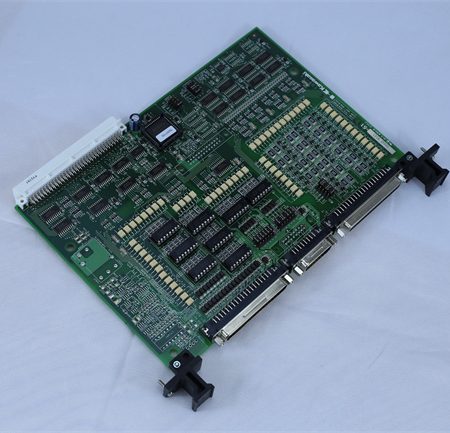
The GE VMIVME-7807RC (part number VME-7807RC-424001. 350-93007807-424001) is a high-performance VMEbus reflective memory real-time network interface board. It belongs to GE’s VMIC/VMIVME series and is specifically designed to build a deterministic, low-latency, globally shared memory network among multiple independent computers or controllers. Its core function is to achieve sub-microsecond data synchronization and sharing between different nodes in a distributed system, making it a key component for building high-real-time, high-reliability multiprocessor systems.
Core Functions and Value
The core value of this board lies in solving the most challenging determinism and synchronization problems in distributed systems. Through a fiber optic network, it creates a virtual, consistent global shared memory space across multiple nodes. When any node writes data to its local board memory, that data is automatically and deterministically “reflected” to the corresponding memory addresses of all other nodes in the network within an extremely short and fixed time (typically microseconds), without requiring intervention from the node’s CPU. This completely eliminates the uncertain delays and jitter caused by protocol stacks, arbitration, and conflicts in traditional networks (such as Ethernet), making it an ideal solution for simulation, testing, high-energy physics, military command and control, and other fields. Technical Specifications
Parameter Category
Description
Product Model
VMIVME-7807RC
Part Number/Catalog Number
VME-7807RC-424001. 350-93007807-424001
Manufacturer
GE Intelligent Platforms (developed from VMIC technology)
Product Type
VMEbus Reflective Memory Network Interface Board
Network Protocol
Reflective Memory
Network Medium
Multimode fiber optic (standard SC/ST interface), providing excellent electromagnetic interference immunity
Local Memory
On-board global shared memory, typical capacity of 256 MB (may vary depending on firmware version)
Access Method
Direct access via VMEbus or on-board memory port using memory mapping
Transmission Rate
Up to 174 Mbps (fiber channel full-duplex rate)
Network Latency
Sub-microsecond deterministic and low latency, largely independent of the number of network nodes
Maximum Number of Nodes
Up to 256 nodes in a single loop
Maximum Distance
Up to 300 meters between nodes using multimode fiber (longer distances possible with repeaters)
Interrupt Support
Supports generating and responding to hardware interrupts for inter-node event notification and synchronization
VMEbus Interface
Compliant with VME64 specifications, supports master/slave mode, and allows direct access to on-board memory
Physical Specifications
6U single-slot VME board
Power Supply
Powered via VME backplane (+5V, +/-12V)
Application Scenario
Scenario: Real-time simulation and testing platform for complete aircraft systems
In the aerospace field, developing new aircraft requires an integrated test bench that can integrate various devices such as flight control computers, avionics systems, actuator servos, and visual systems. Traditional networks cannot meet the nanosecond-level synchronization requirements. Using GE VMIVME-7807RC boards, each industrial control computer (VME bus) for each subsystem (such as flight control simulator, avionics simulator, and load simulator) is equipped with a reflective memory card, connected in a closed loop via fiber optics.
When the flight control model calculates a new control surface command on the host computer, this data is written to the shared memory address of the local VMIVME-7807RC. In less than 1 microsecond, this command data “magically” appears at the exact same address in the reflective memory of all other subsystems. The avionics system immediately reads the data and responds, and the load simulator simultaneously applies the corresponding torque. The entire system operates as if running on the same memory, achieving strict time synchronization and determinism. This solves the core pain point of data consistency and ultra-low latency in large-scale, multi-disciplinary real-time simulations, and is the cornerstone for complex system “human-in-the-loop” or “hardware-in-the-loop” testing.
Technical Advantages and Innovative Value
Unparalleled Determinism and Low Latency
The core innovation of the VMIVME-7807RC lies in its hardware-implemented, memory-mapped data transfer mechanism. Unlike Ethernet, which requires running complex TCP/IP protocol stacks, the reflective memory network is a “dumb” network. Data write operations are directly captured by hardware logic and broadcast through the fiber optic serial channel, completely bypassing operating system scheduling and CPU intervention. This brings two revolutionary advantages: first, extremely low and fixed latency (typically in microseconds), avoiding the unpredictable latency jitter caused by software protocol stacks; second, almost zero CPU overhead, allowing the main processor to dedicate its full resources to computation tasks without having to process network packets. This determinism is the lifeline of high-end real-time systems.
Simplified Programming Model and Natural Synchronization
It provides perhaps the simplest distributed programming model: direct memory read and write. Developers do not need to learn any network programming interfaces (such as Sockets); they simply write data to a specific address or read data from a specific address, just like operating local memory, to achieve data sharing across multiple computers. At the same time, its built-in hardware interrupt function allows one node to immediately trigger all other nodes after updating critical data, achieving precise event-driven synchronization. This “shared memory + hardware interrupt” model greatly simplifies the development, debugging, and maintenance of complex distributed real-time software.
Highly Reliable and Robust Fiber Optic Network
Using fiber optics as the transmission medium provides complete electrical isolation. This fundamentally eliminates ground loop interference, voltage differences, and electromagnetic pulse threats in long-distance wiring, ensuring data integrity in harsh electrical environments (such as large factories, ships, and aircraft). The fiber optic ring network itself supports redundant paths; when a fiber breaks, data can be transmitted in the reverse direction, maintaining network connectivity. The robust design of the VMIVME-7807RC also ensures reliable operation under vibration, shock, and a wide temperature range, meeting military and industrial-grade application standards.
Industry Application Case
Case: Large Phased Array Radar Data Processing System
A certain type of shipborne active phased array radar needs to transmit and synchronize the massive amount of echo data received from thousands of T/R modules to multiple signal processors for parallel processing in real time. Traditional data buses have bandwidth bottlenecks and synchronization difficulties. The system uses a reflective memory network based on GE VMIVME-7807RC as the core data exchange backbone.
Implementation and Value:
Building a high-bandwidth data pool: Each signal processor (based on the VME bus) is inserted with a VMIVME-7807RC, connected in a ring via fiber optics. All radar echo data is segmented and written into this globally shared 256MB memory pool.
Achieving zero-copy, deterministic processing: Each processor does not need to request data from each other, but directly “grabs” the part of the data it is responsible for processing from the shared memory, achieving zero-copy data transmission with stable sub-microsecond latency.
High-reliability synchronization: At the beginning of each radar scanning cycle, the main control node sends a hardware interrupt signal through the reflective memory network, and all processors strictly synchronize to start calculations.
Results: This system reduced the total latency of radar data processing by an order of magnitude, and the latency time is highly deterministic, greatly improving the radar’s target update rate and multi-target tracking accuracy. At the same time, the system software architecture became exceptionally simple and reliable due to the “shared memory” model. Complete Solution
Reflective Memory Cards for Other Bus Interfaces: Such as the PCI-5565 series, used to connect PCI/PCIe bus-based servers or industrial PCs to the same reflective memory network, enabling interconnection of heterogeneous platforms.
Fiber Optic Network Components: Multimode/single-mode fiber optic patch cords, fiber optic splitters, and fiber optic repeaters are used to build the physical network, extend transmission distance, and implement network topology.
Host Adapters and Cables: Used to connect the memory ports on the front of the board to the host, enabling higher-speed DMA data transfer.
Software Development Kit: Reflective Memory API drivers and libraries, supporting operating systems such as VxWorks, Linux, and Windows, providing simple and easy-to-use memory mapping and interrupt management functions.
System Monitoring and Management Tools: Such as the RFM2G management tool, used to monitor network status, configure node IDs, and diagnose network health.
Ruggedized VME Chassis: Used to integrate the VMIVME-7807RC and other VME processor boards and I/O boards into a robust chassis, forming a complete embedded real-time processing node.
Installation, Debugging, and Maintenance Support
Installation and Debugging
Network Planning: Plan a unique node ID for each VMIVME-7807RC board in the network. Plan the fiber optic connection sequence to form a ring or star topology (requires a splitter).
Hardware Installation: Insert the boards into the VME chassis slots, and connect the “IN” and “OUT” ports of each board with fiber optic cables according to the planned sequence, ensuring the loop is closed. Connect the host interface cables to the nodes requiring direct memory access.
Software Driver Installation: Install the corresponding reflective memory driver on each host operating system.
Configuration and Testing: Use the management tool or driver API to set the node ID and memory size for each board. Write a simple test program to write data in a specific pattern on one host and verify that the same data can be read simultaneously and consistently on all other hosts. Test the hardware interrupt function.
Maintenance and Support
Status Monitoring: Regularly check the fiber optic link status and network activity through the board status indicators (such as the “Link” light) and network management software. Troubleshooting: Common failure points include fiber optic link interruptions (check the fiber and connectors), node ID conflicts (check the configuration), and power supply or board failures (use the replacement method). Network management tools can usually locate the faulty node.
Firmware Upgrades: Pay attention to firmware updates released by GE to fix potential problems or improve performance. Upgrades should be performed cautiously and tested in a non-production environment.
Professional Services: We provide complete reflective memory solution services, including network design consulting, hardware configuration, integration and debugging, troubleshooting, and repair. For complex multi-node, multi-platform system integration, we can provide expert on-site support to ensure your real-time network achieves optimal performance and stability.

Reviews
There are no reviews yet.