
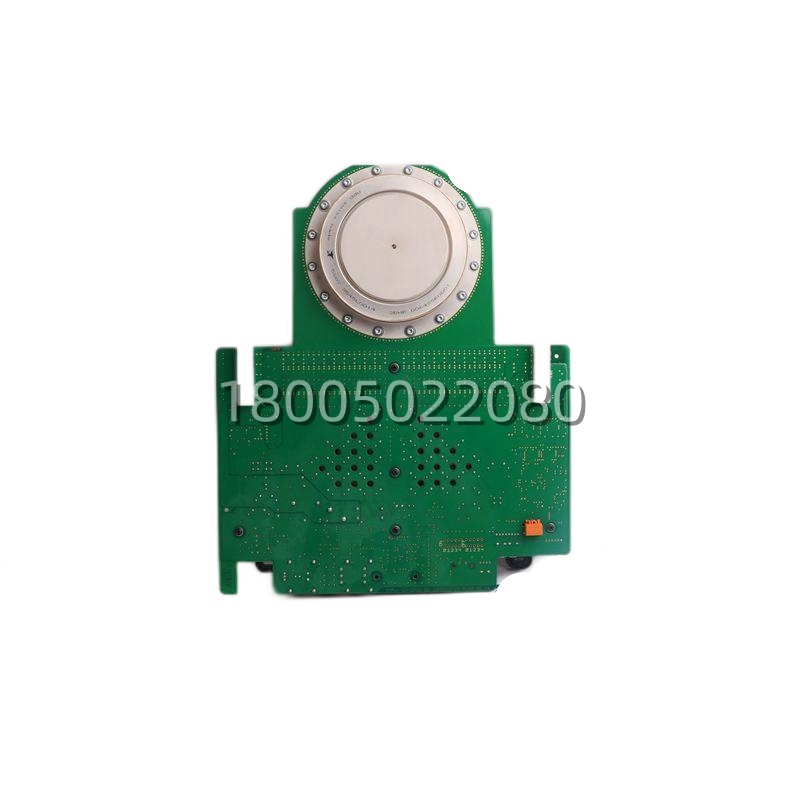
Application Scenarios:
In a large automotive assembly plant, maintaining precise synchronization between robotic welding arms, conveyor systems, and safety interlocks is critical. A sudden controller failure or performance bottleneck can halt the entire production line, costing thousands per minute. The plant engineers integrated the Allen-Bradley 1756-L61 controller as the central brain of their new body-in-white line. Its deterministic performance ensured that high-speed robots operated in perfect coordination, while its ample memory capacity handled the extensive logic for hundreds of I/O points and complex safety routines. The 1756-L61 directly addressed the pain points of system instability and limited scalability, enabling seamless line speed increases and reducing unplanned downtime by over 30% in the first year, showcasing its vital role in modern, high-throughput manufacturing.
Parameter:
| Main Parameters | Value/Description |
|---|---|
| Product Model | 1756-L61 |
| Manufacturer | Allen-Bradley (Rockwell Automation) |
| Product Category | Programmable Automation Controller (PAC) / Processor Module |
| Processor Type | Logix 5561 |
| User Memory | 2 MB |
| I/O Capacity | Up to 256 Local & Remote (est.) |
| Communication Ports | 1x Serial, Integrated Backplane |
| Key Protocols | EtherNet/IP, ControlNet, DeviceNet (via comms modules) |
| Programming Software | RSLogix 5000 / Studio 5000 Logix Designer |
| Operating Temperature | 0 – 60°C (32 – 140°F) |
| Power Supply | via 1756 ControlLogix Chassis (1.5A typical @ 5V) |
| Certifications | cULus, CE, ATEX (for suitable chassis) |
Technical Principles and Innovative Values:
- Unified Control Platform: The 1756-L61 is built on the Logix platform, which uses a single, tag-based programming language for all disciplines—sequential, process, drive, and safety control. This eliminates the need for multiple specialized controllers, simplifying development, commissioning, and maintenance.
- Deterministic Performance and Scalability: Its powerful processor executes control logic in a highly predictable, time-critical manner, essential for high-speed applications. Its architecture allows seamless scaling; a system based on the 1756-L61 can be easily expanded with additional I/O or upgraded to processors with more memory without changing the core programming structure.
- Integrated Communications: While the controller itself has a serial port, it is designed to work natively with a suite of communication modules (EtherNet/IP, ControlNet, etc.). This creates a cohesive network where controller, I/O, drives, and HMIs share data seamlessly, reducing wiring complexity and enabling real-time system-wide data access for optimization.
Reviews
There are no reviews yet.