

Application Scenarios:
Within the process chamber of a semiconductor etch tool, maintaining a precise, low-pressure environment is crucial for controlling the plasma density and etch rate. A deviation of even a fraction of a Torr can lead to non-uniform etching, damaging an entire wafer of expensive microchips. The MKS 223BD-00001AAB is mounted directly on the chamber, continuously measuring the absolute pressure. Its exceptional stability means the tool’s control system receives a signal that doesn’t drift over time, allowing for perfectly repeatable process recipes from one wafer to the next, batch after batch. Before utilizing such stable sensors, process engineers had to contend with gauge drift, requiring frequent recalibration and leading to yield-limiting variations. The 223BD-00001AAB solves this by providing a highly accurate and stable electrical signal (like 0-10V) that faithfully represents the chamber pressure, enabling real-time, closed-loop control of the throttle valve and gas flow to hold the setpoint pressure rock-steady. This directly translates to higher yield, consistent product quality, and reduced waste in multi-million dollar fabrication facilities.
Parameter:
Main Parameters Value/Description
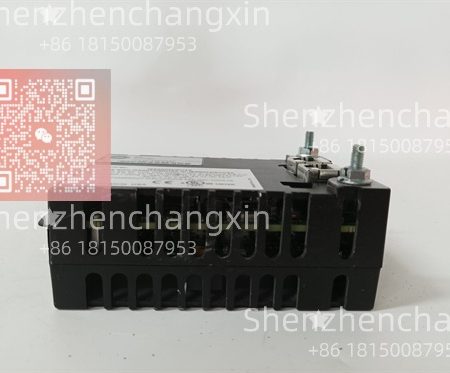
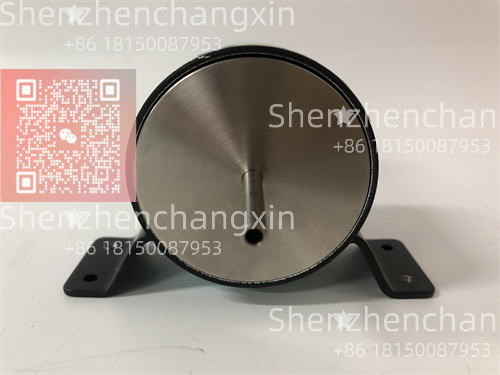
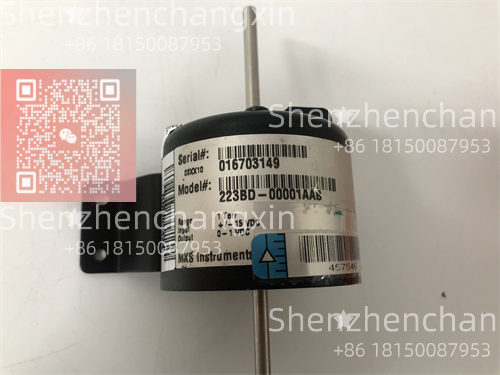
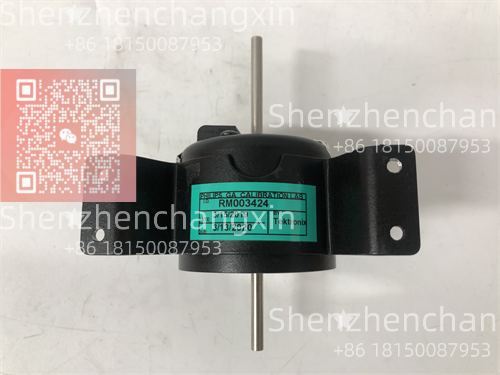
Product Model 223BD-00001AAB
Manufacturer MKS Instruments (Baratron)
Product Category Capacitance Manometer / Absolute Pressure Transducer
Pressure Range A specific, low-pressure range (e.g., 0-10 Torr, 0-1000 mTorr)*
Accuracy Typically a high percentage of reading (e.g., ±0.12% of reading)
Output Signal Analog Voltage (e.g., 0-10 VDC) or Analog Current (4-20 mA)*
Power Supply Typically +15 VDC or +24 VDC (model dependent)*
Wetted Materials Stainless Steel, Inconel, Ceramic (Corrosion resistant)
Process Connection Standard vacuum flange (e.g., CF, KF) or threaded port
Operating Temperature Controlled for high accuracy (e.g., 45°C ± 0.1°C)
Key Feature Exceptional long-term stability and repeatability
*Note: Specific full-scale range, output, and power must be confirmed from datasheet for exact -00001AAB variant.
Technical Principles and Innovative Values:
Innovation Point 1: Deflection-Based Capacitance Sensing. Unlike strain gauges, the core of the MKS 223BD-00001AAB is a precision-formed, corrosion-resistant metal diaphragm that acts as one plate of a capacitor. The applied process pressure causes this diaphragm to deflect minutely. This deflection alters the capacitance between the diaphragm and a fixed electrode. This change in capacitance is detected by a high-sensitivity, integrated circuit and converted into a linear, high-level analog output signal. This method provides superior sensitivity at low pressures and is inherently stable, as it measures physical displacement rather than a variable resistive property.
Innovation Point 2: Active Temperature Control for Ultimate Stability. One of the biggest sources of drift in pressure sensors is temperature fluctuation. The 223BD-00001AAB incorporates a sophisticated, actively controlled heater system that maintains the sensor’s critical components at a constant, elevated temperature (typically 45°C). This thermal stabilization effectively nullifies errors caused by ambient temperature changes, which is the primary reason for its legendary long-term stability and low zero drift. This makes it far superior to unheated or passively compensated sensors in environments where room temperature is not tightly controlled.
Innovation Point 3: Robust, Process-Resistant Sensor Design. Designed for harsh real-world environments, the sensor’s wetted parts—the diaphragm and housing—are manufactured from specialized materials like Inconel or stainless steel with a ceramic insulator. This construction provides excellent resistance to corrosion from aggressive process gases commonly used in semiconductor fabrication (e.g., chlorine, fluorine compounds). This durability ensures the sensor’s accuracy and performance are maintained over a long service life, even in the most punishing applications, reducing the total cost of ownership.
Application Cases and Industry Value:
Case Study: Thin-Film Optical Coating Deposition. A manufacturer of precision optical filters for telecommunications was struggling with coating uniformity. The deposition process required maintaining a vacuum chamber pressure in the 1E-4 Torr range with extreme stability. Variations in pressure caused changes in the refractive index and thickness of the deposited layers, leading to out-of-spec wavelength performance. The installation of an MKS 223BD-00001AAB Baratron, with its sub-0.1% of reading accuracy and active temperature control, provided a pressure signal an order of magnitude more stable than their previous gauge. This allowed their PLC to control the deposition rate and gas flow with much finer precision. The result was a 40% reduction in batch-to-batch variation and a significant drop in scrap rate. The process engineer noted that the stability of the 223BD-00001AAB was so reliable that they were able to extend calibration intervals from quarterly to annually, reducing tool downtime and maintenance costs.
Related Product Combination Solutions:
The MKS 223BD-00001AAB transducer is often integrated into a complete measurement and control solution. It is typically powered and its signal interpreted by a dedicated MKS Type 670B Signal Conditioner/Display or a Type 246 Power Supply/Readout. For multi-channel systems, an MKS Model 937B Multi-Channel Pressure Controller can manage several Baratrons. It connects to the process via vacuum fittings (CF or KF flanges) and cables (e.g., MKS P/N 009-021-003). For ultimate system control, its analog output is fed into a Process PLC (e.g., Siemens S7-1200) or a Vacuum Gauge Controller (like an MKS Model 946). To protect it from harsh particulates, a Sintered Metal Filter is sometimes used upstream. This ecosystem ensures the sensor delivers its full performance potential.
Installation, Maintenance, and Full-Cycle Support:
Proper installation is key to realizing the performance of the MKS 223BD-00001AAB. Mount it directly to the vacuum chamber or as close to the measurement point as possible using the appropriate clean, vacuum-rated flange. Use the specified cable to connect it to its corresponding power supply/readout controller. During power-up, allow sufficient time (often 30-60 minutes) for the sensor to reach its stabilized operating temperature for rated accuracy. Avoid exposing the sensor to pressure above its full scale or to incompatible chemicals.
Routine maintenance primarily involves verifying performance through periodic calibration against a known standard (e.g., a primary standard or a calibrated reference gauge). The sensor itself is a sealed, non-serviceable unit. If the output drifts outside acceptable limits or a fault is indicated, the standard procedure is replacement. Our full-cycle support ensures minimal disruption. We provide genuine, factory-specified MKS 223BD-00001AAB transducers. We can assist with confirming the exact pressure range and electrical connections for your variant and offer compatible signal conditioners and cabling. Our technical support can guide integration, and each unit is backed by a warranty. For critical processes, we recommend keeping a calibrated spare on hand to facilitate swift changeover and minimize system downtime.
Contact us for a customized solution and to ensure you have the right, precision MKS Baratron sensor for your critical pressure control application.

Reviews
There are no reviews yet.