
Application Scenarios:
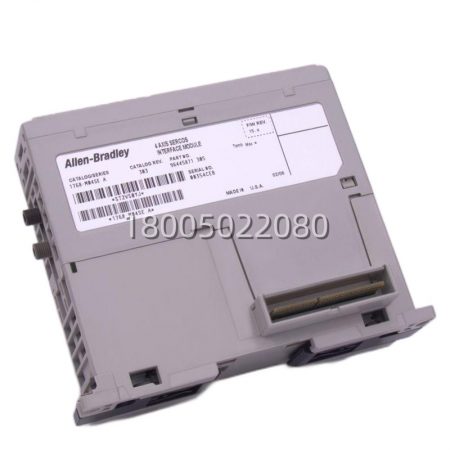
In a pharmaceutical packaging line, a 1769-ASCII module was used to solve a critical data integration challenge. The existing CompactLogix L32E controller lacked the native serial ports needed to communicate with a legacy weigh scale (RS-232) and a thermal transfer printer (RS-422). By adding the 1769-ASCII to the local I/O rack, engineers configured Channel 0 to read weight data from the scale and Channel 1 to send print commands to the label printer. This eliminated the need for a separate standalone terminal server, reduced cabinet clutter, and allowed the PLC program to directly parse and process raw ASCII strings for real-time quality control.
Parameter:
| Main Parameters | Value/Description |
|---|---|
| Product Model | 1769-ASCII (Series A/B) |
| Manufacturer | Allen-Bradley / Rockwell Automation |
| Product Category | Specialty Communication Module |
| Number of Ports | 2 independent channels (Channel 0, Channel 1) |
| Port Connectors | 2 x DB-9 Male (D-sub 9-pin) |
| Supported Protocols | RS-232 (Full Duplex), RS-422 (Full Duplex), RS-485 (Half Duplex) |
| Baud Rate | 300 to 115,200 bps (configurable per channel) |
| Data/Parity/Stop | 7/8 Data Bits; None/Even/Odd Parity; 1/2 Stop Bits |
| Isolation | 1500V RMS (Channel-to-Channel & Channel-to-Backplane) |
| Power Consumption | 425 mA @ 5V DC (Backplane Powered) |
| Compatible Controllers | 1769 CompactLogix, MicroLogix 1500 (via 1769 expansion) |
Technical Principles and Innovative Values:
- Innovation Point 1: Auto-Sensing Multi-Protocol Ports: Unlike fixed-function serial modules, the 1769-ASCII features “media autoselect” technology. The physical layer (RS-232, RS-422, or RS-485) is determined solely by how the user wires the DB-9 connector pins. This eliminates the need for hardware jumpers or specific module ordering, providing unparalleled flexibility for integrating diverse field devices with a single, universal module.
- Innovation Point 2: In-Rack String Processing Engine: The module offloads the heavy lifting of serial communication from the main CPU. It handles low-level byte timing, hardware handshaking (RTS/CTS), and features a 4 KB data buffer per channel. This allows it to receive and assemble complete ASCII strings (e.g., long barcode data) even during high-speed backplane traffic, preventing data overrun errors and freeing up controller scan time for application logic.
- Innovation Point 3: Dual-Operation Modes for Resource Optimization: The module supports two distinct operational modes. Alternating Mode allows a single set of PLC logic to service both ports sequentially, ideal for applications with similar devices. Simultaneous Mode treats each channel as fully independent, enabling concurrent communication with two completely different devices (e.g., a scanner and a printer) at different baud rates, maximizing I/O rack slot efficiency.

Reviews
There are no reviews yet.