
Application Scenarios
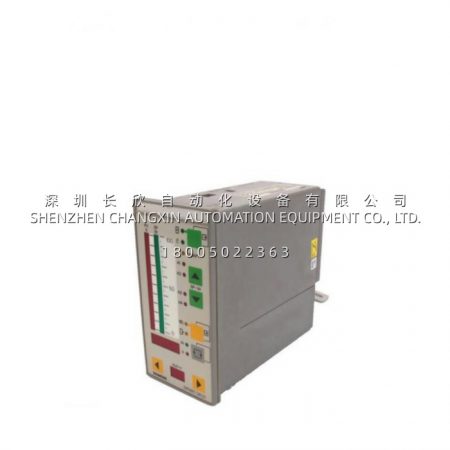
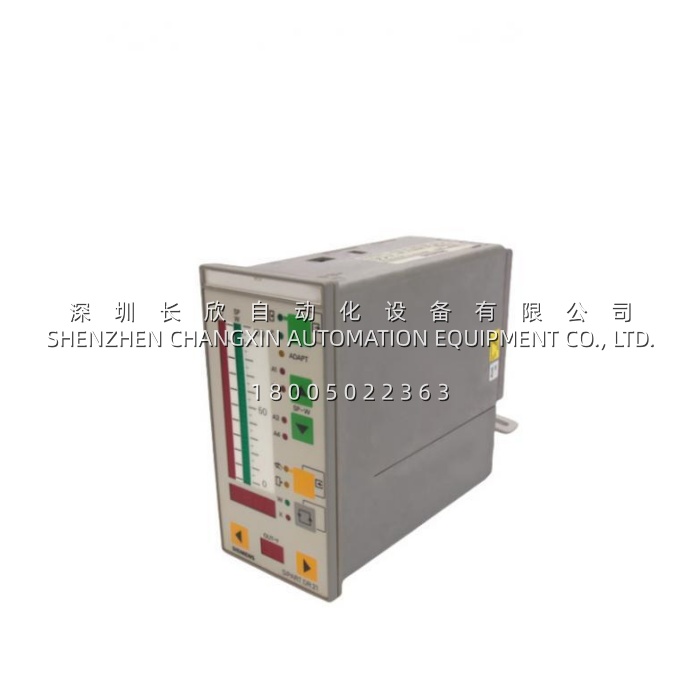
A specialty polymer plant in the Rhine-Ruhr region was struggling with an exothermic batch reactor where legacy on/off thermostat control produced ±6 °C swings around the 145 °C setpoint, leading to inconsistent molecular weight in the final product and recurring batch rejects. The control panel above the reactor had only 80 mm of horizontal rail space left, ruling out a full DCS expansion or a larger standalone controller. The engineering team dropped in a Siemens 6DR2104-5 into the 72 × 144 mm cutout — a direct fit with zero panel modification. They wired the 4–20 mA temperature transmitter to analog input 1, used analog input 2 for the cooling jacket flow transmitter (with the built-in square-root extractor linearizing the orifice signal on-chip), and assigned the two relay outputs to the heating contactor and high-temperature alarm.During the first batch, the operator triggered the 6DR2104-5‘s self-adaptation routine: the controller excited the loop, measured the process response including dead time, and auto-computed Kp, Tn, and Tv in under 8 minutes — no manual tuning, no consultant fees. Subsequent batches held ±0.8 °C around setpoint, and the plant’s batch reject rate on that reactor line dropped from 4.2% to 0.6% in the first quarter. Three years later, the same 6DR2104-5 is still in the panel, now supplemented by a rear-mounted PROFIBUS DP option module (6DR2800-8A) that pushes PV and SP data to the plant’s SCADA — a retrofit the base unit accommodated without being pulled from the cutout.
Key Parameters
| Main Parameters | Value/Description |
|---|---|
| Product Model | Siemens 6DR2104-5 |
| Alternate Identifier | SIPART DR21K |
| Manufacturer | Siemens AG |
| Product Category | Digital Single-Loop Process Controller |
| Supply Voltage | 115 / 230 V AC selectable, 50/60 Hz |
| Analog Inputs | 2 × (0/4–20 mA, non-isolated; configurable function assignment) |
| Digital Inputs | 2 × configurable |
| Digital Outputs | 2 × active (DC voltage signal) |
| Relay Outputs | 2 × floating contacts |
| Analog Output | 1 × 0/4–20 mA (manipulated variable) |
| Control Algorithms | P, PD, PI, PID; K (continuous), S (switching), two-step |
| Dimensions (W × H) | 72 × 144 mm (panel cutout DIN) |
| Front Protection | IP64 |
| Weight | Approx. 1.2 kg |
| Operating Temp. | 0 °C to +50 °C |
| Certifications | Germanischer Lloyd, DIN 3440, TÜV, EN 61010-1 Class I |
Technical Principles and Innovative Values
- Innovation Point 1: Built-In Self-Adaptation (Auto-Tuning). The Siemens 6DR2104-5 embeds a self-learning PID tuning routine that excites the control loop and measures the process response — including dead-time compensation — to compute optimal Kp, Tn, and Tv automatically. In side-by-side commissioning comparisons on typical thermal loops, this cuts setup time by up to 70% versus manual Ziegler-Nichols or trial-and-error approaches, and it doesn’t require the engineer to build a process model beforehand.
- Innovation Point 2: Flexible Function-Input Architecture. Physical inputs on the 6DR2104-5 aren’t hard-wired to fixed roles. The function inputs (x1, x2, x3/w0, yN, yR, z) can be mapped dynamically — so, for example, the feedforward input z can be weighted to the manipulated variable to cancel a measurable disturbance (like upstream flow changes hitting a heat-exchanger outlet temp) before it propagates into the PV. This kind of feedforward-without-adders logic is normally DCS-territory; here it lives in a single-loop panel device.
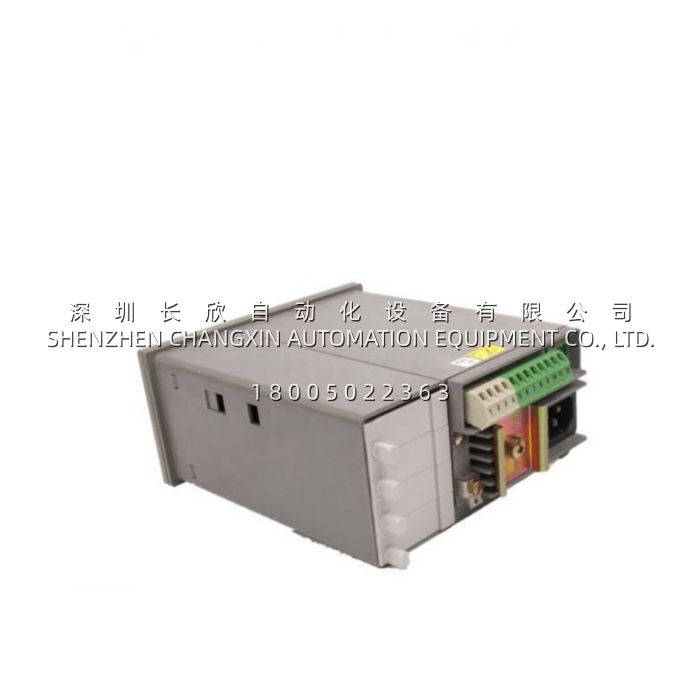
- Innovation Point 3: Rear-Slot Modular Expandability. The base 6DR2104-5 is deliberately minimal, but its rear panel carries dedicated option slots. Users can snap in UNI modules for TC/RTD direct connection (AE3/AE4 expansion), add RS-232/RS-485 for serial SCADA polling, or fit a PROFIBUS DP slave module (6DR2800-8A) to bring the controller into a SIMATIC PCS 7 or third-party DCS as a field node. This protects the capital investment: the same panel cutout scales from “standalone PID” to “networked loop” without a controller swap.
- Innovation Point 4: Adaptive Interference Filtering. The Siemens 6DR2104-5 applies an adaptive filter (tF) to the control deviation path, tunable to suppress low-frequency process noise — a common headache on flow-loops with pulsating pumps or stirred-tank temperature sensors near agitator gear. The filter constant is set during self-adaptation but can be overridden, letting the engineer trade responsiveness for smoothness without external signal conditioning hardware.
Application Cases and Industry Value
Case 1: Specialty Polymer Exothermic Reactor (described above). A German chemical plant commissioned the Siemens 6DR2104-5 on a 5 m³ batch reactor after rejecting a full DCS card expansion on cost grounds. The self-adaptation routine delivered stable ±0.8 °C control at 145 °C setpoint versus ±6 °C under the old on/off scheme. Batch reject rate fell from 4.2% to 0.6% in Q1 post-install, translating to ~€187K saved on rework and disposal for that single reactor. The plant later added a 6DR2800-8A PROFIBUS module at the rear slot to expose PV/SP/alarm bits to the site-wide SCADA — zero panel rework required.Case 2: Regional Brewery Pasteurizer Zone Control. A mid-size brewery in Bavaria uses the Siemens 6DR2104-5 on each of four plate-pasteurizer zones (hold temp 72 °C ±0.5 °C). Each controller takes a Pt100 input (via a UNI expansion on the rear slot) and drives a motorized 3-way mixing valve via the 0/4–20 mA analog output. Before the DR21K install, the zones were run off a 15-year-old multi-loop controller that had no auto-tuning and required seasonal re-commissioning as inlet wort temperature shifted with seasonal ground-water temps. After the swap, the brewmaster runs the self-adaptation once per season (5 minutes per zone) and leaves the loops alone. Energy consumption per hectoliter dropped 6.4% because the PID no longer over-corrected on inlet disturbances — the feedforward-capable architecture lets each controller see the pre-heat stage’s outlet temp as a z-input and pre-adjust valve position before the hold-stage PV moves. The brewery’s maintenance lead notes the 6DR2104-5‘s IP64 front face has survived 4+ years of daily wash-down without a single keypad failure — a detail that matters in food-grade panels.

Reviews
There are no reviews yet.