
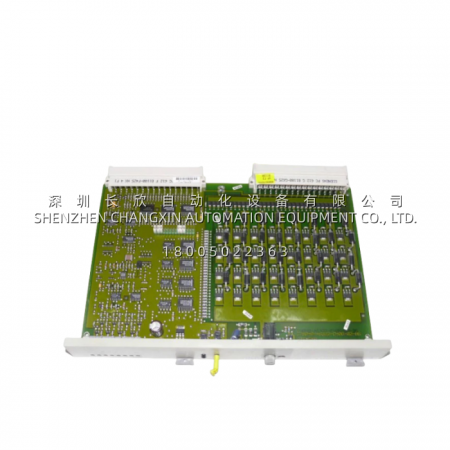
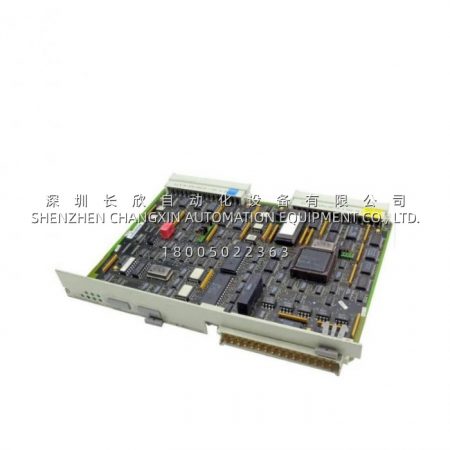
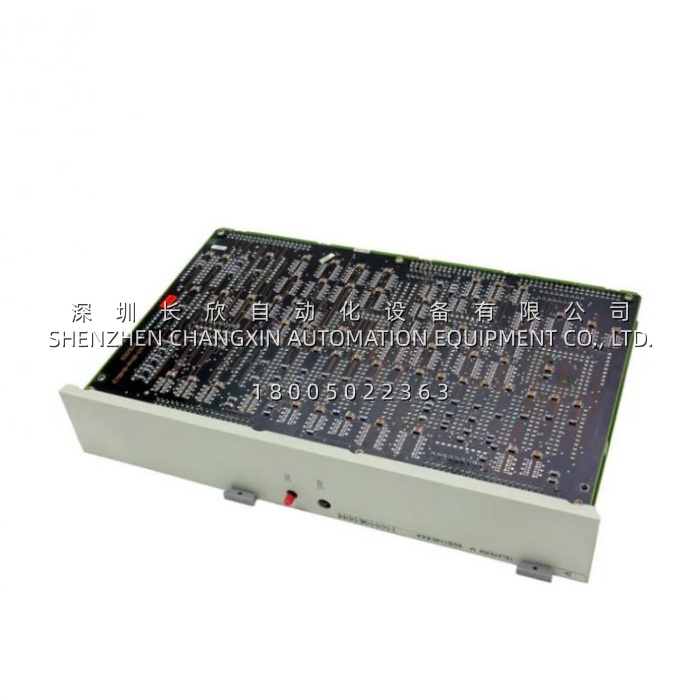
Technical Specifications
| Parameter Name | Parameter Value |
|---|---|
| Product Model | 6DS1140-8AA |
| Manufacturer | Siemens |
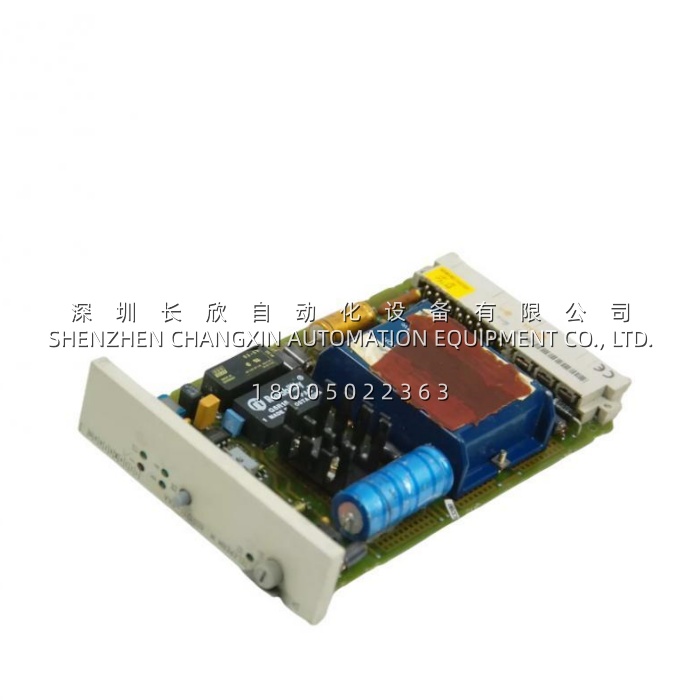
| Product Type | Central Processor Module (CPU 235) |
| Compatible Systems | AS 235, AS 235K (TELEPERM M family) |
| Processor Type | 16-bit high-performance microprocessor |
| Memory Capacity | 512 KB (user program + data) |
| Execution Time | ~0.8 ms / kB (basic instruction) |
| Power Supply | 24 V DC (–20 % / +25 %) |
| Current Consumption | Typ. 3.2 A |
| Communication Interface | SINEC L1 / System Bus (backplane) |
| Max I/O Points | 8192 (configuration-dependent) |
| Operating Temperature | 0 °C to +60 °C |
| Storage Temperature | –40 °C to +70 °C |
| Relative Humidity | 5 % to 95 % (non-condensing) |
| Mounting | Dedicated AS 235/235K rack slot |
| Dimensions (approx.) | 160 × 100 × 30 mm |
| Protection Class | IP20 |
| Certifications | CE, VDE, UL, CSA |
Main Features and Advantages
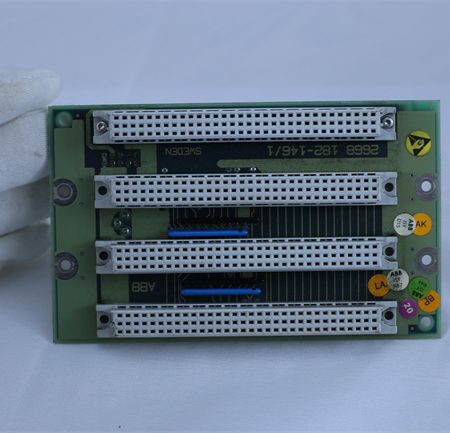
Deterministic 16-bit execution for process-grade loops. The 6DS1140-8AA centers on a 16-bit high-performance microprocessor architecture that, within the TELEPERM M generation, delivers class-leading scan predictability. With a basic-instruction execution rate near 0.8 ms per kilobyte of user program, the CPU 235 sustains multi-loop PID, interlock chains, and sequencing logic without the jitter penalties that plague general-purpose PLCs pushed beyond their scan budget. For AS 235/235K stations controlling boiler auxiliaries or high-speed filler/capper synchronization, this determinism translates directly into tighter process variance.512 KB program-and-data memory footprint. Although modest by today’s S7-1500 standards, the 512 KB pool on the 6DS1140-8AA was sized for the AS 235 sweet spot—dozens of analog loops plus hundreds of digital points—without forcing code-segment swapping. Data retention across power cycles and the ability to hold setpoint/recipe blocks in the same memory space simplifies backup strategy for legacy sites where the original engineering station may no longer be online.Native SINEC L1 and AS 235 backplane integration. The 6DS1140-8AA does not require external communication coprocessors to talk to TELEPERM M I/O racks, operator stations, or peer AS nodes. SINEC L1 system-bus handshaking is built into the module’s backplane interface, reducing cabinet component count and eliminating the “orphaned CPU” failure mode where a comms coprocessor fails independently of the processor. For retrofit or spare-swap scenarios, this means the 6DS1140-8AA drops into an AS 235/235K rack, seats on the backplane, and resumes bus communication once the engineering-load matches the hardware revision.Redundancy-ready architecture. In AS 235K configurations (the “K” denoting redundant-capable variant), a pair of 6DS1140-8AA CPUs can be staged for bumpless hot-standby switching—primary failure triggers millisecond-scale takeover by the secondary, with field devices seeing no control interruption. This is a decisive advantage in continuous-process contexts (power-plant auxiliaries, continuous F&B lines) where even a 2-second CPU bounce can cascade into a line shutdown or turbine trip.Cross-generation compatibility within TELEPERM M. The 6DS1140-8AA interfaces cleanly to the wider 6DS I/O module family (digital, analog, communication sub-modules) that populate AS 235/235K racks, meaning a spare CPU can be rotated across multiple stations in a plant that standardized on TELEPERM M for auxiliaries. This “common-spares” effect reduces inventory SKU count for maintenance stores.

Reviews
There are no reviews yet.