
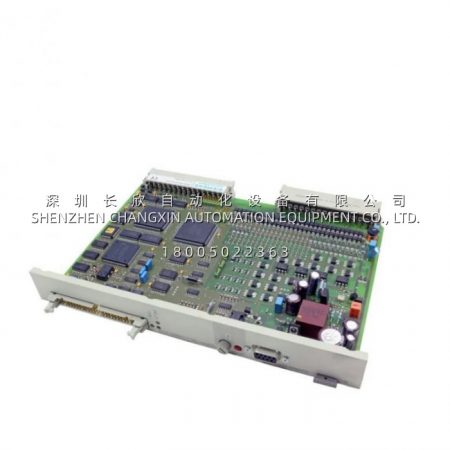
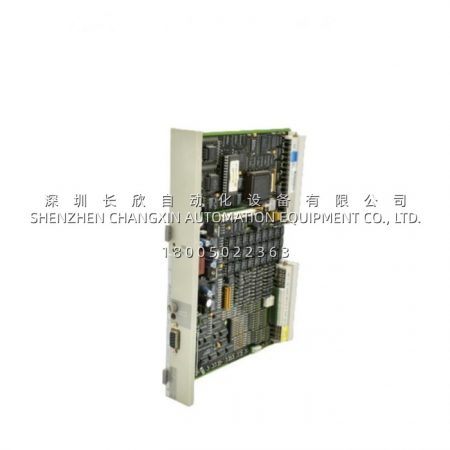
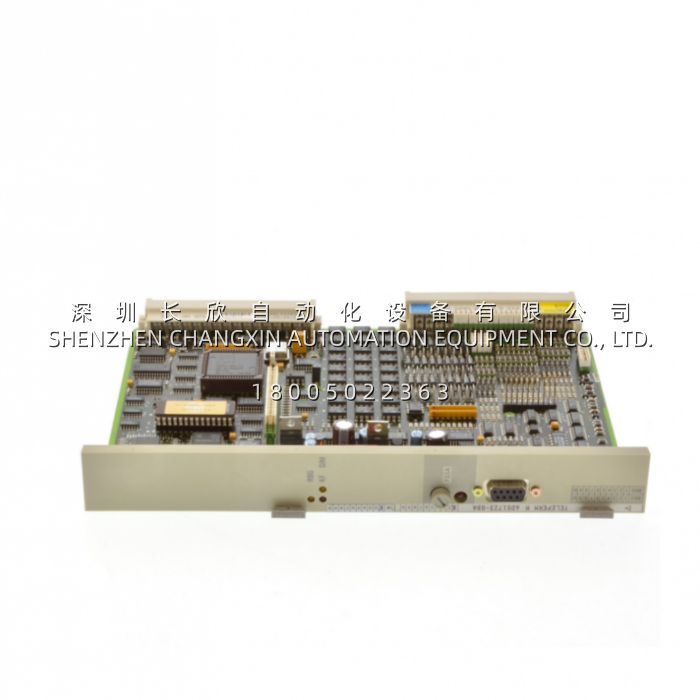
Technical Specifications
| Parameter Name | Parameter Value |
|---|---|
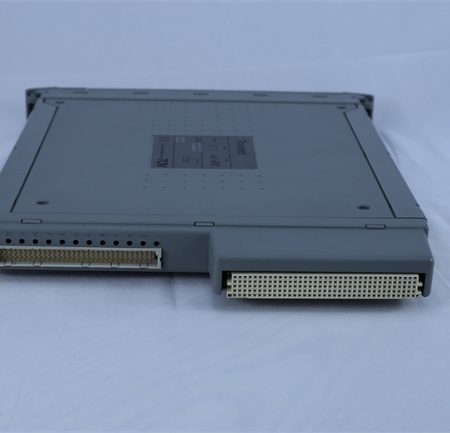
| Product Model | 6DS1723-8BA |
| Manufacturer | Siemens |
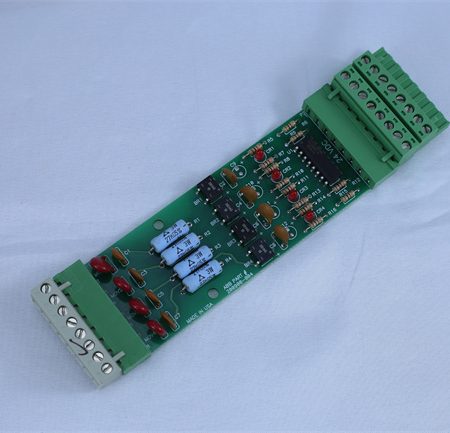
| Product Type | Analog Input Module |
| Compatible Platform | SICOMP C30 / C35 rack system |
| Input Channels | 8 channels, differential |
| Resolution | 16-bit (class), 12-bit base ADC on select builds |
| Supported Input Ranges | ±10 V, 0–10 V, 0–20 mA, 4–20 mA (via shunt) |
| Sampling Rate | 1 kS/s aggregate (typ. 500 Hz–1 kHz per channel, build-dependent) |
| Input Impedance | > 1 MΩ (voltage mode) |
| Accuracy | ±0.1 % FSR (typical, with temperature compensation) |
| Power Supply | 24 V DC (backplane / local, config-dependent) |
| Power Consumption | ≈ 1.5–2.5 W |
| Operating Temperature | –25 °C to +60 °C |
| Storage Temperature | –40 °C to +70 °C |
| Relative Humidity | 5 % to 95 % (non-condensing) |
| Communication | SICOMP internal backplane bus; Profibus DP via C30/C35 host gateway |
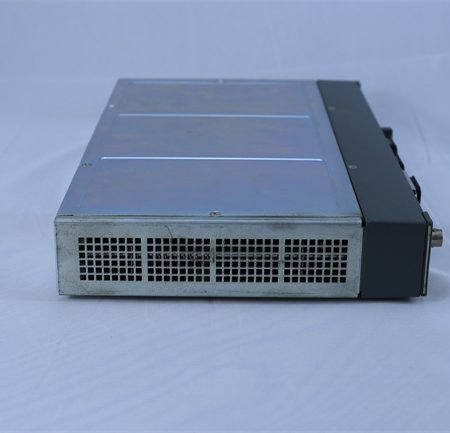
| Mounting | SICOMP C30/C35 rack slot |
| Dimensions (approx.) | 120 × 100 × 35 mm |
| Weight (approx.) | 0.5 kg |
| Protection Class | IP20 |
Main Features and Advantages
Eight differential AI channels in a single SICOMP slot. The 6DS1723-8BA gives the C30/C35 rack an 8-channel analog-front-end without consuming panel space on external signal-conditioning blocks. Differential topology rejects common-mode noise on long sensor leads—critical when thermocouple or RTD transmitters share tray space with VFD power conductors. For skid builders who standardized on SICOMP C30/C35 as the machine-controller IPC, the 6DS1723-8BA collapses what would otherwise be a separate remote-I/O block into the same rack that holds the C30/C35 CPU, memory, and fieldbus cards.16-bit-class resolution with temperature-compensated ADC. Across the –25 °C to +60 °C band, the 6DS1723-8BA holds ±0.1 % FSR typical accuracy thanks to onboard temperature-compensation referencing. For process loops where setpoint resolution maps to product quality—heat-exchanger outlet temperature, filling-head pressure, CIP chemical-concentration feedback—the extra bits over a baseline 12-bit part translate into finer PID action before the loop oscillates. Even on builds where the silicon is 12-bit base, the –8BA firmware reporting and dither scheme push effective resolution into the 16-bit class.Mixed-range flexibility without hardware swaps. Per-channel parameterization on the 6DS1723-8BA lets adjacent channels run different ranges—Ch1 on ±10 V from a pressure transducer, Ch2 on 4–20 mA from a magnetic flow, Ch3 on 0–10 V from a position potentiometer—all in the same module. This avoids the “one module type per signal family” inventory sprawl that plagues plants running older single-range AI cards. In SICOMP C30/C35 machines where the I/O mix changes between build variants (same rack, different sensor suite), the 6DS1723-8BA absorbs the variation through software alone.Ruggedized for non-climate-controlled enclosures. Most SICOMP C30/C35 installations sit in MCC rooms, but a meaningful subset of 6DS1723-8BA deployments end up in auxiliary-plant cubicles, test-stand pushstations, or outdoor-skid enclosures with only fan-filter ventilation. The –25 °C cold-start rating and 95 % non-condensing humidity tolerance let the 6DS1723-8BA ride through seasonal swings that would drift a consumer-grade DAQ card. Internal ESD, surge, and reverse-polarity protection on the 24 V DC feed add another layer—accidental probe slips during commissioning don’t kill the module.Seamless C30/C35 + Profibus DP story. The 6DS1723-8BA itself sits on the SICOMP backplane; the C30/C35 host then exposes scanned AI data to a plant-level DCS or SCADA over Profibus DP (via the C30/C35’s own DP interface card). This two-tier architecture—local IPC logic on C30/C35 reacting to 6DS1723-8BA data in sub-10 ms, plant SCADA polling at 100 ms—gives machine builders the best of both worlds: tight local loop closure plus upstream visibility.

Reviews
There are no reviews yet.