
Description:
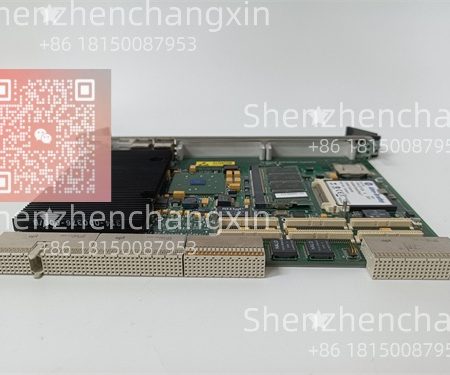
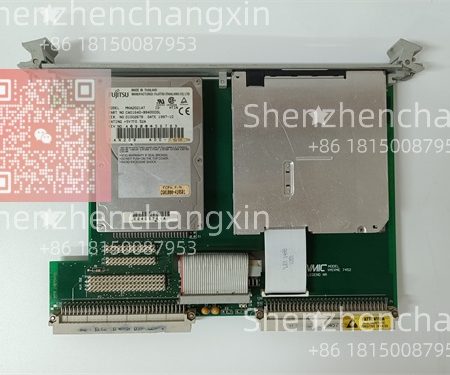
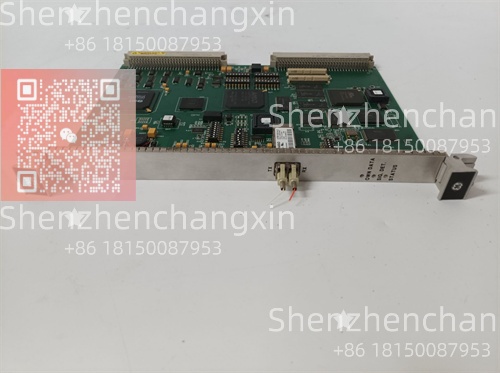
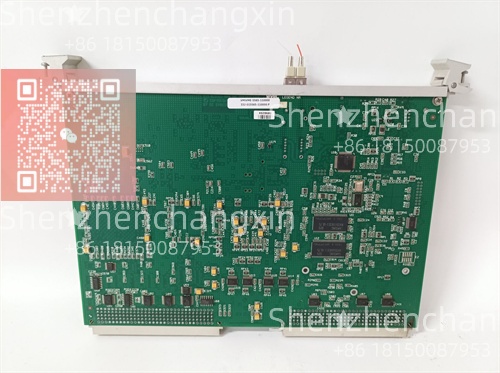
The VMIC VMIVME-5565 (also referenced as VME-5565 or full variant VMIVME-5565-110000332-015565-110000) is a high-speed reflective memory network interface card designed for the VME64x bus architecture. Developed by VMIC (now part of GE Intelligent Platforms, later acquired by Emerson), this module enables deterministic, low-latency data sharing across multiple computers in tightly synchronized real-time systems—critical in defense, aerospace, power, and industrial simulation environments.
Using a shared-memory paradigm over a ring or star fiber-optic topology, the VMIVME-5565 allows all nodes to access a common memory space with microsecond-level consistency, eliminating traditional network stack overhead and jitter.
Application Scenarios:
During development of a next-generation missile guidance simulator at a U.S. defense lab, engineers struggled with timing drift between six distributed real-time PCs running radar emulation, target tracking, and threat response algorithms. Ethernet-based communication introduced unpredictable latency spikes (>10 ms), corrupting time-critical sensor fusion. By deploying the VMIC VMIVME-5565 across all nodes via single-mode fiber, the team achieved sub-500 ns data propagation with zero packet loss—even under 100% CPU load. All subsystems now read from an identical 128 MB memory map updated at 10 kHz, enabling perfect phase alignment during closed-loop hardware-in-the-loop (HIL) tests. This transformation turned a failing prototype into a field-deployable validation platform, showcasing how the VMIC VMIVME-5565 solves the “time coherence” challenge in multi-domain real-time systems.
Parameter:
Main Parameters Value/Description
Product Model VMIVME-5565 (full P/N: VMIVME-5565-110000332-015565-110000)
Manufacturer VMIC / GE Intelligent Platforms (now part of Emerson)
Product Category VME64x Reflective Memory Network Interface Card
Memory Capacity 128 MB onboard SDRAM (shared across network)
Data Rate Up to 170+ MB/s per link; 2.1 GB/s aggregate ring bandwidth
Interface Type VME64x (6U form factor, 32/64-bit, 32 MHz), ANSI/VITA 1.1 compliant
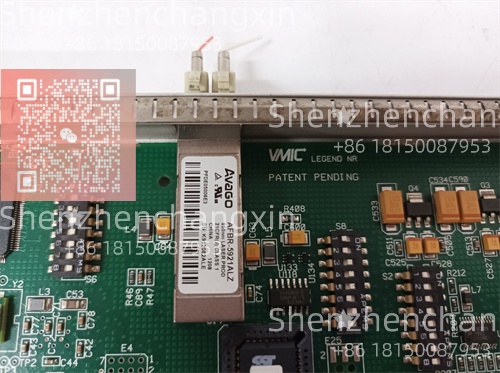
Network Topology Ring or star via duplex LC fiber-optic ports (multimode or single-mode)
Latency Deterministic <1 µs node-to-node; jitter <50 ns
Operating System Support VxWorks, Linux, Windows, INTEGRITY, QNX (with vendor drivers)
Cooling Method Conduction-cooled (rugged variants) or air-cooled (commercial)
Environmental Rating -40°C to +85°C (conduction-cooled); MIL-STD-810G compliant options
Certifications IEEE 1386.1. VITA 31.1. CE, RoHS
Technical Principles and Innovative Values:
Reflective Memory Architecture: The VMIC VMIVME-5565 writes data to its local memory segment, which is instantly “reflected” to all other nodes via high-speed serial links—bypassing OS kernels and TCP/IP stacks for true hard real-time performance.
Deterministic Microsecond Synchronization: Unlike Ethernet or PCIe fabrics, the VMIC VMIVME-5565 guarantees bounded latency regardless of traffic load, making it ideal for control loops requiring nanosecond-level coordination.
Hardware-Based Data Consistency: Each write triggers automatic, atomic broadcast across the ring using dedicated FPGA logic—ensuring all nodes see identical data states without software intervention.
Scalable Multi-Node Deployment: Supports up to 256 nodes in a single ring, with optional star couplers for complex topologies in large-scale simulators or power grid monitoring systems.
Application Cases and Industry Value:
At a European rail signaling test center, the VMIC VMIVME-5565 synchronized 12 train control emulators across a 500-meter facility to validate ETCS Level 3 interoperability. Legacy CAN networks couldn’t handle the 5 kHz update rate required for virtual train positioning. After deployment, the system achieved 99.999% data coherence across all nodes—even during simulated radio dropouts—accelerating certification by 8 months. In another case, a nuclear fusion research lab in Japan used the VMIC VMIVME-5565 to coordinate plasma injector timing across 8 pulse power supplies. The module’s immunity to EMI and sub-microsecond precision prevented beam misalignment that previously damaged containment walls. Users consistently cite its “set-and-forget” reliability in 24/7 mission-critical operations.
Related Product Combination Solutions:
VMIC VMIVME-7750: High-end VME CPU board often paired with VMIC VMIVME-5565 for real-time processing
GE Fanuc cPCI-5565: CompactPCI version of reflective memory for modern chassis migration
VMIC RM-2000: Fiber-optic star coupler for non-ring VMIC VMIV5565 topologies
National Instruments PXIe-8880: Alternative in PXI ecosystem; VMIC VMIVME-5565 excels in legacy VME real-time systems
Wind River VxWorks BSP: Certified board support package ensuring seamless VMIC VMIVME-5565 integration
ABB Ability™ System 800xA: Can integrate VMIC VMIVME-5565 via OPC UA gateways for power plant sync
Honeywell Experion R510: Uses similar tech; VMIC VMIVME-5565 preferred for ultra-low-latency military apps
Emerson PACSystems RX7i: Modern PLC alternative; VMIC VMIVME-5565 remains unmatched for HIL simulation
Installation, Maintenance, and Full-Cycle Support:
Installing the VMIC VMIVME-5565 requires a standard 6U VME64x chassis with proper backplane termination. Fiber-optic cables (LC duplex) connect nodes in a ring, with automatic link negotiation at power-up. Drivers are available for all major real-time OSes, and configuration is typically handled via API calls (e.g., rmWrite(), rmRead()). No IP addressing or switch management is needed—simplifying deployment compared to Ethernet-based solutions.
Maintenance involves periodic inspection of fiber connectors and verification of link LEDs. The module supports hot-insertion in compliant chassis and includes built-in BIT (Built-In Test) for rapid fault isolation. Mean time between failures (MTBF) exceeds 150.000 hours due to solid-state design and no moving parts.
Every VMIC VMIVME-5565 we supply undergoes full functional burn-in, fiber link stress testing, and memory integrity validation across temperature extremes. Our engineering team—certified in VME, reflective memory, and real-time systems—provides lifetime support for driver integration, topology design, and migration planning to modern standards like TSN or Time-Sensitive Networking.
Contact us for a customized solution—whether you need a single VMIC VMIVME-5565 for a radar test bench or a 32-node reflective memory ring for a national flight simulator, we deliver deterministic data coherence where timing is everything.

Reviews
There are no reviews yet.