
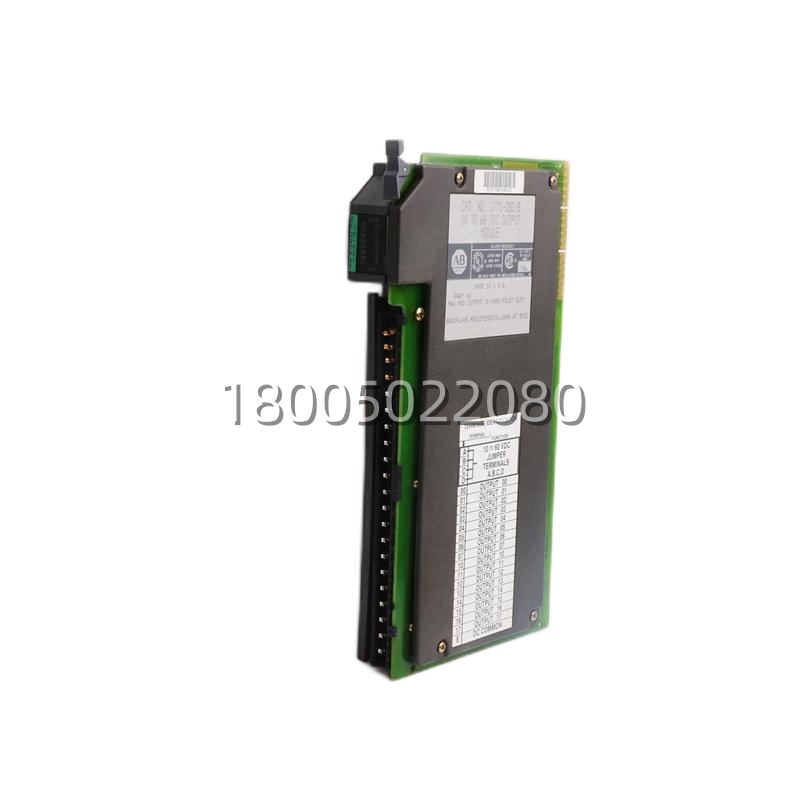
Parameter
| Main Parameters | Value/Description |
|---|---|
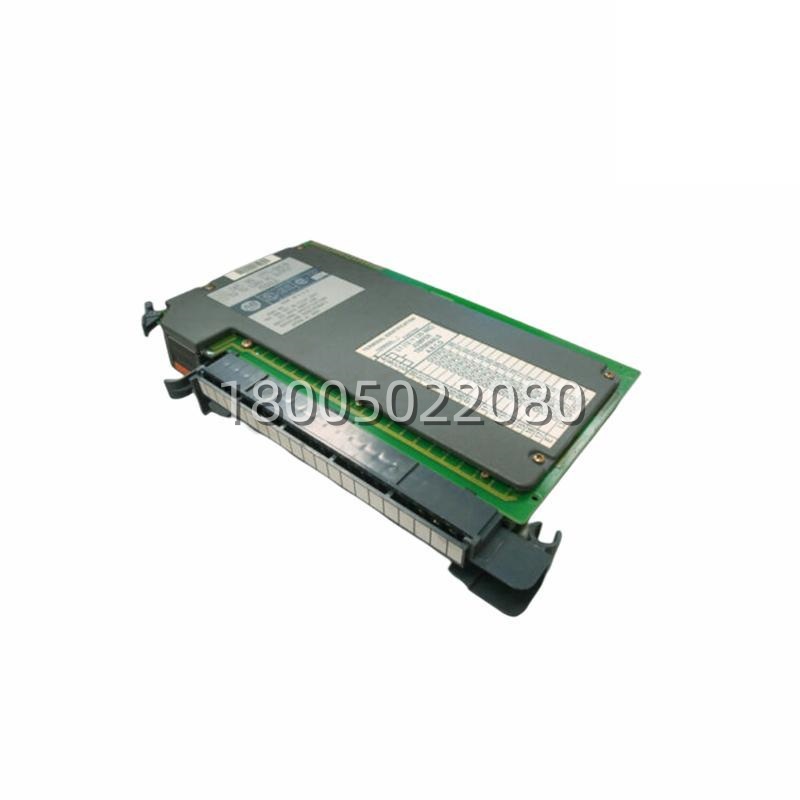
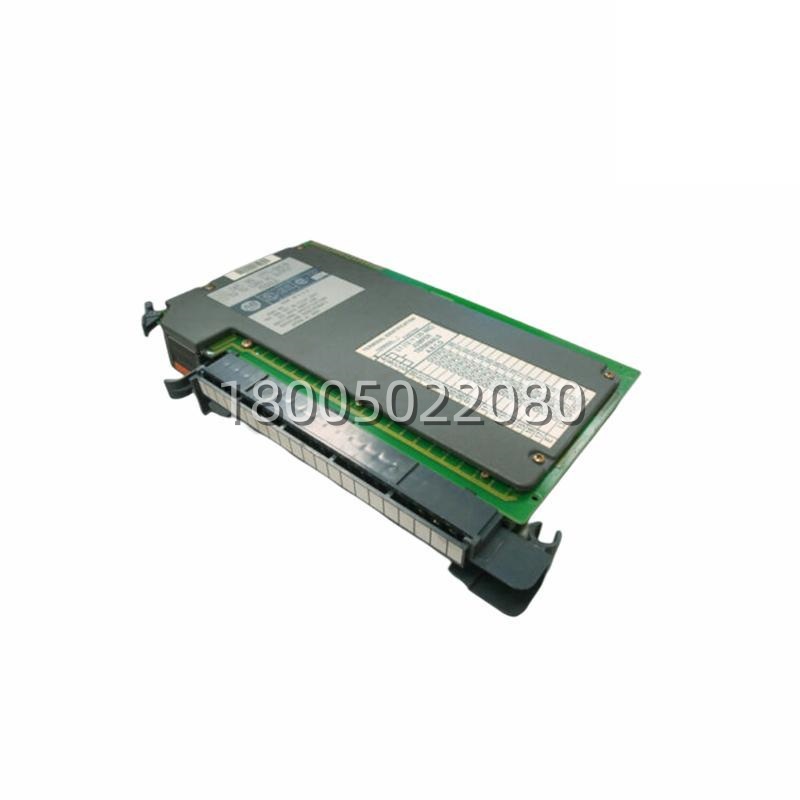
| Product Model | 1771-OAD |
| Manufacturer | Rockwell Automation (Allen-Bradley) |
| Product Category | 1771 Digital AC Output Module (Triac) |
| Output Channels | 16 points, grouped (2 groups × 8 pts typical) |
| Output Voltage | 10–138 V AC, 47–63 Hz |
| Max Current per Point | 2 A continuous / 25 A surge (100 ms, repeatable 1 s) |
| Module Total Current | ≤ 8 A continuous |
| Backplane Current Draw | 295 mA @ 5 V DC |
| Turn-On Delay | 8.3 ms @ 60 Hz / 10 ms @ 50 Hz (zero-cross) |
| Isolation | 1500 V DC ch-to-backplane (optical + RC snubber + MOV) |
| Fusing | 12 A, 250 V (per-point / group, Bussman GBB 12 style) |
| Wiring Arm | 1771-WH (std) or 1771-WHF (fused field) |
| Chassis Required | 1771-A1B/A2B/A3B/A4B or AM1/AM2 (NOT A1/A2/A4) |
| Operating Temp | 0 °C to +60 °C |
Technical Principles and Innovative Values
Innovation Point 1: Zero-Cross Triac Switching for EMI Suppression. The 1771-OAD doesn’t just “turn on” when the PLC logic says so—it waits for the next AC zero-cross before firing the triac. This limits the inrush dI/dt on inductive loads (contactor coils, solenoid banks) and keeps conducted EMI off the 1771 backplane. In panels where VFDs or soft-starters share the same gutter, this difference is measurable on a scope—and invisible in the maintenance log.Innovation Point 2: Per-Point Fusing + LED Indication. Each output group on the 1771-OAD carries a 12 A / 250 V fast-blow fuse (visible through the module front), and every channel has its own LED. When a solenoid shorts, the LED stays dark (fuse blown) rather than lying “on”—a diagnostic cue that saves a truck roll. The 1771-WHF wiring arm adds field-side fusing if the panel design wants a second barrier.Innovation Point 3: Detachable 1771-WH Wiring Arm. Like all 1771 modules, the 1771-OAD uses a swing-arm terminal (1771-WH standard, 1771-WHF fused) that unplugs with a release tab. Swap the module without de-terminating 32 field wires—critical when the spare lives in a live MCC and the clock is ticking.Innovation Point 4: 25 A Surge Tolerance Matched to AC Coil Inrush. A typical NEMA Size 1 contactor 120 V AC coil can pull 15–20 A for the first half-cycle. The 1771-OAD is rated 25 A surge for 100 ms, repeatable every second—meaning it handles the inrush without nuisance fusing, then settles to the 2 A holding current. Generic SSR blocks often undersize this; the 1771-OAD doesn’t.
Application Cases and Industry Value
A Midwest foundry running a 1997-vintage molding line had twelve 1771-OAD modules in a four-rack PLC-5/80 cluster, driving everything from sand-plow solenoids to cooling-fan contactors. When one module began dropping Channel 7 intermittently, the night shift electrician suspected backplane corrosion—but the per-point LED on the 1771-OAD told a different story: LED lit (logic commanded ON) but the contactor didn’t pull. Meter confirmed 118 V at the 1771-WH terminal, 0 V at the load side of the fuse. Fuse blown, but not visibly. Swapped the 1771-WH fused arm (1771-WHF) and the channel came back—root cause was a solenoid coil developing a partial short that drew 10 A holding (well under the 12 A fuse, but enough to eventually open it). The 1771-OAD‘s per-group fusing contained the fault to one channel; the other 15 kept running the line. The foundry’s maintenance chief later standardized all their AC-output slices on 1771-OAD + 1771-WHF combos “because the fuse tells you which solenoid is dying before the whole rack flakes.” In a plant where a line stop costs $4k/hour, that visibility pays for the module difference ten times over.
Related Product Combination Solutions
The 1771-OAD lives in a PLC-5 / 1771 rack ecosystem; these are the modules most often racked alongside it:
- 1771-WH / 1771-WHF: The wiring arm specific to the 1771-OAD—WH is standard, WHF adds a fused terminal strip on the field side. Every 1771-OAD ships needing one of these; spares belong in the MCC’s parts cubby.
- 1771-OD16: The “diagnostic” 16-point AC output sibling—adds wire-off detection and load-current sensing per channel. If the 1771-OAD feels under-informed for your fault-finding needs, the OD16 is the pin-compatible step-up (check chassis keying though).
- 1771-OAC: Often confused with 1771-OAD—the OAC is also 16-point AC output but with different voltage grouping; verify your load voltage before substituting.
- 1771-IFE: 12-bit analog input module, frequently on the same rack as 1771-OAD on process skids where the AC outputs drive staging contractors while the IFE reads 4–20 mA from pressure transmitters.
- 1771-IXE: Communication/co-processor module; in larger PLC-5 cells the 1771-OAD handles local AC loads while the IXE bridges to Remote I/O or DH+ uplink.
- PLC-5/40C / PLC-5/80: The host processors most commonly seen upstream of a 1771-OAD rack—5/40C for mid-size cells, 5/80 for the big clusters. The 1771-OAD draws 295 mA @ 5 V from the backplane, so tally total 1771 module count against the processor’s 5 V budget (5/80 gives ~12 A, 5/40C ~8 A).
- 1756-1771-A1/A2: ControlLogix-to-1771 adapter chassis—for plants migrating PLC-5 → ControlLogix but keeping the 1771-OAD (and other 1771 I/O) in place. The adapter lets the L8x processor talk to legacy 1771 racks over ControlNet or EtherNet/IP without rewiring the AC load field cables.
Installation, Maintenance, and Full-Cycle Support
The 1771-OAD occupies one slot in a 1771 I/O chassis and communicates with the PLC-5 processor over the 1771 backplane (no DIP switches, no node address—slot position = logical address, set in the PLC-5 I/O configuration). Critical chassis note: the 1771-OAD requires a B-serieschassis (1771-A1B through A4B, or AM1/AM2) because of keying between pins 10–12 and 20–22 on the backplane connector. It will not seat in the older A1/A2/A4 non-B chassis—forcing it damages the keying fingers. Verify chassis label before racking.Wiring the 1771-OAD goes through the 1771-WH (or WHF) swing arm: land L1 (120 V AC hot) and L2 (neutral) on the group commons (typically 8 points share a common, 2 groups per module = 2 field commons), then run each load’s switched leg to its numbered terminal. The triac’s off-state leakage is up to 3 mA @ 138 V AC—usually irrelevant for contactor coils, but if you’re driving a very small 120 V LED beacon, add a parallel 10 kΩ bleed resistor at the load to prevent ghost-glow. The 1771-OAD‘s on-state drop is ≤1.5 V at load >50 mA (rises to ~5.8 V below 50 mA), so at 2 A per point the module dissipates roughly 3 W per active channel—plan chassis airflow accordingly; a fully-loaded 1771-OAD (8 A total) runs near the top of its 13 W envelope.Maintenance on the 1771-OAD is mostly visual: the per-point LEDs should mirror the PLC output image; a lit LED with no load voltage means a blown fuse (swap the 1771-WH/WHF arm or just the fuse insert). The module itself is solid-state with no user-serviceable parts—if a triac fails shorted (rare, but possible on repeated surge overload), the whole 1771-OAD swaps in under two minutes thanks to the detachable WH arm. No backplane power cycling required for the swap if the rack’s powered—though best practice is to kill the 120 V field feed first.

Reviews
There are no reviews yet.