
Technical Specifications
| Parameter Name | Parameter Value |
|---|---|
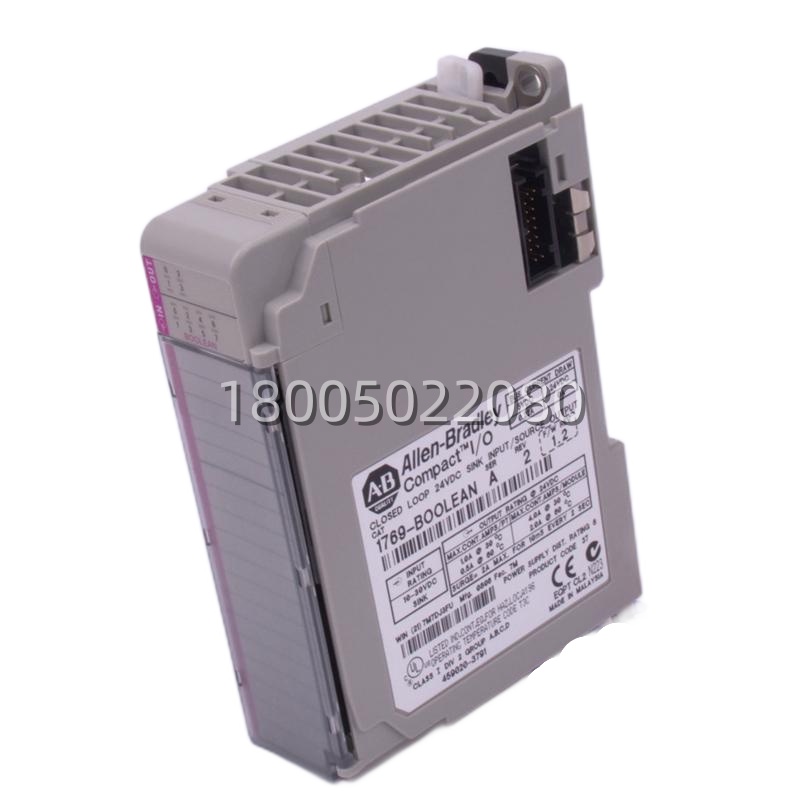
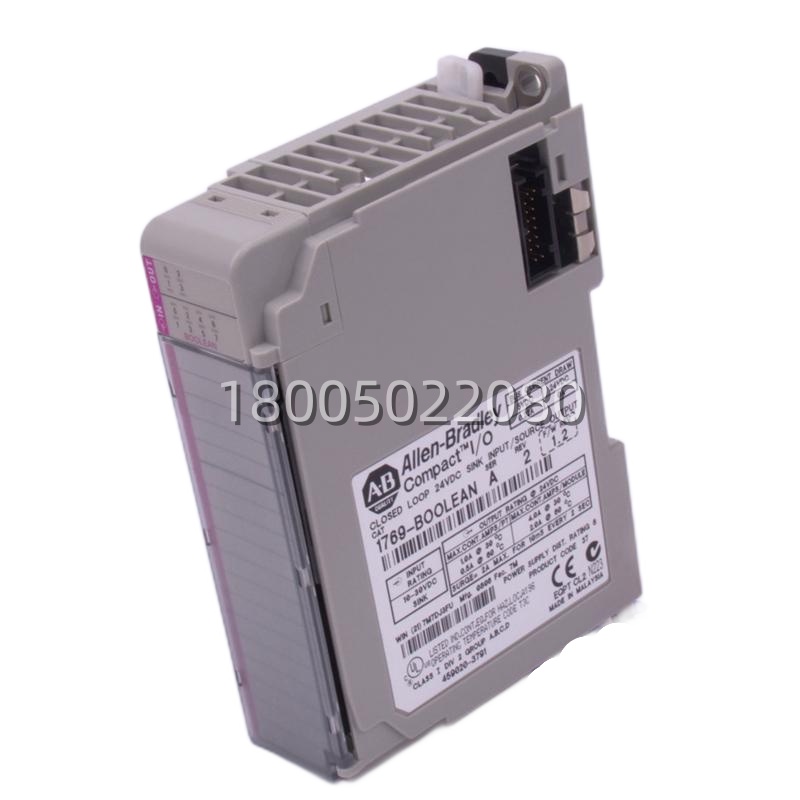
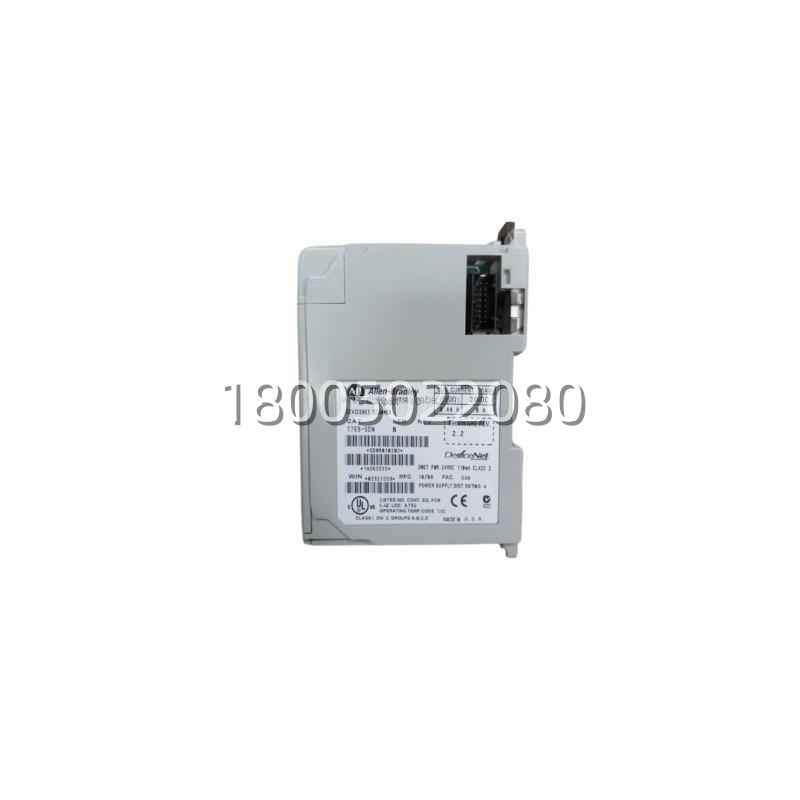
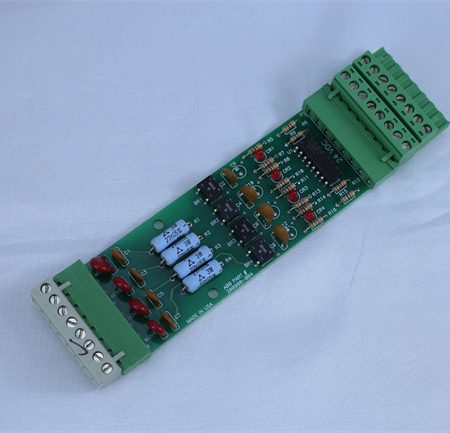
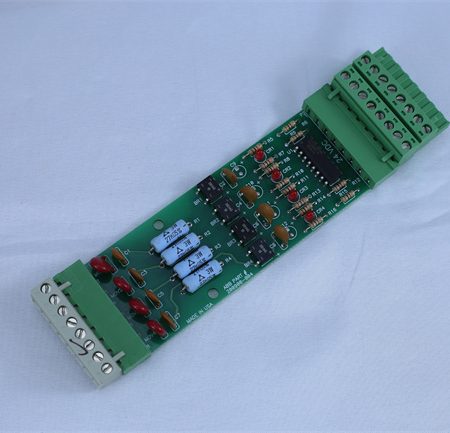
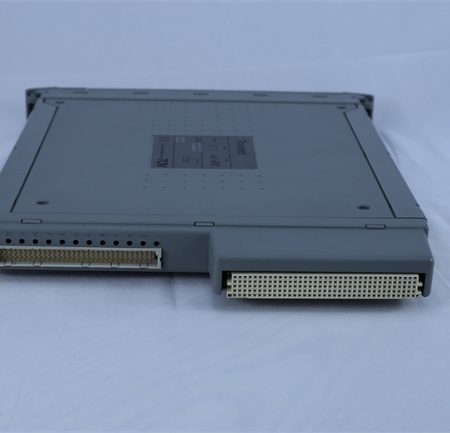
| Product Model | 1769-BOOLEAN (Series A / B) |
| Manufacturer | Rockwell Automation (Allen-Bradley) |
| Product Type | Compact I/O Combination Boolean Control Module (24 V DC In / Out) |
| Compatible Platform | CompactLogix 1769 racks; MicroLogix 1500 with 1769 expansion |
| Number of Inputs | 8 single-ended, 24 V DC sink |
| Input Voltage Range | 10–30 V DC (10–26 V DC at 60 °C derated) |
| Input Impedance | 2.0 kΩ @ 24 V DC / 2.3 kΩ @ 30 V DC |
| Input Delay (OFF→ON / ON→OFF) | 10 µs typical |
| Number of Outputs | 4 single-ended, 24 V DC source |
| Output Voltage Range | 20.4–26.4 V DC |
| Boolean Operations | OR, AND, XOR, NONE (per output, configurable) |
| Closed-Loop Expression Time | ~1 µs |
| Backplane Current Draw | 220 mA @ 5.1 V DC / 0 mA @ 24 V DC |
| Isolation Voltage | 75 V DC working; 1200 V AC / 1697 V DC for 1 s (IEC Class 2 reinforced) |
| Heat Dissipation | 3.55 W maximum |
| Dimensions (H × D × W) | 118 × 87 × 35 mm (4.65 × 3.43 × 1.38 in) |
| Mounting | 35 mm DIN rail or panel mount |
| Certifications | CE, cULus, UKCA, ABS; EU EMC & Low Voltage Directives |
Main Features and Advantages
On-module Boolean-expression engine with 1 µs resolution. The headline differentiator of the 1769-BOOLEAN is the ability to assign each of the four outputs an independent Boolean expression built from the eight inputs using AND, OR, XOR, or NONE operators, plus optional output-delay and output-duration timers. In Boolean Control Mode, the module evaluates and drives the output locally—roughly 1 µs from input transition to output response—without waiting for the CompactLogix scan. For high-speed reject stations, guard-logic chains, or encoder-synchronized latches, this keeps determinism tighter than any controller-level rung can guarantee.Dual control modes: Direct vs. Boolean. Every output on the 1769-BOOLEAN can be switched at runtime between Direct Control (output follows the controller’s output-image bit exactly, like a normal 1769 card) and Boolean Control (output follows the evaluated expression). This means a single application can use two outputs as plain program-driven 24 V sourcing drivers and the other two as autonomous gated interlocks—no hardware change required, just a configuration word toggle. Commissioning teams often start with Direct mode to prove wiring, then flip to Boolean mode once the expression logic is validated.Configurable delay and duration per output. Beyond the raw logic operator, the 1769-BOOLEAN supports an output-delay (ON after TRUE held for X ms) and output-duration (ON for Y ms once triggered) on each channel, configured through the module’s data file. This turns the card into a miniature pulse-stretch / one-shot / debounce engine at the rack edge—handy for contactor coil hold-in, strobe generation for vision triggers, or debouncing mechanical limit chains without timer instructions in the PLC program.Compact 1769 footprint with removable finger-safe terminals. The 1769-BOOLEAN shares the standard 1769 mechanical envelope (118 mm tall, 87 mm deep) and keys into the 1769 bus connector on both sides, so it nests anywhere in the rack between a CompactLogix processor and other 1769 I/O. The front terminal block is finger-safe rated and removable for pre-wiring off-panel, and the LED array gives at-a-glance health: module OK, input state per channel, output state per channel, and fault indication readable without a laptop.Low backplane load and reinforced isolation. Drawing only from the 5.1 V backplane (220 mA) and nothing from 24 V means the 1769-BOOLEAN doesn’t compete with 24 V-hungry analog or relay cards for the rack’s 24 V budget. At 3.55 W max dissipation and IEC Class 2 reinforced insulation (75 V DC working, 1200 V AC / 1697 V DC dielectric), the module sits comfortably in mixed-voltage cabinets where 120 V AC control and 24 V DC I/O share the same enclosure, provided Pollution Degree 2 and Overvoltage Category II rules are observed.
Application Field
The 1769-BOOLEAN earns its keep anywhere a CompactLogix or MicroLogix 1500 system has a handful of combinational gating decisions that either need sub-scan speed or simply don’t justify controller CPU cycles. In packaging machinery—flow wrappers, cartoners, case packers—the module commonly handles guard-door interlock strings: three or four safety switches (inputs) AND-ed together to enable a guarding-OK output that feeds the main contactor, with XOR used on a pair of position-prove switches to detect door-misalignment. Because the 1769-BOOLEAN evaluates locally, the E-stop-to-contactor path gains determinism independent of whatever heavy logic the CompactLogix main task is chewing on.Conveyor and material-handling cells use the 1769-BOOLEAN for photo-eye gating ahead of divert arms: two or three sensors (product-present, lane-full, jam-detect) feed OR/AND expressions that drive a reject-kicker or divert-gate output with configurable duration, keeping the reject pulse timing consistent even if the PLC scan slips during a large-data move. In press and stamping applications, the module’s 1 µs loop makes it suitable for light-curtain + dual-hand / palm-button gating—the expression (LightCurtain_OK AND Hand1 AND Hand2 AND NOT Reset) drives the clutch-permit output, and because the 1769-BOOLEAN resolves it locally, the machine builder can document a deterministic permissive path without stepping up to a dedicated safety controller for non-SIL gating (for SIL/PL-rated circuits, a proper GuardLogix or POINT Guard device would still be specified; the 1769-BOOLEAN fills the non-safety or secondary-gating niche).OEM machine builders also lean on the 1769-BOOLEAN to shave rungs off the CompactLogix program. A 500-rung ladder that includes twenty lines of “if A and B and not C then Y” scattered across three programs can be collapsed by moving A/B/C to the 1769-BOOLEAN inputs and letting the module drive Y, freeing scanner bandwidth and making the remaining ladder easier to read. In retrofits—particularly MicroLogix 1500 panels being squeezed for scan time—adding a 1769-BOOLEAN on the expansion bus offloads the combinatorial grunt work without migrating the whole program to CompactLogix. And in test-stand and lab-automation rigs, the module’s delay/duration config makes it a quick-and-dirty pulse generator: wire a pushbutton and a sensor as inputs, configure XOR with a 500 ms duration, and the output drives a strobe or indicator—no PLC code touched.
Related Products
- 1769-IB16 – 16-point 24 V DC sink input module in the standard 1769 footprint; when the 1769-BOOLEAN‘s eight inputs aren’t enough, pair it with the IB16 for bulk discrete acquisition on the same rack.
- 1769-OB16 – 16-point 24 V DC source output module; complements the 1769-BOOLEAN when more than four sourcing outputs are needed for the same machine cell.
- 1769-OB8 – 8-point 24 V DC source output (relay-free transistor version); lower channel count than OB16, useful when the 1769-BOOLEAN‘s four outputs are nearly sufficient but one or two extras are needed without jumping to 16.
- 1769-IF8 – 8-channel analog input (voltage/current) for the same 1769 rack; frequently sits next to the 1769-BOOLEAN in mixed discrete+analog CompactLogix panels.
- 1769-OF8C – 8-channel analog current output; paired with the 1769-BOOLEAN when a cell mixes discrete gating (on the Boolean module) with analog setpoint driving (on the OF8C).
- 1769-L18ER / 1769-L24ER – CompactLogix 5370 L1x/L2x processors that host the 1769-BOOLEAN on the local 1769 expansion bus; the most common pairing in new-build CompactLogix panels.
- 1769-L35E – Larger CompactLogix processor (L3x series) with deeper 1769 expansion; the 1769-BOOLEAN is often found here in more complex machines where Boolean offload matters most.
- 1769-ADN – DeviceNet adapter for remote 1769 banks; allows the 1769-BOOLEAN to sit in a remote DeviceNet-mounted Compact I/O assembly rather than local to the processor.
- 1769-PA2 / 1769-PB2 – 1769 AC/DC system power supplies; add one if a rack carrying the 1769-BOOLEAN plus many 24 V-hungry modules pushes the backplane budget.
Installation and Maintenance
Pre-installation preparation: Before fitting the 1769-BOOLEAN onto a CompactLogix 1769 rack or MicroLogix 1500 1769 expansion bank, confirm the controller is offline and the enclosure meets Pollution Degree 2 / Overvoltage Category II per IEC 60664-1. Verify the 5.1 V backplane budget can absorb the 1769-BOOLEAN draw of 220 mA—in a typical CompactLogix L1x/L2x local bank this is negligible, but in a deeply expanded rack with multiple analog and relay cards it should still be cross-checked against the processor’s 5 V budget. The module ships in an open-type enclosure, so cabinet placement must protect it from conductive dust, oil mist, and direct wash-down; if the cell sees any of those, a higher-rated panel or secondary enclosure is required. Handle the 1769-BOOLEAN with an ESD wrist strap—the front connector and backplane pins route to the Boolean ASIC and CPLD, and static damage will not show up until weeks later as intermittent expression mis-fires. Plan wiring before snapping the module in: the eight sink inputs expect PNP-prox or contact-to-+24V style wiring (current sinks into the module), while the four source outputs source from the module’s internal 24 V supply to the field load; mixing sink/source mental models is the #1 commissioning error on this card. Pre-label the finger-safe terminal block off-panel if possible, since the 1769-BOOLEAN terminal numbering runs IN0–IN7 on the left column and OUT0–OUT3 + COM on the right—mirroring the manual layout avoids “why is my AND evaluating wrong” wiring callbacks.Maintenance recommendations: The 1769-BOOLEAN is solid-state with no user-serviceable parts, but a few practices keep it reliable. During annual cabinet PM, verify terminal torque (the removable block is screw-type; vibration on conveyor lines can loosen over months) and inspect the LED pattern: module-OK solid green means healthy, flashing/fault red means the Boolean configuration data didn’t match the AOP revision or a dielectric event occurred—check the controller’s Minor/Major fault table for the 1769-BOOLEAN extended error code. If an output behaves unexpectedly, first confirm in RSLogix/Studio 5000 whether that output is currently in Direct Control or Boolean Control mode—many “faults” turn out to be a mode-toggle left over from commissioning. The expression operands (which inputs map to which operator for each output) live in the module’s configuration data file; if the program is ever re-downloaded from a different laptop, ensure the 1769-BOOLEAN config tags travel with the ACD file, or the module will either fault or revert to Direct mode depending on the “program to fault enable” bit. For cabinets with VFDs or contactors nearby, check that the 10 µs input filter remains appropriate—if fast transients are tripping false input transitions, the 1769-BOOLEAN input filtering can be adjusted in the module-defined data, though the hardware floor is 10 µs. Finally, if the rack is ever expanded beyond six modules from the processor, remember the 1769-BOOLEAN‘s own backplane load is modest, but the cumulative 5.1 V budget still dictates whether a 1769-PA2/ PB2 supplemental supply is needed.

Reviews
There are no reviews yet.