
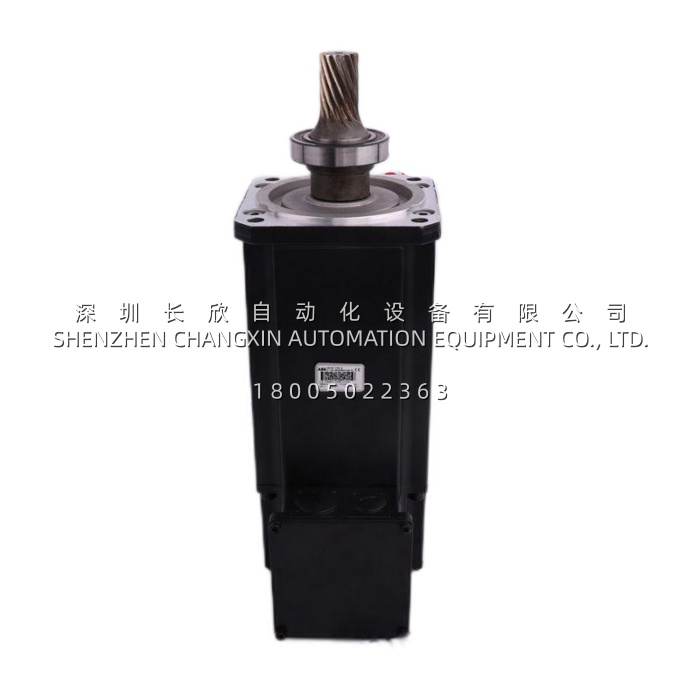
Application ScenariosIn a high-volume automotive body-in-white welding cell, an IRB 7600 handling door-panel spot-welding experienced intermittent position drift on the elbow axis after three years of two-shift operation. The original motor’s encoder degradation was causing path deviation beyond ±1.5 mm — unacceptable for weld-gun repeatability. The maintenance team replaced the failing unit with a new 3HAC3403-1/2, leveraging the OEM mechanical interface (shaft key, flange drill pattern, brake connector) to complete the swap in under 45 minutes without removing the adjacent RV reducer or re-teaching the axis zero. Post-replacement, the cell returned to ±0.3 mm path consistency, and the built-in encoder resolution allowed the IRC5 controller to close the loop tighter than before. For a line producing 68 bodies per hour, that 45-minute intervention saved an estimated four-figure downtime loss — exactly the kind of “plug-and-play reliability” plant managers pay the OEM premium for.h2
Parameter
| Main Parameters | Value/Description |
|---|---|
| Product Model | 3HAC3403-1/2 |
| Manufacturer | ABB |
| Product Category | AC Permanent-Magnet Synchronous Servo Motor (Robot Axis) |
| Rated Power | 2.5 kW (continuous) |
| Rated Torque | 8.0 N·m |
| Peak Torque | 24.0 N·m (short-term) |
| Rated Speed | 3000 rpm (max. 4500 rpm field-weakened) |
| Encoder Type | Incremental optical encoder, 1024 PPR, A/B/Z differential (RS-422) |
| Protection Class | IP65 (motor body), IP54 (connector area per variant) |
| Cooling Method | Natural convection (IC 0041, finned housing) |
| Output Shaft | Ø22 mm with keyway, IEC 60034-5 flange compatible |
| Weight | Approx. 12 kg |
| Operating Temp. | 0 °C to +40 °C (ambient, robot cabinet climate-controlled recommended) |
h2 Technical Principles and Innovative ValuesInnovation Point 1: Robot-Optimized PM Rotor with Vacuum-Impregnated Stator. The 3HAC3403-1/2 uses rare-earth magnets in a low-cogging rotor stack, paired with a vacuum-pressure-impregnated (VPI) stator winding that resists moisture, oil mist, and high-hour thermal cycling. This combination keeps winding temperature rise in check even during the repeated acceleration/deceleration profiles typical of spot-welding and material-handling robots.Innovation Point 2: Drop-In Mechanical & Electrical Interface. Flange drill pattern, shaft key dimensions, brake air-gap, and multi-pin circular connector (power + brake + encoder) are all ABB-robot-native. Replacing a failed 3HAC3403-1/2 does not require machining the link, modifying the cable harness, or re-machining the reducer coupling — a critical advantage when “minutes = money” on a automotive or foundry line.Innovation Point 3: High-Resolution Feedback + Drive Auto-Commissioning. The 1024 PPR incremental encoder with RS-422 differential outputs feeds clean position data back to the ACS800 / ACS880 drive and IRC5 controller. Drive-side auto-tuning recognizes the motor parameters out of the box, shortening commissioning from hours to minutes and reducing the risk of tuning-induced oscillation on large inertial loads like IRB 7600 upper arms.h2 Application Cases and Industry ValueCase 1 – Foundry Casting Cell (IRB 6600, 150 kg payload). A European die-cast plant running 20+ IRB 6600s for aluminum ladle and extraction duties replaced third-party “equivalent” servo motors on the shoulder axis after repeated bearing-seal failures in the high-temperature (~55 °C ambient near the furnace) zone. Switching back to genuine 3HAC3403-1/2 units restored the original IP65 integrity and bearing-life expectation; the plant reported a 60 % drop in unscheduled shoulder-axis swaps over the next 18 months, with no encoder contamination events despite the oil-mist and particulate-heavy environment.Case 2 – General Industry Retrofit. A contract manufacturer running mixed IRB 6600 / 7600 cells for palletizing standardized all shoulder/elbow spares on the 3HAC3403-1/2 to reduce SKU count. Cross-compatibility across both robot families simplified storeroom management, and the natural-cooling design removed the need for auxiliary fan wiring that had previously been a point of failure during wash-down cycles.

Reviews
There are no reviews yet.