
Technical Specifications
| Parameter Name | Parameter Value |
|---|---|
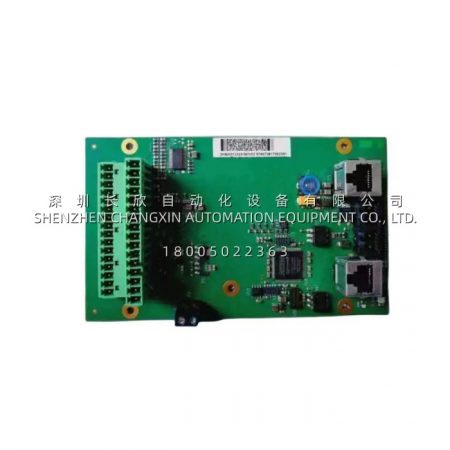
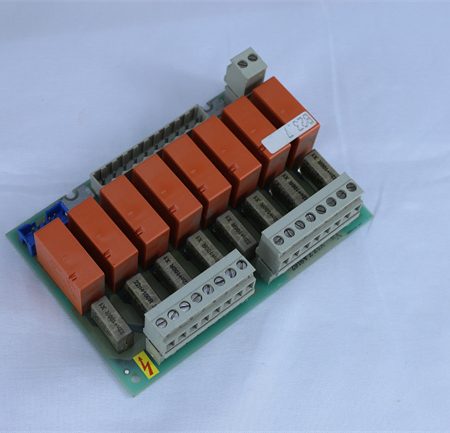
| Product Model | 3HEA800906-001 |
| Manufacturer | ABB Robotics (ABB Welding Systems) |
| Product Type | Node Splitter / Bus T-Joint (DeviceNet / CANopen) |
| Bus Physical Layer | CAN 2.0A/B, High-Speed 125 / 250 / 500 kbps |
| Topology Function | 1× Line In → 2× Line Out (T-branch / Y-split) |
| Termination | 120 Ω optional (enabled/bypassed per version; some versions require external terminator) |
| Connector Style | RJ45, or M12 4/5-pin A-coded, or 5-pin Mini-Circ DIN (version-dependent—verify on-site) |
| Mounting | Cable tie-down (Y-cable), or DIN-rail clip (boxed version) |
| Dimensions (Box/Body) | 127 mm (D) × 53 mm (H) × 27 mm (W) |
| Weight | 0.1 kg (net & gross) |
| Operating Temp | -20 °C to +70 °C (box); -10 °C to +60 °C (cable jacket typical) |
| Protection Class | IP20 (boxed); PVC-overmold (cable) |
| Customs Tariff (typical) | 8517.62.00 |
| Lifecycle | Discontinued / Legacy – New Surplus |
| Country of Origin (typical) | Switzerland (CH) / Sweden (SE) / Estonia (EE) per batch |
| Ordering Note | Non-returnable once harness pins confirmed – verify plug type before purchase |
Main Features and Advantages
The 3HEA800906-001 exists because ABB’s weld-pack DeviceNet pinout is not generic DeviceNet. A standard off-the-shelf T-connector from a catalog will physically click in but the CAN-H/CAN-L/shield/power pin allocation inside an ABB arc-package (especially on older IRB 1400/1520 S4C+ cells migrated to IRC5) can differ from ODVA default, and the weld-power-source expects the ABB-defined assignment. Using the genuine 3HEA800906-001 preserves that pinning, which is why ABB service bulletins still list it by material number rather than “any 5-pin Y-cable.”A second advantage is topology breathing room without scanner expansion. An IRC5 with the Arc Option typically consumes one DeviceNet scanner channel for the weld bus (welder + seam-tracking + touch-sensing). When a cell adds a second welder (common in twin-gun hood/wheelhouse arcs) or a single-axis positioner that also talks DeviceNet, the scanner is out of slots. The 3HEA800906-001 lets both devices share the same scanner node, respecting the 64-node DeviceNet limit but avoiding a €2 k+ scanner add-on. For a €100-class splitter, that ROI is obvious.Third, the 3HEA800906-001 keeps the 120 Ω stub/termination story clean. DeviceNet on a weld cell runs next to 300–500 A secondary cables, so stub length and termination matter—loose terminators here show up as intermittent “weld-bus off-line” faults during high-current arcs. Versions of the 3HEA800906-001 that carry onboard 120 Ω (dip-selectable or hardwired) let the far-end of the T-leg close the bus properly without stuffing a terminator into the welder’s own Comms port, which many weld-power OEMs discourage.Finally, sparing reality: the 3HEA800906-001 is discontinued. Plants that still run 2005–2015 vintage IRC5 arc cells (automotive Tier-1 job-shop lines, exhaust/manifold welding, white-goods spot cells) usually find the original splitter was never spares-planned—”it’s just a cable,” until it isn’t. Having a tested 3HEA800906-001 on the shelf avoids a weekend emergency where the only fix is cutting and splicing CAN pairs inside heat-shrink, which ABB field service will flag on the next PM.

Reviews
There are no reviews yet.