
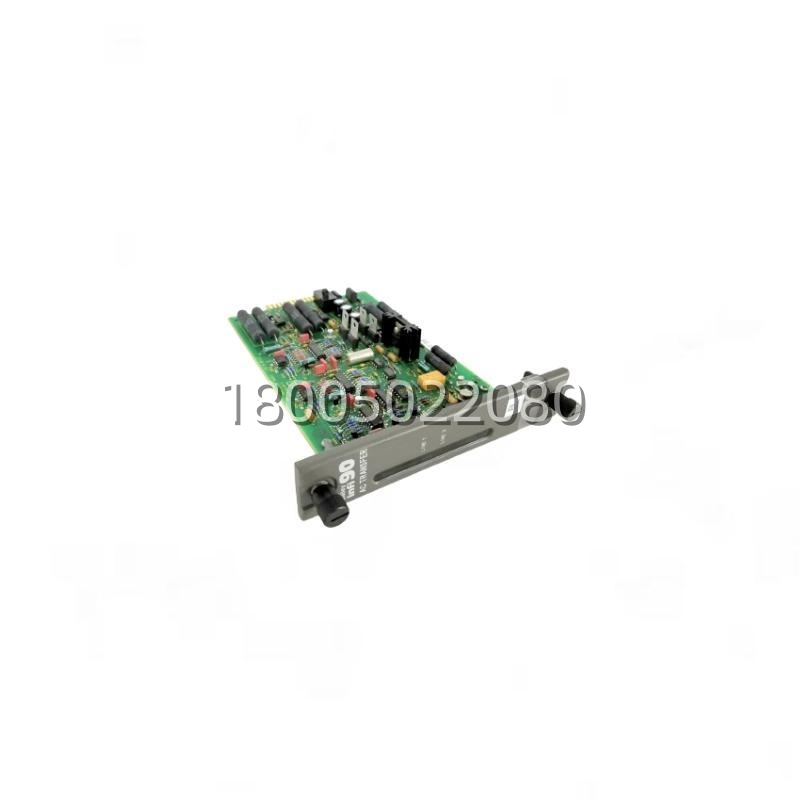
Application Scenarios:Picture a combined-cycle power plant where the Bailey INFI 90 DCS rack is fed from a dual-string UPS backed by diesel generators. During a planned UPS battery maintenance window, one string drops offline and the connected static bypass switch introduces a brief voltage sag. Without redundant source monitoring, this sag could reset the I/O power supplies and force a partial process trip. Installed upstream of the DCS rack’s 24 V DC power supplies, the 6637827G1 constantly compares the two AC feeds (UPS output vs. building standby mains). The moment the primary UPS sags below the preset threshold, the module’s break-before-make logic transfers the load to the alternate source in under 5 ms—well within the hold-up time of the downstream DC power supplies. The control room never sees a glitch; boiler and turbine protection loops remain fully energized. One site E&I supervisor later noted that the 6637827G1 “closed the last gap in our power redundancy chain—we now survive single-source failures without operator intervention or process upset.”h2
Parameter:
| Main Parameters | Value/Description |
|---|---|
| Product Model | 6637827G1 |
| Manufacturer | ABB (Bailey Controls / INFI 90 Series) |
| Product Category | AC Transfer Module / Automatic Power Changeover Switch |
| Input Configuration | Dual independent AC inputs (Primary + Secondary / Alternate) |
| Input Voltage Range | 85–264 V AC (auto-sensing; typical 100–132 V AC or 200–240 V AC selectable via internal jumper) |
| Rated Load Current | 0.5 A – 10 A depending on variant / application (typical DCS cabinet feeder ≤ 6 A) |
| Transfer Type | Break-Before-Make (BBM), automatic on loss/fall-below-threshold of preferred source |
| Transfer Time | < 5 ms typical (solid-state sensing + electromechanical relay or SSR hybrid) |
| Voltage Monitoring | Adjustable / fixed threshold detection with hysteresis; PFI (Preferred Source Failure Indicator) output |
| Status Indication | LED: Primary Active / Alternate Active / Fault / Module OK |
| Alarm Output | Dry contact or TTL-level PFI signal for DCS alarm input |
| Wiring Terminals | Screw-type barrier terminals for Input A, Input B, Load Out, Alarm Contact |
| Operating Temperature | 0 °C to +60 °C |
| Mounting Method | DIN rail (35 mm TS35) or panel mount in control cabinet |
| Certifications | CE, cULus listed, complies with IEC 60947-6-1 / IEC 61010 |
h2 Technical Principles and Innovative Values:
- Innovation Point 1 — True Dual-Source Voltage Threshold Monitoring with Debounce Logic. The 6637827G1 doesn’t merely pass power; it continuously samples both AC inputs via an isolated sensing circuit. If the preferred source drops below a programmable or factory-set threshold (e.g., < 85 V on a 120 V system), a digitally debounced decision algorithm prevents nuisance switching from brief sags. Once confirmed failed, it commands a break-before-make transfer to the alternate source—and automatically reverts when the preferred source recovers and stabilizes, configurable as auto-retransfer or manual-reset.
- Innovation Point 2 — Integrated PFI (Preferred Failure Indicator) for Closed-Loop Alarm Management. Beyond LEDs, the module provides a dry-contact or logic-level PFI output that can be wired to a Bailey INFI 90 digital input card or any DCS DI point. This brings the transfer event into the plant’s alarm summary, timestamps it in the SOE (Sequence of Events) recorder, and triggers operator notification—turning a hidden power switch into a fully supervised, diagnosable asset rather than a blind cabinet component.
- Innovation Point 3 — Seamless DCS-Cabinet Form Factor with Zero Configuration Startup Option. Designed specifically for INFI 90 / Net 90 cabinet integration, the 6637827G1 mounts on standard DIN rail adjacent to the IEPAS02 / IEPAF02 power supply modules. For many installations, factory-default thresholds require no adjustment—wire the two AC sources and the load, and the module is operational. This eliminates the need for external automatic transfer switches (ATS) with separate enclosures and control wiring in control-room-grade applications where the load is the DCS itself.

Reviews
There are no reviews yet.