
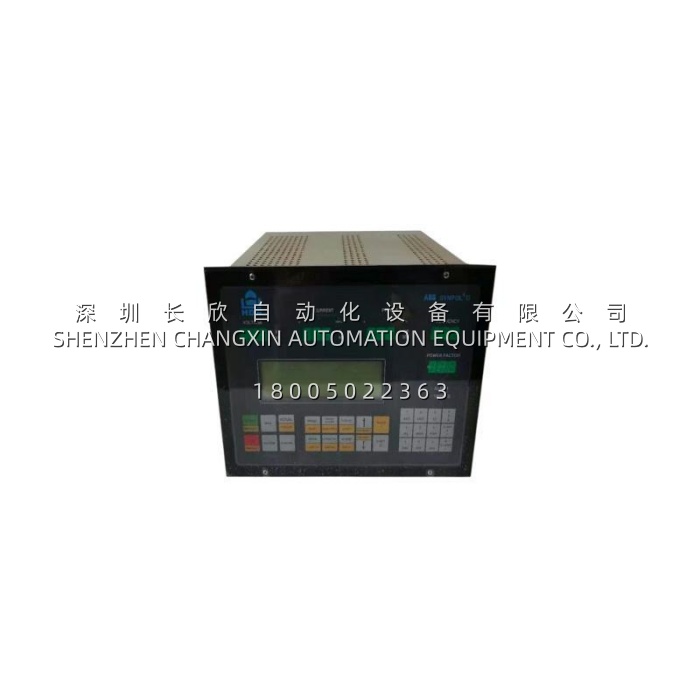
Application ScenariosIn a 1990s-vintage petrochemical blending unit still running on ABB MOD 300, maintenance technicians used to waste 20–30 minutes per incident walking to the CCR just to check why a loop had tripped into manual. After installing the ABB CMA120 on the local motor-control-centre door, operators could read PV/SP, toggle Manual/Auto/Cascade, and ACK alarms right at the cabinet—cutting fault-response time by more than half. One senior instrument engineer put it simply: “the CMA120 doesn’t control the loop—the controller does—but without it, you’re blind at the cabinet.” For plants sitting on legacy Bailey / MOD 300 / Advant OCS infrastructure, the ABB 3DDE300400 CMA120 is that rare “small part with big uptime value,” especially now that MOD 300 spares are entering last-time-buy status and counterfeit / refurbished units are circulating widely.h2
Parameters
| Main Parameters | Value / Description |
|---|---|
| Product Model | CMA120 (Material No. 3DDE300400) |
| Manufacturer | ABB (inherits Bailey MOD 300 / Advant OCS HMI line) |
| Product Category | Basic Controller Panel / Local HMI (door-mount) |
| Compatible System | ABB MOD 300 Basic Controller, Advant OCS (serial link), standalone PLC via RS-485 |
| Display | Backlit LCD, character/dot-matrix (shows PV, SP, MODE, ALARM per firmware page) |
| Keypad | Sealed film keys – ▲▼ numeric, ENTER, ESC, MODE (Man/Auto/Cas), ACK |
| Digital Input | 8 × 24 V DC sink, opto-isolated |
| Analog Input | 4 × 4–20 mA or 0–10 V DC (software-selectable, 12-bit resolution) |
| Relay Output | 2 × NO/NC, 5 A @ 250 V AC / 5 A @ 30 V DC (resistive) |
| Communication | RS-485 (Modbus RTU standard, 9600–19200 bps); some variants support Profibus DP |
| Supply Voltage | 24 V DC (18–30 V DC range), typ. 5–8 W |
| Front Panel Rating | IP65 / NEMA 4X (sealed for door-exposed duty) |
| Rear / Terminal Side | IP20 (cabinet interior) |
| Mounting | Door cut-out panel embed (sealing gasket + clamp nuts), DIN 43700 style approx. 144×72 mm |
| Operating Temp. | 0 to +55 °C (front exposed); storage –20 to +70 °C |
| Indicators | RUN / ALM / COM LEDs (variant-dependent) |
h2 Technical Principles and Innovative ValuesInnovation Point 1 – “Controller-Independent” Local Presence. The ABB CMA120 is deliberately designed not to participate in the closed control loop. Even if the panel is unplugged, the downstream MOD 300 / Advant controller continues auto-running. This decoupling means the CMA120 is a diagnostic and convenience layer, not a single point of failure—a philosophy that legacy Bailey panels got right decades before modern touch-HMIs arrived.Innovation Point 2 – IP65 Front + Film Keypad for Hose-Down Areas. While the terminal side stays IP20 inside the cabinet, the front bezel of the ABB CMA120 is gasket-sealed to IP65 / NEMA 4X. In chemical dosing skids or outdoor MCC columns where spray-down happens, the CMA120 survives where a naked LCD would fog in a season.Innovation Point 3 – Native MOD 300 Serial + Open Modbus RTU Dual Identity. Out of the box the ABB 3DDE300400 CMA120 speaks the proprietary MOD 300 serial protocol over shielded twinax to the controller COM port. But the same RS-485 port can be flipped to Modbus RTU, letting the panel act as a standalone local I/O + HMI node talking to a third-party PLC or a newer ABB AC 800M / 800xA rack. That dual-mode is what makes the CMA120 viable in mixed-generation retrofits.Innovation Point 4 – Minimal-Footprint Local I/O. Instead of hanging a separate remote-I/O block just to get “start / stop / fault” at one skid, the ABB CMA120 packs 8 DI + 4 AI + 2 relay DO onto the same door cut-out. For pump, fan, and small-machine skids this collapses a separate terminal-box+HMI into one device, saving panel space and cable passes.h2 Application Cases and Industry ValueA regional power-plant CEMS (continuous emissions monitoring) skid, originally commissioned in 1998 with a MOD 300 Basic Controller rack, had its original door panels cracked by UV and cleaning chemicals. The plant engineer sourced ABB 3DDE300400 CMA120 replacements and re-pinned the original MOD 300 serial cable (DB9-to-round-DIN style). Post-swap, the operators regained clear PV/SP readout for the O₂ and NOx loops and could ACK high-emission alarms at the skid instead of calling the CCR. More importantly, because the CMA120 is a legacy slow-mover (Class C “operational availability item”), the plant established a centralized buffer pool—3–5 spare panels per 15–20 MOD 300 cabinets—to ride out the last-time-buy window.In another case, a food-beverage syrup-blending area replaced several scattered pushbutton-stations with ABB CMA120 panels talking Modbus RTU back to a CompactLogix. The CMA120‘s IP65 front and 4–20 mA AI inputs let them mount directly on stainless wash-down enclosures; the built-in relay outputs drove local solenoid interlocks. The integrator noted that using the CMA120 instead of a full touch-panel saved roughly 40 % on BOM cost per skid while keeping the “look” consistent with older MOD 300 areas elsewhere in the plant.


Reviews
There are no reviews yet.