
Technical Specifications
| Parameter Name | Parameter Value |
|---|---|
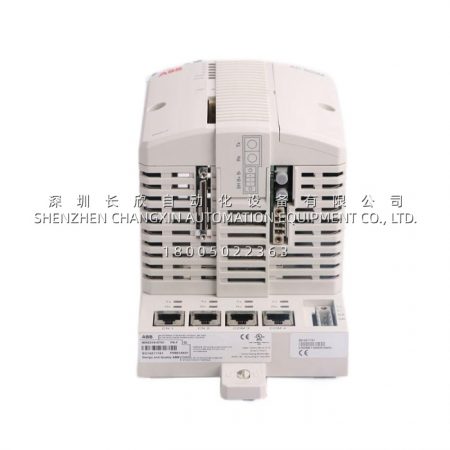
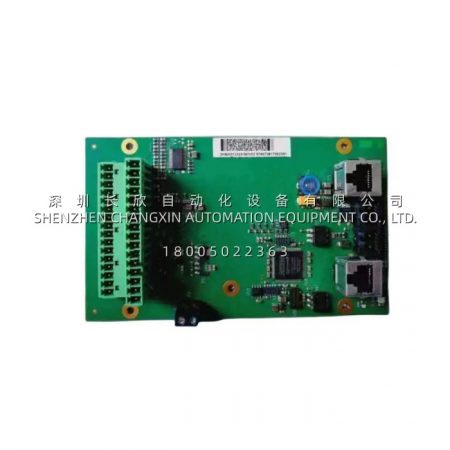
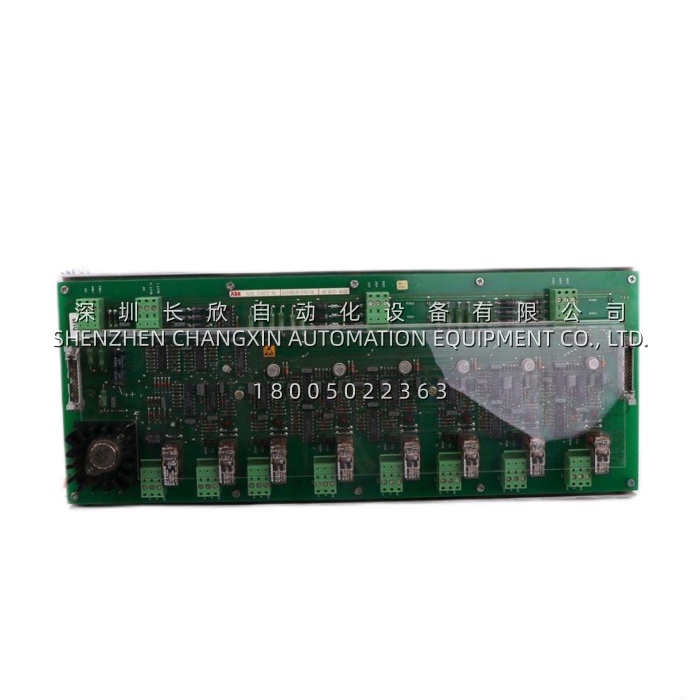
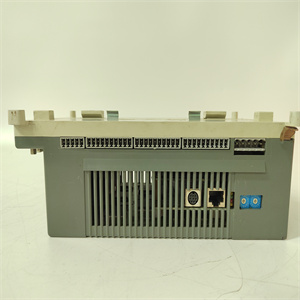
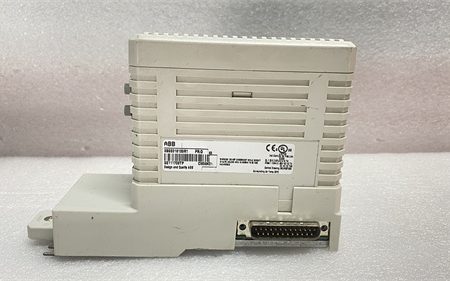
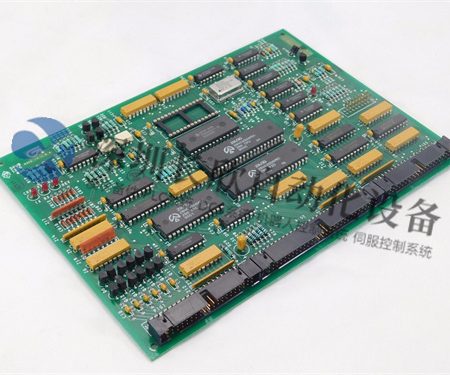
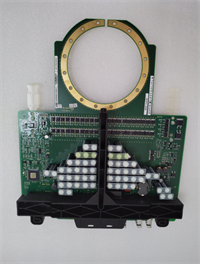
| Product Model | DSQC563 |
| ABB Material / Order No. | 3HAC16035-1 |
| Manufacturer | ABB (Sweden) |
| Product Type | Brake Release Board (Manual / Emergency) |
| Compatible Controllers | ABB IRC5 M2004 / M2000, S4C+ |
| Applicable Robots | IRB 2400 / 2600 / 4400 / 4600 / 6600 / 6640 / 6650S / 6660 |
| Supply Voltage | 24 V DC (controller internal or external emergency supply) |
| Brake Output – per axis | ≤2 A (24 V DC relay, opto-isolated) |
| Brake Output – total | ≤12 A (6-axis robot) |
| Control Interface | Internal cabinet bus to axis computer; front-panel pushbuttons (6× axis + 1× global) |
| Safety Interlock | Brake-release action cuts servo enable per axis |
| Status Indication | LED on each button (on = brake released); flash = fault / supply anomaly |
| Operating Temp. | –25 °C to +60 °C |
| Storage Temp. | –40 °C to +85 °C |
| Vibration | 5–150 Hz, 5 g (IEC 60068-2-6) |
| EMC / Cert. | CE, RoHS, UL; IEC 61000-6-2 industrial EMC |
| Dimensions (approx.) | 148 mm × 76 mm × 22 mm |
| Weight | ≈0.14 kg |
| Protection | IP20 (cabinet-internal / door-mount) |
| Alternative / Interchange | 3HAC046642-001 (BRK001), 3HAC059158-001 (check cabinet rev.) |
Main Features and Advantages
Per-axis independent manual release. The ABB 3HAC16035-1 (DSQC563) gives the technician six clearly labeled pushbuttons, one per robot axis, plus a master release. Pressing a button latches 24 V DC onto that axis’s brake coil; releasing the button drops the coil and the spring re-locks. This granular control prevents the classic “all-six-axes flop at once” hazard—you can free the elbow (axis 2) for re-homing without accidentally dropping the wrist or the base.Emergency external 24 V supply port. When the main controller is dead—UPS failed, main breaker tripped, drive fault that won’t clear—the ABB DSQC563 still accepts a flying-lead 24 V battery or bench supply on its emergency terminals. That lets a maintenance crew manually unbind a crashed robot, rotate it off the collision, and re-home, even with the cabinet completely de-energised on the AC side.Hard-wired servo-enable interlock. Every brake-release action on the 3HAC16035-1 is AND-gated with a servo-enable cut to the corresponding axis computer. The robot cannot be driven from the teach pendant or the main controller while a manual brake is held open—this is the single feature that keeps a tech’s hand safe when they’re underneath a 150 kg payload arm. The interlock is hardware, not firmware, so it holds even if the axis computer is confused.Opto-isolated relay outputs. Each brake channel on the ABB 3HAC16035-1 uses a relay stage decoupled from the logic side by optocouplers. A shorted brake coil or a 24 V transient on the field side will not back-feed into the controller’s internal bus—the worst case is a blown relay contact, not a dead axis computer.Diagnostic feedback. The board continuously monitors per-channel current and reports brake-state, over-current, and coil-short back to the controller. On the DSQC563, a button LED that starts flashing instead of steady-on tells the tech “your 24 V rail is sagging” or “axis 4 brake coil impedance looks wrong” before they even pick up a multimeter.Spare-pool familiarity. Because the ABB 3HAC16035-1 is mechanically and electrically backward-compatible across IRC5 M2000 → M2004 → later S4C+ retrofits, most ABB robot shops already stock it. It interchanges with 3HAC046642-001 (BRK001) directly, and in some cabinet revisions with 3HAC059158-001—meaning a line-down emergency rarely waits on lead time.
Application Field
The ABB 3HAC16035-1 (DSQC563) lives exclusively in ABB robot controller cabinets, but the scenarios that call it into action are varied. In automotive body shops, IRB 6600 / 6640 spot-welding cells run 20+ hour shifts; when a gun tip jams and the robot drives into the fixture, the servo faults and locks all brakes. Maintenance cannot re-home with the drive active (risk of secondary crash), so they cut AC, land a 24 V service battery on the ABB DSQC563 terminals, and manually release axis 2 + axis 3 to back the wrist off the weld gun, one axis at a time. Without the brake-release board this would require unbolting the motor or fighting the spring brake with a hex key—both slow and risky.In metal fabrication and machining cells, IRB 2600 / 4600 material-handling robots frequently collide with pallet corners or gripper fingers during program touch-up. The 3HAC16035-1 is the interface the cell operator uses to “jog the arm free” while the main controller remains faulted. In paint shops (IRB 5400 / 5500 family, where DSQC563 also sees duty on compatible cabinets) the board’s IP20 envelope and opto-isolated outputs matter because solvent-laden air and VFD switching noise are constant companions.Service companies doing IRC5 cabinet refurbishment treat the ABB DSQC563 as a wear item—button caps yellow, relay contacts pit after a few thousand cycles, and the LED lenses haze under cabinet UV. Swapping the 3HAC16035-1 is a 10-minute job: four screws, the 24 V terminal block, and the ribbon to the axis computer. For plants running mixed IRB 2400 / 4400 legacy alongside newer IRB 6660, keeping a half-dozen ABB 3HAC16035-1 on the local spare rack covers the entire fleet. In short, the board does nothing during normal production runs—and everything the day a robot buries itself in a die.

Reviews
There are no reviews yet.