
Technical Specifications
| Parameter Name | Parameter Value |
|---|---|
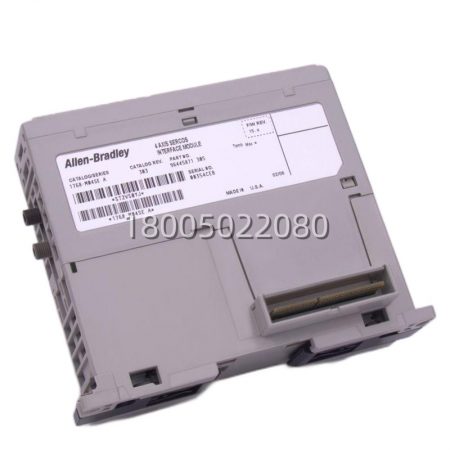
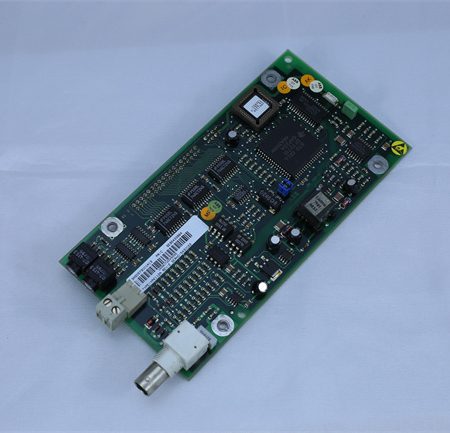
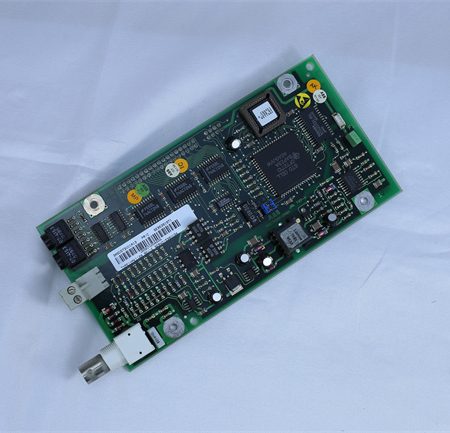
| Product Model | 1768-M04SE (commonly miswritten as 1768-MO4SE) |
| Manufacturer | Allen-Bradley (Rockwell Automation) |
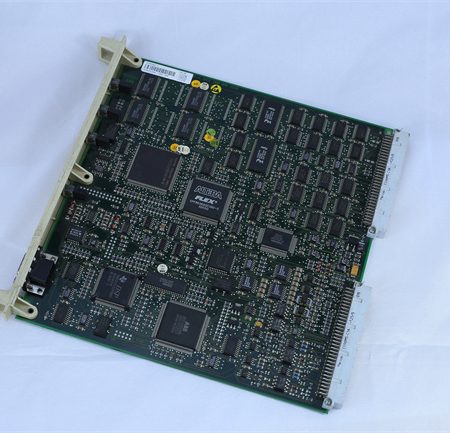
| Product Type | CompactLogix SERCOS-II Motion Interface Module |
| Supported Axes | Up to 4 physical servo axes (plus virtual axes hosted on L4x CPU) |
| SERCOS Interface | SERCOS-II, 2 × ST-type fiber connectors (ring in/out) |
| Configurable Data Rates | 2, 4, 8, 16 Mbps |
| Update / Cycle Time | 0.5 ms (≤2 drives @ 8 Mbps); 1 ms / 4 ms (4 drives @ 4 Mbps); 1 ms (≤2 drives @ 4 Mbps) |
| Compatible Drives | Kinetix 2000, Kinetix 6000, Kinetix 7000, Ultra 3000 / Ultra 5000 (SERCOS variants) |
| Backplane Current Draw | 969 mA @ 5.2 VDC / 0 mA @ 24 VDC |
| Logix Connections Consumed | 3 |
| Programming Software | RSLogix 5000 / Studio 5000 Logix Designer (Logix motion instruction set) |
| Operating Temperature | 0 °C to +60 °C |
| Mounting | 1768 rack, left-side expansion attached to 1768-L43 / 1768-L45 processor |
Main Features and Advantages
True integrated motion on a compact backplane: The biggest differentiator of the 1768-M04SE is that it collapses what used to be a two-box architecture — a CompactLogix for logic plus a standalone SERCOS motion controller — into a single 1768 rack. By sharing the L4x CPU, tags, and task scheduler, the 1768-M04SE eliminates the glue logic, cross-controller handshakes, and duplicate programming environments that traditionally slowed commissioning. One RSLogix 5000 project, one download, one fault table.SERCOS-II fiber ring with deterministic sync: The dual ST ports on the 1768-M04SE build a daisy-chained fiber loop — controller → drive 1 → drive 2 → drive 3 → drive 4 → back to module. Fiber gives total immunity to VFD switching noise, weld ground loops, and long-cable capacitive coupling that plague RJ-45 or analog ±10V motion schemes. The SERCOS-II protocol embeds a broadcast synchronization word, so all drives on the ring latch their position commands on the same clock edge — synchronization jitter in the microsecond band, which is why the 1768-M04SE can hold electronic gear ratios and cam profiles tight through high-speed registration marks.Flexible cycle / rate tuning per axis count: Not every machine needs 0.5 ms loop time, and pushing 4 axes at 8 Mbps may exceed what the drive array can digest. The 1768-M04SE lets the integrator trade off: 2 drives at 8 Mbps for 0.5 ms update on high-dynamic indexing spindles, or 4 drives at 4 Mbps for 1 ms / 4 ms on lower-bandwidth conveyor / feeder axes. This tunability keeps CPU loading predictable on the L4x host — important because the L43 also carries up to 6 virtual axes and 2 feedback-only axes, and the L45 scales to 8 total axes with 4 feedback and 6 virtual .Broad Kinetix & Ultra drive ecosystem: The 1768-M04SE isn’t locked to one drive generation. It talks SERCOS-II to Kinetix 2000 (older bookshelf units), Kinetix 6000 (the volume workhorse with 2092 rack power), Kinetix 7000 (high-power large-frame), and the Ultra3000 / Ultra5000 intelligent positioning drives. For plants that mix vintages — a Kinetix 6000 Y/Z stage plus an Ultra3000 indexing spindle — the 1768-M04SE rings them together without protocol gateways.Compact footprint for OEM cabinets: At one 1768 slot width, the 1768-M04SE tucks left of the L4x processor with no extra DIN space, no separate 24V supply branch (it lives off the 1768 5.2V backplane fed by the 1768-PA2 / 1768-PB3 / 1768-PB4 power supply), and no additional cabinet cooling beyond what the 1768 rack already requires. For 1–4 axis OEM machines — rotary indexers, carton erectors, labelers, small gantry loaders — that footprint economy matters.Sustainment reality: Rockwell’s current integrated-motion story has moved to EtherNet/IP CIP Sync / CIP Motion on 5370/5380 CompactLogix and 5570/5580 ControlLogix with Kinetix 5700, which use standard RJ-45 and eliminate the SERCOS fiber entirely. But the installed base of 1768-M04SE + Kinetix 6000 systems is enormous in pharma, converting, and automotive sub-assembly, and Rockwell still lists the module in its sustainment chain. For a plant running L45 + Kinetix 6000 sercos rings, swapping to CIP Motion means new drives, new cables, new tags — the 1768-M04SE remains the lowest-risk keep-it-running choice.
Application Field
The 1768-M04SE fits squarely in applications where 1–4 servo axes need tight synchronization under a CompactLogix L4x, and where the drives on the floor are SERCOS-native Kinetix or Ultra units. In converting and packaging — rotary die cutters, register-mark labelers, pouch fill-seal machines — the 1768-M04SE runs the product-axis servo (from encoder follower), the cross-cut knife servo (electronic cam off the registration mark), and the film-feed servo, all phase-locked via SERCOS-II at 1 ms loop, while the L4x ladder handles the clamshell, fault sequencing, and HMI exchange on the same scan.In laboratory automation and small gantry loaders (2-axis X/Y + Z + gripper rotator), the 1768-M04SE provides the 4-axis ceiling with linear / circular interpolation through the Logix motion planner, letting a single L43 handle both the robot-style PTP moves and the peripheral I/O (vacuum solenoids, door interlocks, tray-present sensors). In web-handling auxiliaries — unwind/rewind tension stands, slitter positioning screws — the module’s electronic gearing mode locks a follower axis ratio to a master encoder without a mechanical line shaft, a classic 1768-M04SE use case on narrow-web presses.Retrofit projects are another strong fit: replacing an obsolete standalone SERCOS motion card (or parallel ±10V analog drive interface) on an L4x-era machine often lands on the 1768-M04SE because the existing Kinetix 6000 drives already have SERCOS daughterboards populated — only the controller side changes, not the drive ring or the motor cabling. Even as new designs migrate to Kinetix 5700 + CIP Motion, the 1768-M04SE continues to be specified for spares holdings, refurb swaps, and “don’t touch the drives” modernization paths where the SERCOS fiber ring is still healthy and the L4x code base is validated.

Reviews
There are no reviews yet.