
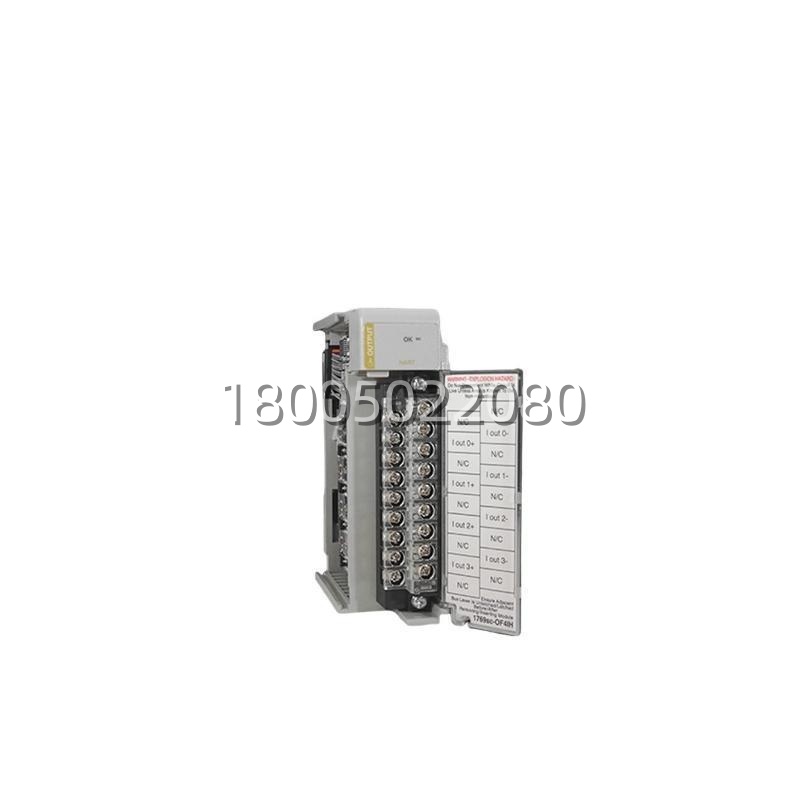
Technical Specifications
| Parameter Name | Parameter Value |
|---|---|
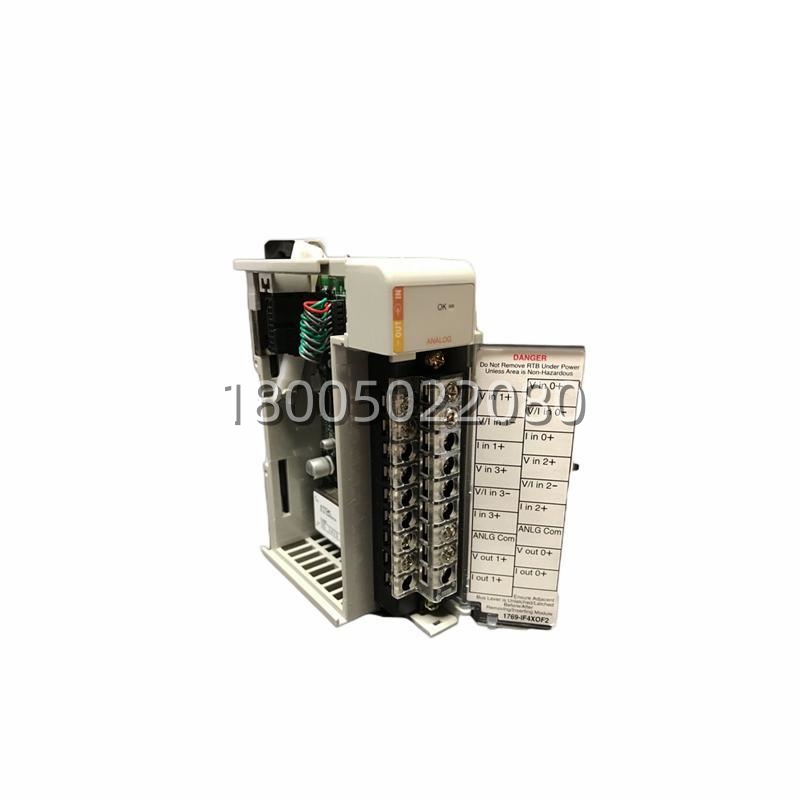
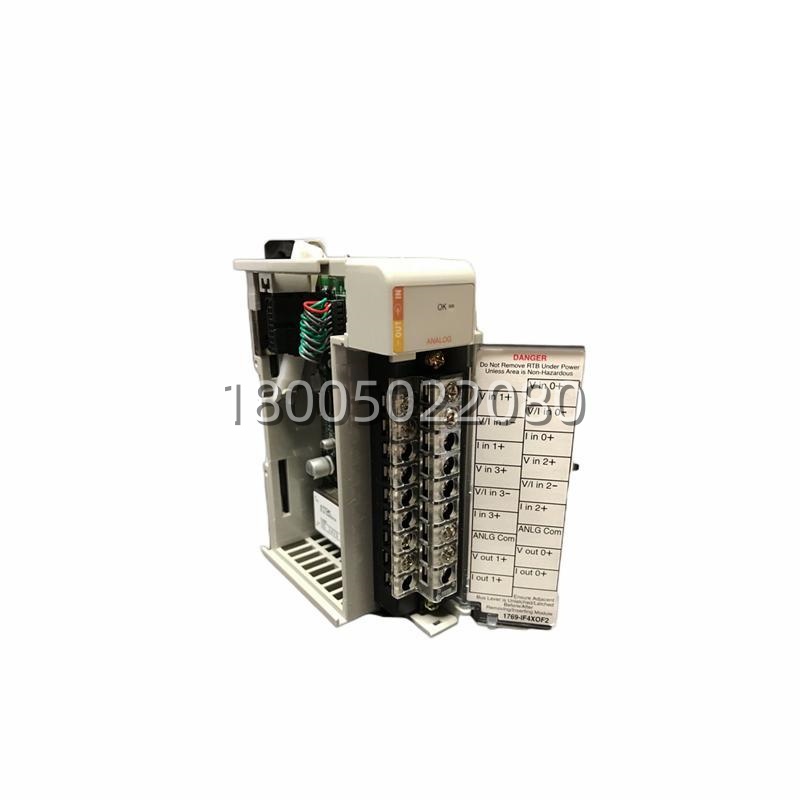
| Product Model | 1769-IF4XOF2 (also 1769-IF4XOF2/A) |
| Manufacturer | Allen-Bradley (Rockwell Automation) |
| Product Type | Compact I/O Analog Combination Module (4 AI + 2 AO) |
| Series | 1769 Compact I/O |
| Input Channels | 4 × analog, single-ended or differential wiring |
| Input Signal Ranges | ±10V DC, 0–20 mA (extended 0–10.5V / 0–21 mA) |
| Output Channels | 2 × analog, single-ended |
| Output Signal Ranges | 0–10V DC, 0–20 mA |
| Resolution | 8-bit + sign (inputs, always positive); 8-bit (outputs) |
| Input Impedance | 150 kΩ (voltage), 150 Ω (current) |
| Output Load Limits | Voltage: ≥1 kΩ @ 10V DC; Current: ≤300 Ω |
| Accuracy (25°C) | Input: ±0.7% (V), ±0.6% (mA); Output: ±0.5% FS |
| Response Time | Input: ~5 ms/ch; Output: 0.3 ms (resistive) / 3.0 ms (capacitive) |
| Backplane Current Draw | 120 mA @ 5V DC, 160 mA @ 24V DC |
| Isolation | 500V AC / 710V DC (1 min qualification), group-to-bus; 30V AC/DC working (IEC Class 2 reinforced) |
| Operating Temperature | 0°C to +60°C |
| Dimensions (H × W × D) | 118 × 35 × 87 mm |
| Certifications | c-UL, CE, UKCA |
| Documentation | 1769-TD006 (tech data), 1769-UM021 (user manual), 1769-SG001 (selection guide) |
Main Features and Advantages
Combo-density economy in a single 1769 slot: The headline value of the 1769-IF4XOF2 is that it replaces what would otherwise consume two adjacent 1769 slots — a 1769-IF4 (4 AI) plus a 1769-OF2 (2 AO) — with one module, freeing the neighbor slot for digital I/O, a communications add-on, or simply shortening the rack. On a CompactLogix L3x local bank where Rockwell’s “power supply distance rating” rule limits any module to no more than 8 slots from the 1769-PA2 / 1769-PB4 supply, squeezing I/O tighter directly extends how far the last module can sit from the power supply. For OEM machines with modest analog footprints — a temperature + pressure input pair and a couple of proportional valve outputs — the 1769-IF4XOF2 hits the sweet spot.Wiring flexibility — differential or single-ended per channel: Each of the four inputs on the 1769-IF4XOF2 can be landed as single-ended (return to common) or differential (dedicated return per channel), selected by jumper/power-supply wiring and configured in RSLogix 5000 / Studio 5000. Differential mode lifts common-mode noise rejection to 60 dB at 60 Hz with a 10V DC common-mode voltage rating per channel — meaningful in electrically noisy panels where VFDs, contactors, and weld returns share the same cabinet. For a non-isolated, economy-tier module, that differential option is a disproportionate noise-immunity win.Extended-range headroom: The “X” suffix isn’t cosmetic — the 1769-IF4XOF2 accepts up to 10.5V and 21 mA before clipping, versus a strict 10V/20mA on narrower siblings. In field loops where a 4–20 mA transmitter overscales to 20.8 mA under fault or saturation, the extra 5% ceiling prevents a hard over-range trip and lets the logic catch the excess via the module’s over/under-range diagnostics and process alarms before the signal rails.8-bit resolution positioned honestly: Rockwell doesn’t pretend the 1769-IF4XOF2 is a 16-bit high-precision part — the 8-bit (256-step) ladder equates to roughly 0.4% per count on a 10V span, and the ±0.7% / ±0.6% accuracy brackets it firmly into “basic process” territory. That honesty is the advantage: you’re not paying for 16-bit linearity you don’t need. For a water-treatment pH loop, HVAC damper actuator, or tank-level pump-staging application where 1% full-scale is acceptable, the 1769-IF4XOF2 delivers the spec without the premium of a 1769-IF8 (16-bit, 8-channel) or 1769-OF4VI (voltage/current isolated output).Diagnostic coverage without complexity: The 1769-IF4XOF2 surfaces over-range / under-range flags per channel and supports process alarms configurable in the Logix tag editor, piped straight into the controller’s fault routines. There’s no isolated-galvanic-per-channel architecture here (group-to-bus only), so diagnostics are software-side — but they’re enough to catch broken loop wires, transmitter loss, and rail-saturation events that matter on a basic process skid.Sustainment fit: The 1769 platform remains Rockwell’s volume Compact I/O for L3x CompactLogix (1769-L33ER, L36ERM, L37ERM, etc.) and legacy MicroLogix 1500 cabinets. The 1769-IF4XOF2 is listed “not repairable” by Rockwell — meaning failed units swap, not shop — so spare holdings and refurb stock are the plant’s continuity path. For new designs needing better than 8-bit, Rockwell steers toward 1769-IF8 (16-bit, 8 AI) or the 5069 Compact I/O on 5380/5480, but the 1769-IF4XOF2 stays the right call for sustaining existing 1769 racks where the analog budget is thin and the code is validated.
Application Field
The 1769-IF4XOF2 is deliberately targeted at applications where analog channel count is low, precision demands are modest, and chassis space or BOM cost drives the selection. In water and wastewater satellite lift stations, the module typically picks up a wet-well ultrasonic level transmitter (4–20 mA) and a pressure transducer on the discharge header, while the two analog outputs drive variable-frequency drive speed references for the duty/standby pumps — a 2-in / 2-out match that exactly fills the 1769-IF4XOF2 slot. HVAC rooftop and AHU controls use the same pattern: supply-air temperature and duct static pressure on the inputs, mixed-air damper positioner and chilled-water valve on the outputs, all looped through the CompactLogix L3x PIDE instruction without needing a separate analog rack.In OEM packaging and converting sub-machines — registered-feed labelers, entry-level form-fill-seal frames, small batch mixers — the 1769-IF4XOF2 often serves as “the analog corner” of an otherwise all-digital 1769 rack: one load-cell conditioner input, one temperature probe, one analog potentiometer for operator speed override (input), and a proportional glue-gun pressure valve plus a dancer-arm tension command (outputs). Because the 8-bit resolution tolerances are well within what these loops require — nobody needs 16-bit fidelity to hold a glue-pressure setpoint within ±2% — the 1769-IF4XOF2 keeps the panel small and the spare-part SKU count low.Retrofit projects migrating an older SLC 500 1746-NI4 / 1746-NO4I analog pair into a CompactLogix L3x chassis frequently land on the 1769-IF4XOF2 because the channel count maps 1:1, the 1769 backplane current budget is comparable, and the RSLogix 500 → Studio 5000 tag conversion for scaled analog integers is trivial. What the 1769-IF4XOF2 is notsuited for: closed-loop servo axis feedback, laboratory-grade temperature profiling, weigh-scale cell bridging, or any application where 12-bit-or-better resolution and channel-to-channel isolation are non-negotiable — those belong on 1769-IF8 / 1769-OF4VI / 1769-SC analog siblings. Within its honest lane, though, the 1769-IF4XOF2 is a workhorse combo that keeps 1769 racks compact and budgets sane.

Reviews
There are no reviews yet.