
Technical Specifications
| Parameter Name | Parameter Value |
|---|---|
| Product Model | 1769-IQ6XOW4 (Series A / B) |
| Manufacturer | Rockwell Automation (Allen-Bradley) |
| Product Type | Compact I/O Digital Combination Module (6 In + 4 Relay Out) |
| Compatible Platform | CompactLogix 1769 racks; MicroLogix 1500 with 1769 expansion |
| Number of Inputs | 6 single-ended, 24 V DC, sink/source (software-selectable) |
| Input Voltage Range | 10–30 V DC |
| Input Current | ~4 mA @ 24 V DC typical |
| Input Response Time | OFF→ON ≤ 2 ms, ON→OFF ≤ 0.5 ms (typical) |
| Number of Outputs | 4 mechanically relayed, NO (normally open) dry contacts |
| Output Voltage Range | 5–125 V DC / 5–265 V AC |
| Output Current Rating | 2 A per point (resistive), 30 V DC / 250 V AC max |
| Output Common Configuration | 4 independent commons (each relay isolated) |
| Backplane Current Draw | 80 mA @ 5 V DC (Series A typical); 0 mA @ 24 V DC |
| Isolation (Input↔Bus / Output↔Bus) | 1200 V AC / 1697 V DC for 1 s, IEC Class 2 reinforced |
| Relay Electrical Life | ~100,000 operations at rated load |
| Dimensions (H × D × W) | 118 × 87 × 35 mm (4.65 × 3.43 × 1.38 in); 138 mm H with tabs |
| Terminal Type | Removable 20-pos screw terminal block (1769-TB2S / TB3S) |
| Mounting | 35 mm DIN rail or panel mount (tongue-and-groove 1769 bus interlock) |
| Agency Certifications | cULus (UL 508), CE, C-Tick, Class I Div 2 Groups A/B/C/D |
Main Features and Advantages
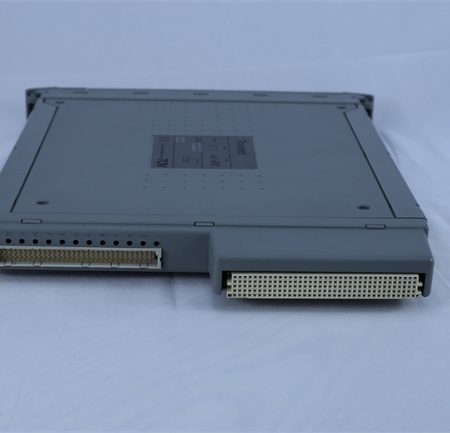
Software-selectable sink or source input wiring. The “X” in 1769-IQ6XOW4 is the differentiator versus the fixed-sink 1769-IQ6: inside RSLogix 5000 / Studio 5000, the input mode is a configuration-bit choice—sinking (NPN, current flows out of the module into the sensor return) or sourcing (PNP, current flows from sensor into the module). For OEMs shipping the same panel drawing to both PNP-dominant and NPN-dominant markets, the 1769-IQ6XOW4 means one BOM line, not two. Commissioning techs just flip the software flag and land wires accordingly—no hardware swap, no re-ordering.Four independent relay commons in one module. Many combo cards force all relay outputs onto a single common stud, which locks you into one switched voltage for the whole card. The 1769-IQ6XOW4 gives each of its four relay outputs its own COM screw, so output 0 can switch a 24 V DC solenoid while output 1 drives a 120 V AC stack light, output 2 a 24 V DC audible horn, and output 3 a 48 V DC interposing relay—all simultaneously, all on one 1769-IQ6XOW4. That flexibility is what makes the card a favorite for “one-off” loads that don’t warrant a dedicated 1769-OW4 four-relay card of their own.Mechanical relay dry contacts for AC/DC mixed loads. Unlike the 1769-OBx transistor siblings that lock you into 24 V DC source/sink territory, the 1769-IQ6XOW4 relay outputs are true dry NO contacts: 5–265 V AC or 5–125 V DC, 2 A resistive. This makes the module the go-to when the CompactLogix rack needs to trigger a 120 V AC indicator tower segment, a 24 V DC solenoid, and a 48 V DC interposing relay all at once. The trade-off is the ~100,000-operation electrical life at rated load—fine for pilot devices and interposing coils, not for high-cycle clocking—but that’s exactly the usage profile the 1769-IQ6XOW4 is aimed at.Single-slot consolidation vs. two separate modules. Buying a 1769-IQ6X (6 in) plus a 1769-OW4 (4 relay out) consumes two 1769 slots and two backplane positions; the 1769-IQ6XOW4 delivers the same I/O count in one slot at roughly comparable cost, freeing the second slot for an analog card, a communications module, or simply leaving headroom in a small Local Expansion rack (CompactLogix L1x/L2x have slot limits). For machines with < 100 total I/O points, that slot economy directly impacts whether a smaller processor (fewer local slots) can close the job.Standard 1769 mechanicals with removable finger-safe terminal. The 1769-IQ6XOW4 uses the same tongue-and-groove interlocking and bus-lever system as every other 1769 card, so it nests flush between a processor and other 1769 I/O without extra brackets. The front 20-position removable terminal block (ordered separately as 1769-TB2S or TB3S) is finger-safe rated per EN 61131-2, and the write-on label strip lets each output COM be marked “24V SOL”, “120V LT”, etc.—small detail, big commissioning win. LEDs follow the 1769 convention: green per input, red per relay-coil energize, green module-OK.
Application Field
The 1769-IQ6XOW4 is most at home in CompactLogix or MicroLogix 1500 panels where the I/O mix is “six DC discretes and four relay-switched loads, nothing else”—a profile that shows up constantly in OEM packaging machines, tabletop test stands, small conveyor zones, and skid-mounted process units. In a vertical-form-fill-seal wrapper, for instance, the six inputs typically land three NPN proxy switches (film-end, jaw-home, guard-door) plus three PNP e-stop string contacts (configured via the software sink/source toggle), while the four relay outputs drive a 24 V DC knife-solenoid interpose, a 120 V AC reject-buzzer, a 24 V DC guard-release latch, and a 48 V DC stack-light segment—four different voltages, one 1769-IQ6XOW4, no separate relay-card slot burned.Material-handling cells use the 1769-IQ6XOW4 for photo-eye gating plus relay-triggered motor contactors on accumulation conveyor zones: inputs read zone-photo, jam-detect, and e-stop; relay outputs kick the zone’s 120 V AC motor starter coil and a 24 V DC jammed-indicator. Because each relay output has its own COM, the same module can switch 120 V AC starter coils and 24 V DC pilot devices without mixing potentials on a shared common—something a solid-state output card cannot do. Water/waste-water skids also favor the 1769-IQ6XOW4: float-switch inputs (24 V DC, often NPN-style mechanical floats) feed the six inputs, while the four relays switch 120 V AC sump-pump contactors, 24 V DC solenoid valves, and local HOA indicator lamps, all in one 1769 slot bolted inside a NEMA 4 enclosure with the CompactLogix L24ER processor.Retrofit contexts are another strong fit. MicroLogix 1500 panels nearing obsolescence but not yet worth a full CompactLogix migration often add a 1769-IQ6XOW4 on the 1769 expansion to pick up a few mixed I/O points without re-racking. And in machine-safety secondary-gating (non-SIL, guard-logic, auxiliary interlocks that sit alongsidethe primary safety device), the 1769-IQ6XOW4 inputs read guard-switches and the relay outputs drive auxiliary “guard-OK” pilot lamps or interposing relays to the main contactor—again, the independent COMs let the relay side run 120 V AC while the inputs stay 24 V DC PNP, all on one card. For any application where “a little of each” I/O type is needed and rack slots are the constraint, the 1769-IQ6XOW4 is the 1769 family’s answer.

Reviews
There are no reviews yet.