
Application Scenarios
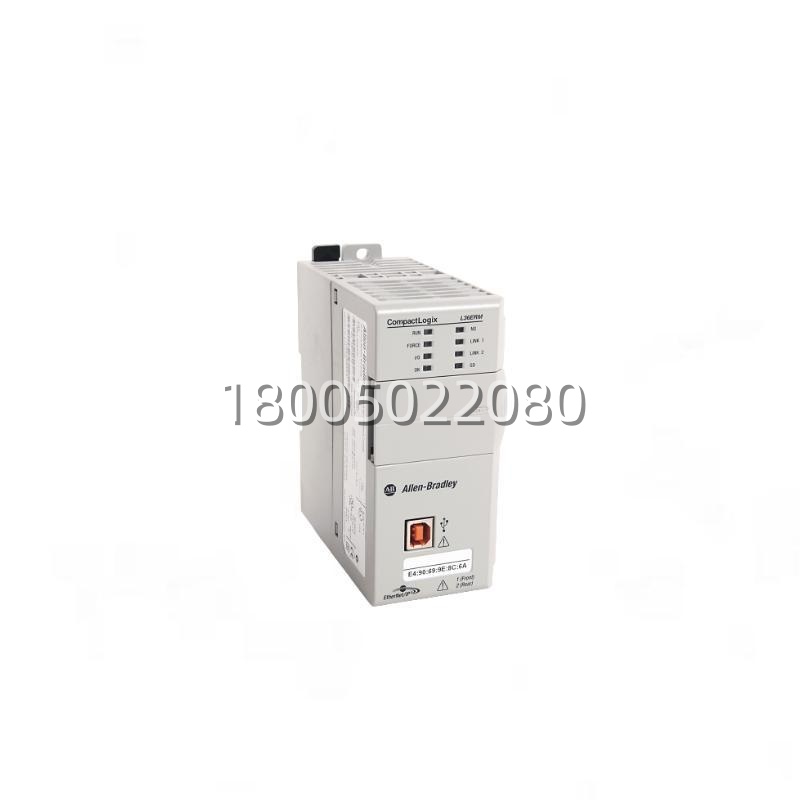
A regional OEM building continuous-motion carton erectors was hitting a wall with the 1769-L33ER on their previous-generation machine: 2 MB memory filled up fast once they added 8 Kinetix 5500 axes, a PanelView Plus 7, three banks of 1769 I/O, and a handful of PowerFlex 755 VFDs on the same EtherNet/IP network. They’d maxed out at 8 axes (the L33ER ceiling) but the new customer spec called for 12 servo axes plus two more VFD positioning loops, and the logic was growing beyond 1.6 MB with AOI-heavy code for tool-change sequencing. The swap to 1769-L36ERM/A solved three things at once: memory jumped to 3 MB (letting them keep all AOIs and add data-logging), axis count unlocked to 16 (CIP Motion over the same dual EtherNet/IP ports, no extra motion card), and EtherNet/IP node capacity went from 32 to 48—enough to hang three remote POINT I/O arms and a second HMI without network reshuffling. The machine shipped with firmware v32, Studio 5000 v32, and a 1784-SD2 2 GB card for non-volatile backup. The integrator’s commissioning lead noted the biggest win wasn’t just the headroom—it was that the 1769-L36ERM/A let them keep the exact same 1769 rack layout (30 modules across 3 banks) and the same 1769-PA4 power supply, so the panel drawings barely changed.
Parameter
| Main Parameters | Value/Description |
|---|---|
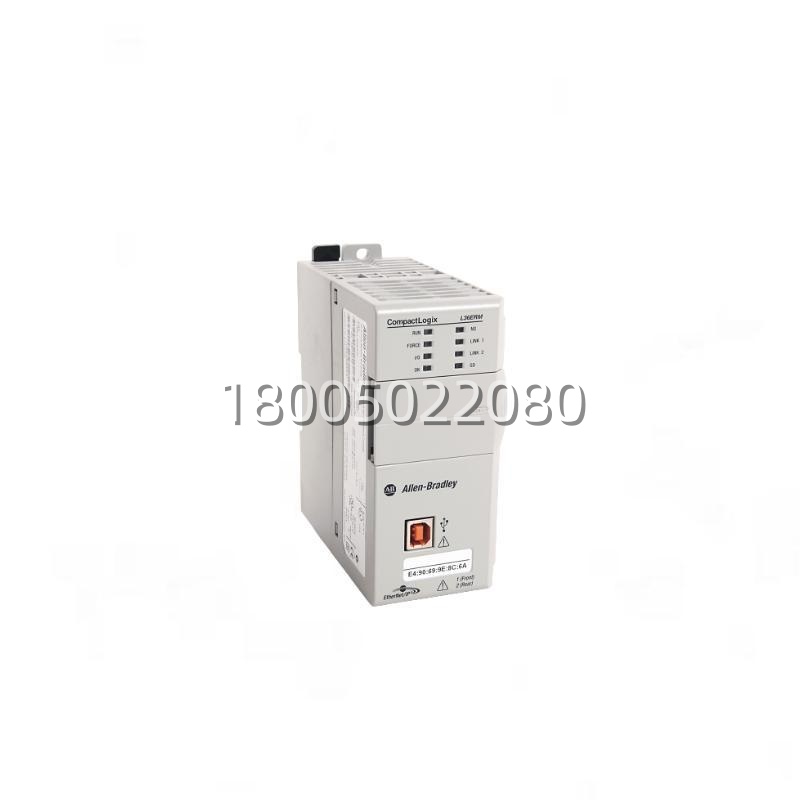
| Product Model | 1769-L36ERM/A |
| Manufacturer | Allen-Bradley / Rockwell Automation |
| Product Category | CompactLogix 5370 L3 PAC (Motion Variant) |
| User Memory | 3 MB (program + data); non-volatile via 1784-SD1/SD2 (1 GB / 2 GB) |
| Integrated Motion | Up to 16 axes CIP Motion over EtherNet/IP, kinematics supported |
| Local I/O Capacity | Up to 30 × 1769 modules (3 expansion banks, 1769-CRR/CR cable) |
| EtherNet/IP Nodes | Up to 48 nodes per controller; 256 EtherNet/IP + 120 TCP connections |
| Embedded Ports | 2 × 10/100 Mbps EtherNet/IP (DLR/linear/star), 1 × USB (prog only) |
| Compatible Drives | Kinetix 350, 5500, 5700, 6500; PowerFlex 755 (position/velocity/torque) |
| Tasks | Up to 32 continuous + 100 periodic tasks; 1 ms motion task cycle |
| Boolean Execution | 0.5 ms typical |
| Programming | Studio 5000 Logix Designer v21+ (RSLogix 5000 v20 for early FW) |
| Mounting / Rating | 35 mm DIN / panel; 0–60 °C; cULus, CE, ATEX Zone 2, IECEx |
Technical Principles and Innovative Values
- Innovation Point 1: CIP Motion Without a Dedicated Motion Card. The 1769-L36ERM/A handles servo axis profiling, position/velocity/torque loops, and even kinematic transformations entirely over standard EtherNet/IP via the dual embedded ports. No SERCOS, no 1756-M08SE, no external motion PCI—just a CAT6 run from the controller port to a Kinetix 5500/5700 drive. CIP Sync (IEEE 1588) gives sub-microsecond clock alignment across axes, so a 12-axis registration section on a flow wrapper stays phase-locked even at 300 packs/min.
- Innovation Point 2: 3-Bank 1769 Expansion in a 55 mm Footprint. Most compact PLCs cap out at one local bank (~8 modules). The 1769-L36ERM/A drives up to 30 1769 I/O modules across three banks using 1769-CRR3 / 1769-CRL3 ribbon expansion cables, each bank needing its own 1769-PA4 or -PB4 power supply (the 425 mA @ 5 V backplane limit still applies per-bank). This lets a single controller host high-density DI/DO/AI/AO/HSC/ASCII on one rack instead of forcing distributed POINT I/O for everything—cheaper per-point and simpler panel layout for OEMs.
- Innovation Point 3: Battery-Less + SD Architecture. The 1769-L36ERM/A ditches the traditional 1756-series lithium battery. Retentive data survives via supercap (≥8-day RTC hold) plus a 1784-SD1 (1 GB, ships standard) or 1784-SD2 (2 GB, upgrade). Firmware, program, and tag data can all persist on the SD—swap a dead controller, pop the SD into the new one, power up, and the machine is back. For food/bev or pharma lines where battery disposal is a compliance headache, this alone justifies the 5370 generation over the older L3x (L35E/L32E) it replaced.
Application Cases and Industry Value
Case 1 – Continuous-Motion Flow Wrapper (Snack Food). A contract packer running 12 lanes of pillow-pack cookies used the 1769-L36ERM/A to coordinate a 14-axis servo train: 4 × Kinetix 5700 on the former/chain, 6 × Kinetix 5500 on the cross-seal rotary knives, 2 × Kinetix 5500 on the discharge turner, plus 2 × PowerFlex 755 for the film unwind/rewind. CIP Motion over a DLR ring meant that when a forklift crushed the “B-side” Ethernet cable during a pallet move, the ring healed in <300 ms and the knives never lost phase—zero scrap on that run. The 3 MB memory held the OEM’s library of 48 AOIs (lane-tracking, mark-registration, auto-splice) plus 6 weeks of OEE datalogging to the SD card. The plant engineer’s feedback: “We tried fitting this on an L33ER first. It ran, but firmware upload took 45 seconds and we were at 88% memory. The 1769-L36ERM/A gave us the breathing room and the second Ethernet port for the DLR.”Case 2 – Automotive Sub-Assembly Dial Indexer (OEM Skid). An integrator built a 6-station dial with 10 servo axes (pick, place, press, vision-registration, torque-monitor) and ~180 1769 I/O points spread across 22 modules in 2 banks. The 1769-L36ERM/A hosted the logic, talked CIP Motion to Kinetix 5700, and served as an EtherNet/IP bridge to a remote 1734 POINT I/O rack on the dial rotor (via a managed switch on port 2). The DLR topology on port 1 tied the HMI, the dial’s local 1769 rack, and a barcode scanner into a single resilient loop. Commissioning time dropped ~18% versus the previous L35E-based design because the USB port let the programmer tether a laptop without hunting for a 1784-CP10 serial cable, and Studio 5000 v32’s motion profile preview meant they dialed in the cam curves at the desk instead of on the floor.
Related Product Combination Solutions
- 1769-L33ER – The middle sibling: 2 MB, 8 axes, 16 modules/2 banks, 32 EtherNet/IP nodes. Often paired alongside 1769-L36ERM/A on OEM lines where a “master + slave” 1769 rack split makes sense.
- 1769-PA4 / 1769-PB4 – 120 VAC / 24 VDC system power for 1769 racks; each I/O bank under a 1769-L36ERM/A needs its own supply, and the controller itself draws from the first-bank PS via backplane.
- 1769-CRR3 / 1769-CRL3 – Ribbon expansion cables linking bank 1→2→3; mandatory once you go beyond 8 modules on a 1769-L36ERM/A build.
- 1784-SD2 – 2 GB Secure Digital card; the 1769-L36ERM/A ships with SD1 (1 GB), but SD2 is the recommended field-upgrade for large AOI libraries and datalogging.
- Kinetix 5700 (2198-Dxxx) – The natural servo drive pairing for 1769-L36ERM/A CIP Motion; dual-axis modules save cabinet space, and Safe Torque Off is native.
- PanelView Plus 7 (2711P-Txxx) – Standard HMI companion; the 1769-L36ERM/A DLR port daisy-chains straight to the PVP7’s second Ethernet port with zero extra switch hardware.
- 5069-L310ER – The CompactLogix 5380 migration target if you’re planning ahead; 5 MB memory, 1769-I/O compatibility via 5069-IFB/OFB interface modules, but note: different rack, different PSU, not a drop-in for 1769-L36ERM/A.
Reviews
There are no reviews yet.