
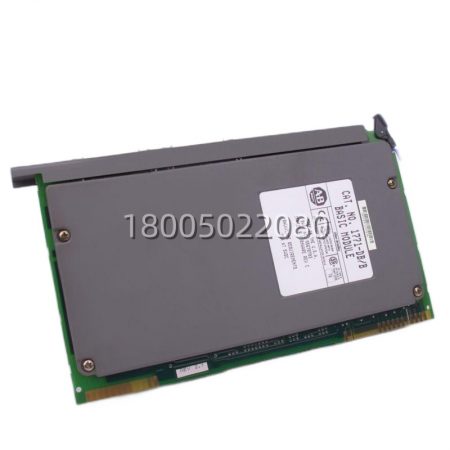
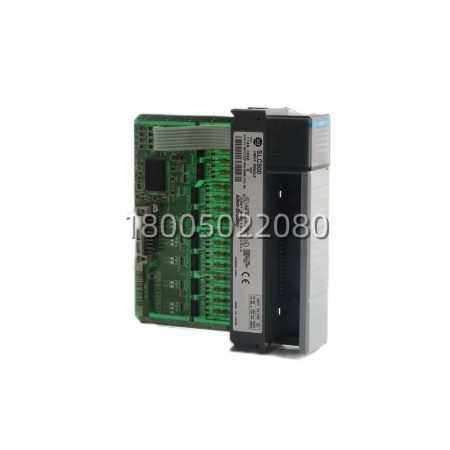
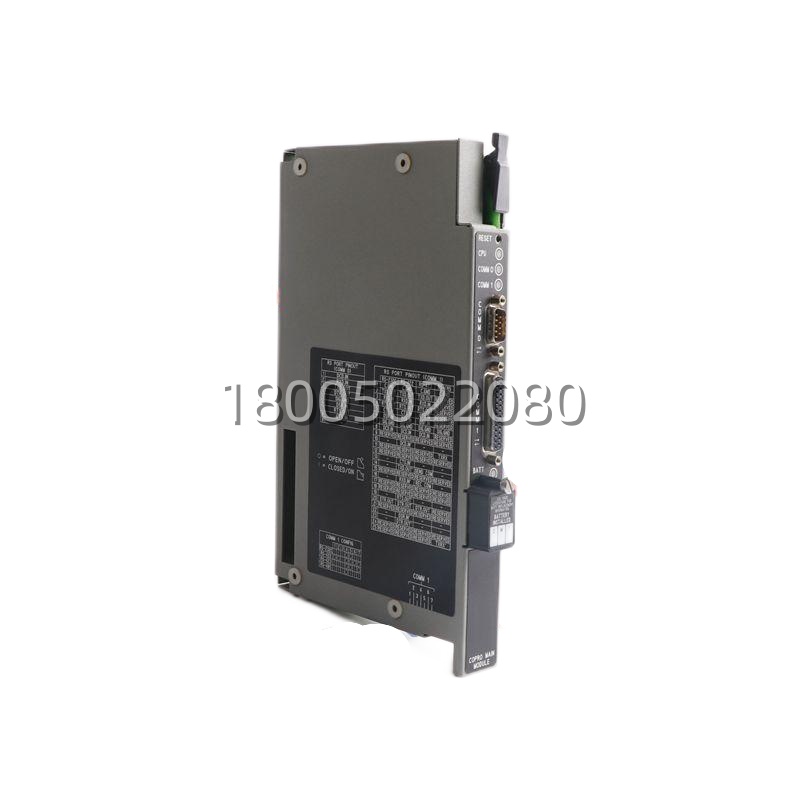
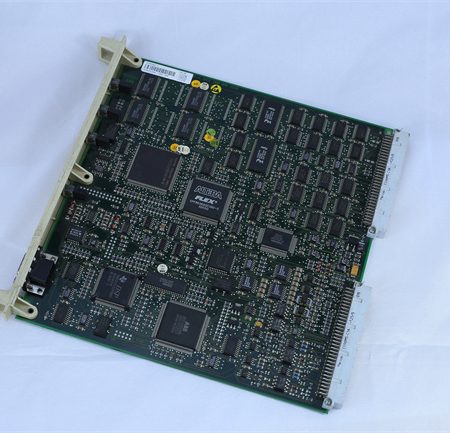
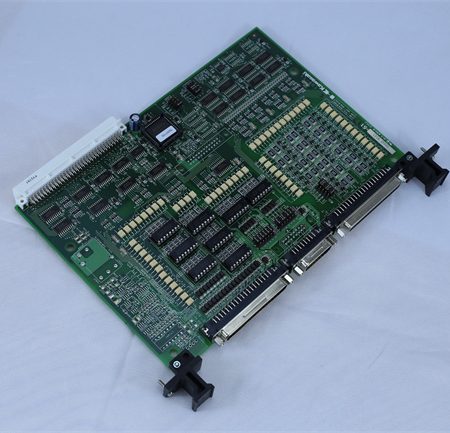
Application Scenarios:In a large‑scale automotive assembly line controlled by a PLC‑5/40 system, the main processor was struggling with the dual burden of high‑speed robotic positioning calculations and real‑time quality data logging. The lengthy scan cycle was causing timing jitter in the welding robots. By installing the 1771‑DMC A/A in an adjacent slot, engineers offloaded all complex trajectory calculations and statistical process control (SPC) logging to the coprocessor. The 1771‑DMC A/A, with its dedicated 256 KB memory and 1 ms update capability, handled these tasks in parallel, freeing the main PLC‑5 CPU to focus on deterministic machine sequencing. This reduced the main program scan time by over 30% and eliminated robot motion faults.
Parameter:
| Parameter | Value / Specification |
|---|---|
| Product Model | 1771‑DMC A/A |
| Manufacturer | Allen‑Bradley (Rockwell Automation) |
| Product Category | Control Coprocessor Main Module |
| For System | PLC‑5 (1771 I/O Chassis) |
| Memory Capacity | 256 KB |
| Programming Languages | C, BASIC, Assembler |
| Communication Ports | 1x 9‑pin RS‑232C; 1x 25‑pin (RS‑232C/423/485) |
| Update Period | 1 ms (typical for control tasks) |
| Backplane Current | ~0.12 A @ 5V DC (typical) |
| Operating Temperature | 0 to 60 °C |
| Key Feature | Independent OS‑9 based real‑time task execution |
Technical Principles and Innovative Values:
- Innovation Point 1: Asymmetric Multiprocessing for PLC‑5. Unlike standard I/O modules, the 1771‑DMC A/A is a full‑fledged computer on a card, running the OS‑9 real‑time operating system. It operates as a true coprocessor, allowing the main PLC‑5 and the 1771‑DMC A/A to execute logic concurrently. This architecture prevents computationally heavy tasks (e.g., complex PID, FFT analysis) from disrupting the primary control scan, a critical advantage for time‑sensitive automation.
- Innovation Point 2: High‑Level Language Flexibility. The module’s support for C and BASIC programming breaks the ladder logic barrier of traditional PLCs. This allows engineers to implement advanced algorithms, custom communication protocols, and complex data structures that are impractical or impossible to write in ladder logic, significantly extending the functional lifespan of legacy PLC‑5 systems.
- Innovation Point 3: Dedicated High‑Speed Serial Connectivity. With two configurable serial ports (RS‑232/422/485), the 1771‑DMC A/A can act as a communication gateway. It can interface directly with barcode readers, vision systems, or proprietary third‑party devices, parse the data, and present clean, pre‑processed information to the main PLC via high‑speed block‑transfer (BTW/BTR) operations.
Application Cases and Industry Value:
- Case 1: Steel Mill Process Optimization. A hot strip mill used a 1771‑DMC A/A to manage the adaptive loop tuning for its reheat furnaces. The coprocessor continuously calculated heat transfer models and adjusted setpoints, which were then passed to the main PLC‑5. This implementation improved temperature uniformity by 12% and reduced fuel consumption by leveraging the 1771‑DMC A/A‘s ability to handle floating‑point math efficiently.
- Case 2: Packaging Machine Data Integration. An OEM integrated a 1771‑DMC A/A into their PLC‑5‑based packaging line to handle real‑time production tracking. The module collected data from 16 scales and 4 inkjet printers, formatted the information into TCP/IP packets (via a serial‑to‑Ethernet converter), and sent it to a plant‑wide SQL database without burdening the main controller, enabling seamless MES integration.

Reviews
There are no reviews yet.