
Application Scenarios:
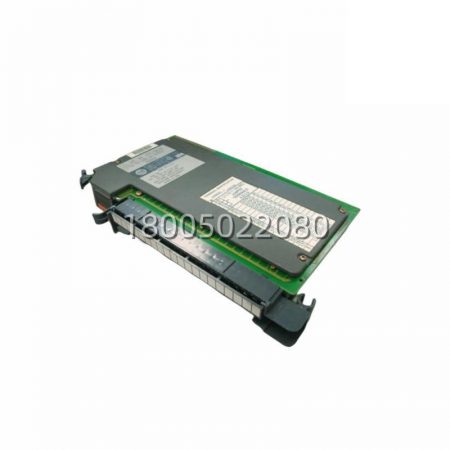
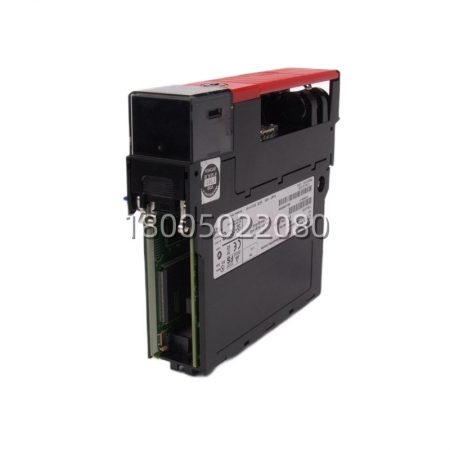
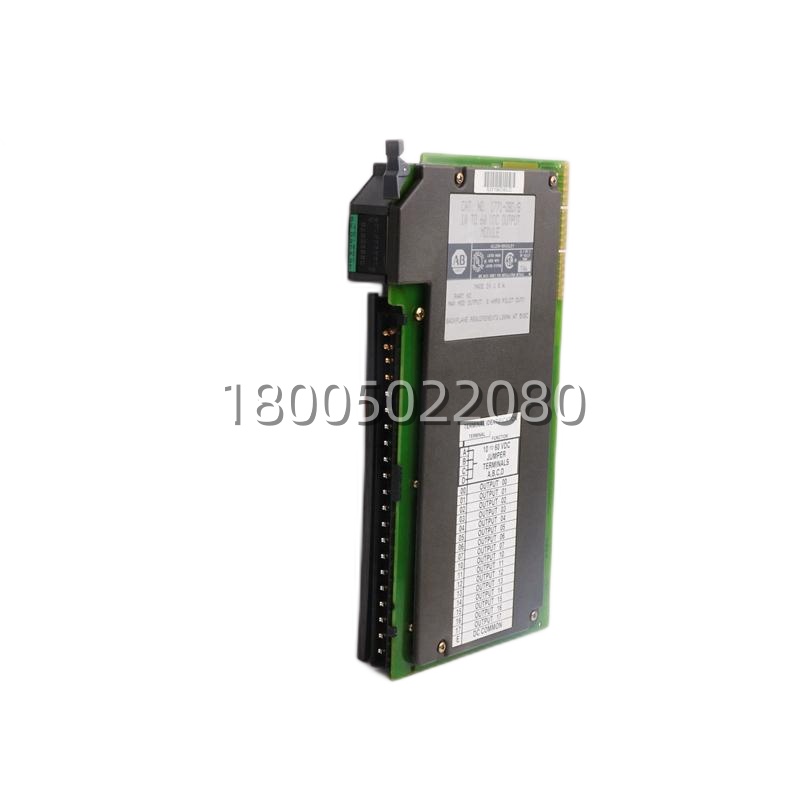
In a large automotive assembly plant, a PLC‑5/40 system controls a conveyor network with multiple zones. Each zone uses a 1771‑OBN/B module to actuate pneumatic solenoids for part stops and pushers. During a surge event caused by a faulty solenoid coil, the module’s internal fusing (indicated by the “Fuse Blown” LED) protects the backplane from damage. Maintenance technicians quickly identify the failed group, replace the external fuse in the wiring arm, and swap the solenoid without needing to replace the entire module. The per-point status LEDs allow for rapid troubleshooting, minimizing line downtime.
Parameter:
| Main Parameters | Value / Description |
|---|---|
| Product Model | 1771‑OBN/B (Series B) |
| Manufacturer | Allen‑Bradley (Rockwell Automation) |
| Product Type | Digital DC Output Module |
| Number of Outputs | 32 points (4 groups of 8 points) |
| Output Type | Sourcing (Sourcing) DC |
| Voltage Range | 10 – 30 V DC |
| Current Rating | 0.5 A per point (2 A per group common, 8 A module total) |
| Surge Current | 2 A per point for 10 ms (repeatable every 2 s) |
| Isolation | 1500 V optical isolation (field to logic) |
| On‑State Voltage Drop | ≤ 1.5 V DC @ 0.5 A |
| Response Time | ON to OFF: 2.0 ms max; OFF to ON: 0.1 ms max |
| Backplane Current | 330 mA @ 5V DC (max) |
| Power Dissipation | 13.7 W (max) |
| Compatibility | PLC‑5, 1771 I/O Chassis (1771‑A1B, A2B, A3B, A4B) |
| Status Indicators | Per-point (red), Fuse Blown indicator |
| Wiring | Requires 1771‑WN or 1771‑W*** series field wiring arm |
| Operating Temperature | 0 °C to 60 °C (32 °F to 140 °F) |
Technical Principles and Innovative Values:
- Innovation Point 1: Group‑Isolated Backplane Protection Architecture. Unlike monolithic output modules, the 1771‑OBN/B divides its 32 outputs into four electrically isolated banks. This design ensures that a ground fault or short circuit in one field device only affects one group of eight outputs, not the entire module or the PLC backplane. The 1500V optical isolation barrier prevents noise and voltage transients from propagating into the sensitive control system, a critical feature in electrically noisy environments like welding or heavy motor control.
- Innovation Point 2: High‑Density, High‑Surge Current Capability. Packing 32 outputs into a single‑slot module was a significant density achievement for its era. Each output is rated for a robust 0.5A continuous current with a 2A surge capability, allowing it to directly drive most industrial solenoids and small motor starters without requiring interposing relays. This reduces panel space, wiring complexity, and points of failure in control cabinets.
- Innovation Point 3: Integrated Diagnostic and Fuse Protection Circuitry. The module incorporates a “Fuse Blown” status indicator on the front panel, which activates if an external fuse (typically housed in the accompanying wiring arm) opens due to an overload. Combined with individual red LEDs for each output point, this diagnostic capability allows maintenance personnel to pinpoint a failed channel or a blown fuse group in seconds, drastically reducing Mean Time To Repair (MTTR) compared to modules without such visual diagnostics.

Reviews
There are no reviews yet.