
Application Scenarios
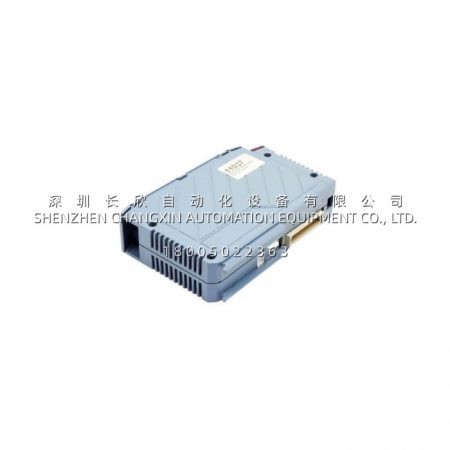
Imagine you are modernizing a packaging line that still relies on an RS232 barcode scanner while simultaneously needing to communicate with several CAN-based remote I/O nodes distributed across a 200-meter factory floor. Your B&R System 2005 CPU only has a single built-in interface. The B&R 3IF672.9 solves this precisely: insert it into the CPU’s interface slot, and you instantly gain the RS232 port for the scanner and two CAN ports for the remote nodes. The CAN interfaces’ electrical isolation protects the PLC from potential ground loops caused by long-distance cabling. This eliminates the need for costly protocol converters or separate gateway modules. Whether you are adding a new HMI via RS232 or integrating a CANopen network of drives, the B&R 3IF672.9 provides a simple, integrated pathway to connect these systems .
Parameters
| Main Parameters | Value/Description |
|---|---|
| Product Model | B&R 3IF672.9 (System 2005, also marked IF672) |
| Manufacturer | B&R Automation (ABB Group) |
| Product Category | Interface Module / Communication Module |
| Slot Compatibility | Plug-in for CP260 CPU, IF260, or IF060 interface modules |
| Power Consumption | Max. 1.8 W (5V DC, 24V DC not used) |
| Interface 1 | RS232 (9-pin DSUB male), max. 115.2 kBaud, max. 15 m cable |
| Handshake Lines | DTR, DSR, RTS, CTS (full handshake support) |
| Interface 2 & 3 | CAN (2x, 4-pin terminal block), network-capable |
| CAN Bit Rate | Up to 500 kbit/s (60 m bus), 250 kbit/s (200 m), 50 kbit/s (1000 m) |
| CAN Electrical Isolation | Yes (isolated from PLC and between interfaces) |
| CAN Node Addressing | 2x hexadecimal switches or software-configurable |
| Status LEDs | TXD/RXD for RS232; 1 LED per CAN interface for transmission |
| Certifications | C-UL-US listed |
| Dimensions | Approx. 14 x 2 x 9 cm (single-width System 2005 module) |
Technical Principles and Innovative Values
Innovation Point 1: Dual-Purpose CAN Node Addressing
The B&R 3IF672.9 features two hexadecimal switches for setting the CAN node number for the first CAN interface (IF2). The second CAN interface (IF3) automatically adopts the node number of IF2 + 1 . This simplifies network configuration and ensures logical node numbering. Node addresses can also be software-overridden, providing flexibility for dynamic network configurations.
Innovation Point 2: Complete Electrical Isolation for CAN
Industrial environments are notorious for ground potential differences, especially when communication spans hundreds of meters. The B&R 3IF672.9 provides full galvanic isolation for its CAN interfaces, both from the PLC backplane and from each other . This prevents ground loops, protects the CPU from voltage spikes, and ensures data integrity in noisy environments. This feature is often overlooked but is critical for reliable long-distance fieldbus installations.
Innovation Point 3: High-Performance UART for RS232
The RS232 interface uses a ST16C650 UART controller with 32-byte FIFO buffers in both transmit and receive directions . This hardware buffering reduces CPU overhead, allowing the B&R 3IF672.9 to handle serial communication reliably at its maximum 115.2 kBaud rate without burdening the main processor—a key advantage when the CPU is already busy with control tasks.
Innovation Point 4: Modular Flexibility in the System 2005 Architecture
The B&R 3IF672.9 is designed as an “insert” module that can be plugged into a range of host modules: directly into a CP260 CPU, into an IF260 expansion module, or into an IF060 system module . This architecture provides significant flexibility. A single CP260 CPU can support multiple IF060 modules on a backplane, each populated with interface inserts like the 3IF672.9, allowing the CPU to interface with a wide variety of fieldbuses and networks simultaneously

Reviews
There are no reviews yet.