
Application Scenarios
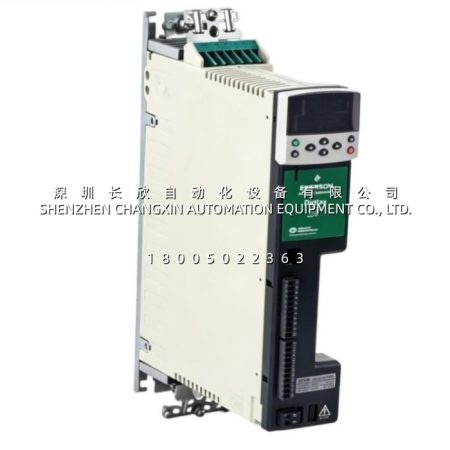
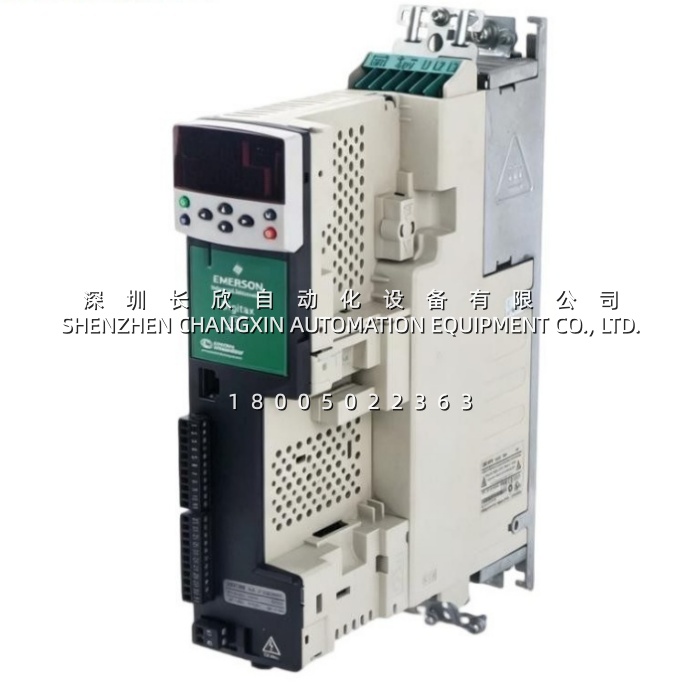
Picture a horizontal form-fill-seal machine running 180 film cycles a minute. Every 333 ms the cross-seal jaw sweeps through its stroke, and for a few dozen milliseconds of that it wants close to three times its continuous torque. A drive chosen on nameplate power alone trips on overcurrent; a drive chosen on peak alone runs hot and eats cabinet space. The DST1405 sits exactly in that gap — 8 A to carry the dwell, 24 A to deliver the bite, inside a 62 mm-wide bookcase frame that stacks neatly beside the neighbouring axes.The same profile shows up on rotary knife cutters on web presses, print-cylinder registration, pick-and-place Z-axes, injection-moulding take-out robots and CNC turret punch presses. On the punch press the recurring complaint is regenerative, not motoring: each rapid stop pushes energy back into the DC bus faster than a small drive can dump it, and the result is a nuisance overvoltage trip at the worst possible moment. The DST1405 absorbs that energy on board through its internal 70 Ω chopper and 220 μF bus capacitance, so medium- and low-inertia decelerations need no external brake resistor and no extra panel hardware.
Parameter
| Main Parameters | Value/Description |
|---|---|
| Product Model | DST1405 (motion-variant suffixes B / I / P / Z / E; bare frame is the ST-B base drive) |
| Manufacturer | Control Techniques — Emerson originally, now Nidec Control Techniques (Kidsgrove, UK) |
| Product Category | Single-axis AC servo drive / servo amplifier, 400 V class |
| Supply Voltage | 380–480 VAC three-phase, ±10%, 48–65 Hz |
| Continuous Output Current | 8.0 A rms (pulse-duty rating); 9.9 A is the thermal upper bound, not the rated duty point |
| Peak Output Current | 24.0 A rms, approximately 3× continuous, duty-cycle limited by the drive’s thermal model |
| Motor Match | Approximately 3–4 kW permanent-magnet servo, 5–7 N·m continuous class |
| Power Rating | 3.32 kW without line reactor; 3.65 kW with line reactor |
| Switching Frequency | 3 / 4 / 6 / 8 / 12 kHz selectable; 6 kHz is the rated-performance setting |
| Control Bandwidth | Current loop ≈1100 Hz; speed loop ≈160 Hz; speed accuracy 0.01%; resolution 0.001 rpm |
| Feedback | Incremental, absolute, SinCos; resolver and second encoder via SM option; encoder input to 500 kHz |
| Braking | Internal 70 Ω chopper, 50 W average over 60 s; 220 μF internal bus capacitance |
| Drive Loss | 150 W @ 6 kHz; 169 W @ 8 kHz; 207 W @ 12 kHz — the heat the cabinet must actually remove |
| Communications | RS-485 Modbus RTU onboard; two option slots for EtherCAT, EtherNet/IP, PROFIBUS-DP, PROFINET, CANopen, SERCOS, DeviceNet |
| Safety | Safe Torque Off on dedicated dual-channel terminals — IEC 61800-5-2 SIL 3, EN ISO 13849-1 PL e, Cat. 3 |
| Protection / Environment | IP20 (UL Type 1 / NEMA 1); 0–50 °C, derate above 40 °C; 95% RH non-condensing; 1000 m rated, 3000 m derated |
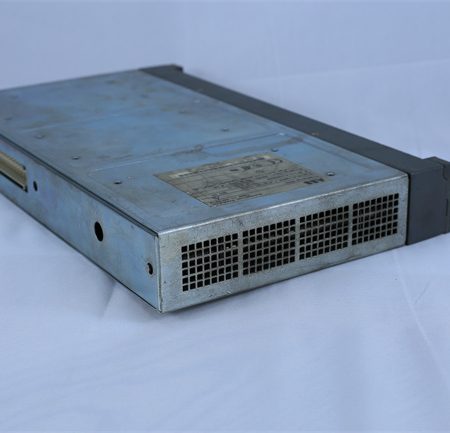
| Mechanical | Approximately 322 × 62 × 250 mm, 2.1 kg net without keypad or option modules |
| Compliance | UL508C, cULus File E171230, EN 61800-3 second environment |
Reviews
There are no reviews yet.