
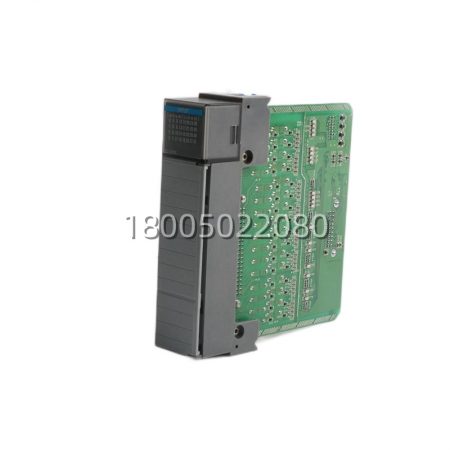
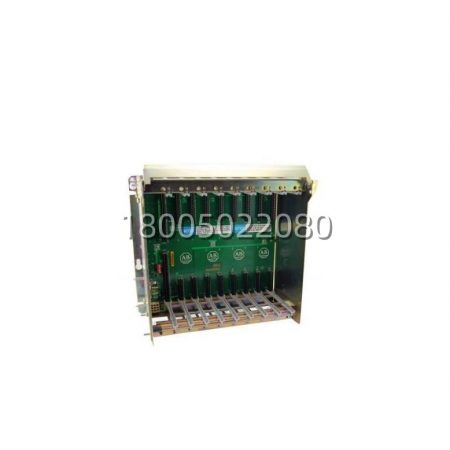
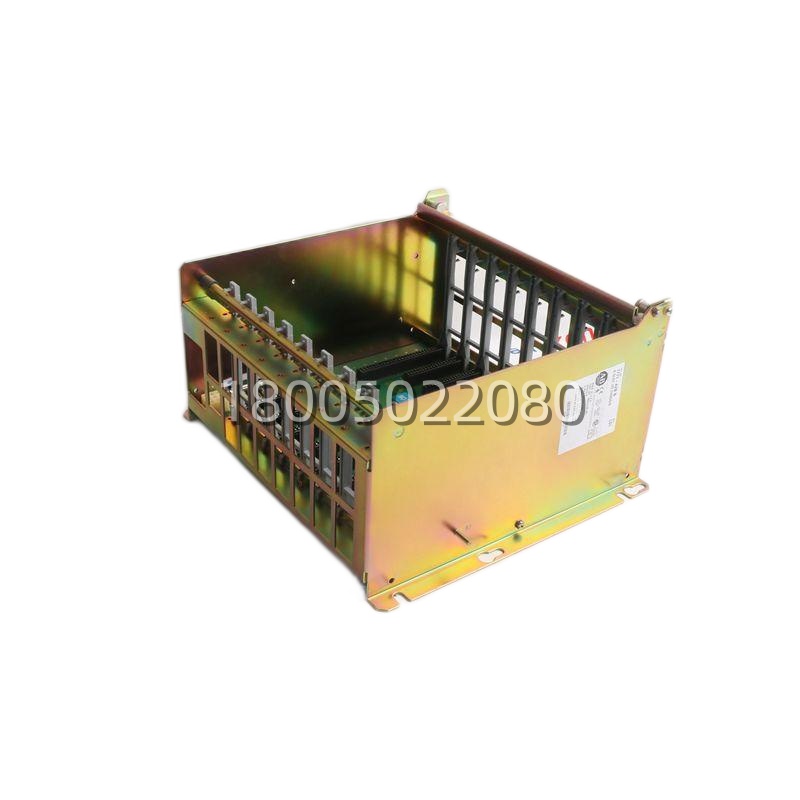
技术规格
| 参数名称 | 参数值 |
|---|---|
| 产品模型 | 1771-A2B(A/B系列互操作) |
| 制造商 | 罗克韦尔自动化(艾伦-布拉德利) |
| Product Type | 8-Slot PLC-5 Local I/O Chassis Assembly (with integrated PS bay) |
| Platform | PLC-5 / 1771 I/O system |
| Number of Slots | 8 module positions + dedicated right-side power-supply bay |
| Slot Addressing | Slot 0 = Processor / Adapter; Slots 1–6 = 1771 I/O; Right bay = 1771-Px PSU |
| Backplane Bus | 1771 parallel backplane (processor ↔ I/O) |
| Backplane Power Rating | 16 A @ 5 V DC (total backplane capacity), 24 V DC auxiliary distribution |
| Compatible Power Supplies | 1771-P4R, 1771-P4S, 1771-P4S2, 1771-P6S, 1771-P7, etc. |
| Compatible Processors | PLC-5/10, 5/12, 5/15, 5/25, 5/40, 5/60, 5/80 (slot 0) |
| Compatible I/O | All 1771 Series A & B modules (digital, analog, comms, specialty) |
| Expansion / Remote I/O | Via 1771-ALX / ALM / ALS adapter modules in slot 0 |
| Mounting | Rear panel mount or 19″ rack-mount (ears optional) |
| Mechanical (W × H × D) | ~508 × 178 × 171 mm (20.1 × 7.0 × 6.7 in) |
| Weight | ~4.7 kg (10.3 lb) |
| Operating Temperature | 0 … 60 °C (32 … 140 °F) |
| Vibration / Shock | 2 g @ 10–500 Hz / 30 g non-operating |
| Enclosure Type | Open-style (requires NEMA 12/13/4 or IP54+ cabinet) |
Main Features and Advantages
Passive parallel backplane with high-current 5 V distribution. The 1771-A2B is not a powered device itself—it’s a precision passive backplane—but its trace design is rated for up to 16 A at 5 V DC across the bus, which matters because analog input cards, communications modules, and high-density digital cards can collectively pull serious current. The low-impedance parallel architecture keeps voltage droop tight across all eight slots, so a heavily loaded chassis doesn’t suffer the scan-non-determinism that daisy-chained ribbon buses invite. For plants still running PLC-5/60 or /80 splits with analog-heavy local racks, the 1771-A2B backplane is a quiet workhorse—no firmware, no config, no failure mode beyond physical damage.Series A/B module interoperability on the same backplane. One of the enduring design wins of the 1771 platform is that Series B modules (late-1990s/2000s revisions with improved diagnostics and CE-compliant silencing) seat and run in a Series A chassis like the 1771-A2B without performance loss, and vice versa for the most part. This means a 1994-vintage panel can accept a 2008 spare, and a 2008 rebuild can reuse 1996 modules—critical for plants sitting on 20+ year installed bases where spare-part mix-and-match keeps the lights on without a full migration budget.Integrated right-side power-supply bay eliminates external 24 V wiring. Unlike generic 19-inch subracks that force you to DIN-mount a third-party PSU and run ferruled wires to the backplane, the 1771-A2B carves a dedicated, keyed bay at the right end that accepts any 1771-Px supply module. The PSU bolts in, engages the backplane via the same card-edge geometry, and feeds 5 V / 24 V down the bus. Redundant power configurations (dual 1771-P4R in a larger chassis; on the A2B a single PSU is typical but the bus design tolerates phased swaps) mean a supply swap can happen without dropping the rack if the load is within a single PSU’s headroom—though on the A2B you’ll typically power-down for a PSU change unless you’ve engineered an external bypass.Heavy-gauge steel construction for shock/vibe environments. The 1771-A2B isn’t just a painted sheet-metal box—the card guides, backplane stiffener, and module-retention rails are built for 2 g continuous vibration (10–500 Hz) and 30 g non-operating shock, which puts it in scope for mining, metals, paper-machine, and marine-generator compartments where cabinets see real mechanical energy. The module-retention screws at the top of each card further secure 1771 modules against vibration-induced creep-out—an underrated feature on high-cycle compressor or crusher panels.Remote-I/O repurposing via adapter modules. When the 1771-A2B is deployed not as a local PLC-5 rack but as a remote I/O drop (e.g., in a PLC-5/80 system with distributed field racks), slot 0 takes a 1771-ALX (Adapter, Link, eX tend) or 1771-ALM/ALS module instead of a processor, and all eight backplane positions become available for 1771 I/O. This duality means the same chassis part number serves both the main-panel and the field-enclosure roles in a single plant, simplifying spares. The 1771-A2B backplane transparently carries the Remote I/O scanner traffic from the adapter to every seated I/O module, so the host PLC-5 never “knows” the rack is physically distant.
Application Field
The 1771-A2B is concentrated in three contexts, all tied to the PLC-5 installed base that Rockwell has kept in “active mature” status for decades. First, main-control cabinets in process and heavy-industrial sites: water/wastewater treatment plants, pulp & paper machine rooms, metals rolling mills, and oil & gas well-pad skids routinely run a PLC-5/15 or /25 in a 1771-A2B, with slots 1–6 populated by 1771-IX (analog in), 1771-OX (analog out), 1771-IM (120 V AC in), 1771-OW (relay out), and perhaps a 1771-LK (Data Highway/DH+) or 1771-ASCII module for HMI/logger comms. The chassis sits inside a NEMA 12 floor-standing enclosure alongside the 1771-P4R supply, a DH+ terminal, and a disconnect—classic late-1990s panel architecture that still dominates many municipal plants because “it hasn’t failed yet, don’t touch it.”Second, remote I/O drops in large PLC-5/60 or /80 distributed systems: a cement plant’s reclaim tunnel might have three 1771-A2B racks, each with a 1771-ALX adapter in slot 0 and eight slots of 1771 digital input (prox switches on conveyors) and relay output (motor starter coils), all scanned from the main PLC-5/80 in the MCC room over a 1770-CD cable (Remote I/O, 57.6 kbps / 115.2 kbps / 230.4 kbps). The 1771-A2B‘s passive backplane carries the RIO token transparently, and the heavy-gauge steel shrugs off the vibration from adjacent conveyor starters. Third, machine-level OEM panels on legacy extrusion lines, injection molders, and stamping presses where the OEM spec’d PLC-5/15 + 1771-A2B + 1771-P4S in the late 1990s and the end user has never had a business case to migrate to ControlLogix—the chassis silently carries 6 MHz-ish scan through decades of 3-shift operation. In all three cases, the 1771-A2B‘s value isn’t feature velocity; it’s that the backplane has no firmware, no config file, and no planned obsolescence date that forces a rip-and-replace. For plants operating on “run it until it fails, then swap the module” doctrine, the 1771-A2B is exactly the right piece of metal.
Reviews
There are no reviews yet.