
Technical Specifications
| Parameter Name | Parameter Value |
|---|---|
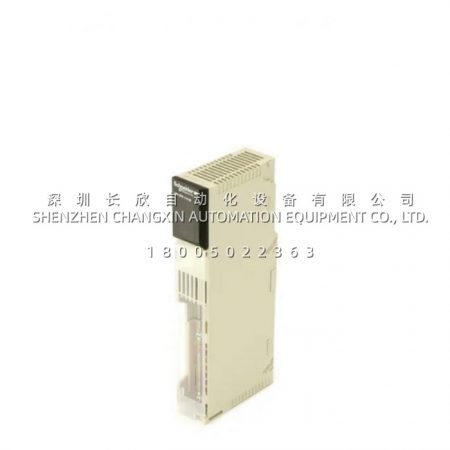
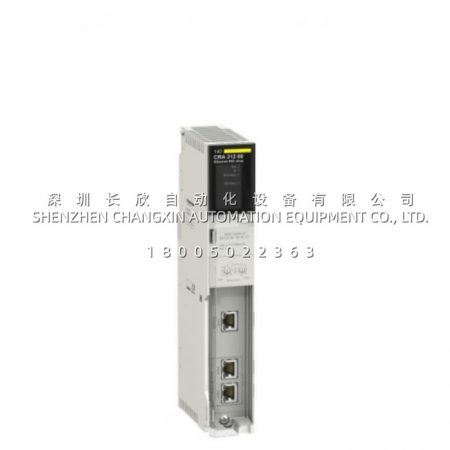
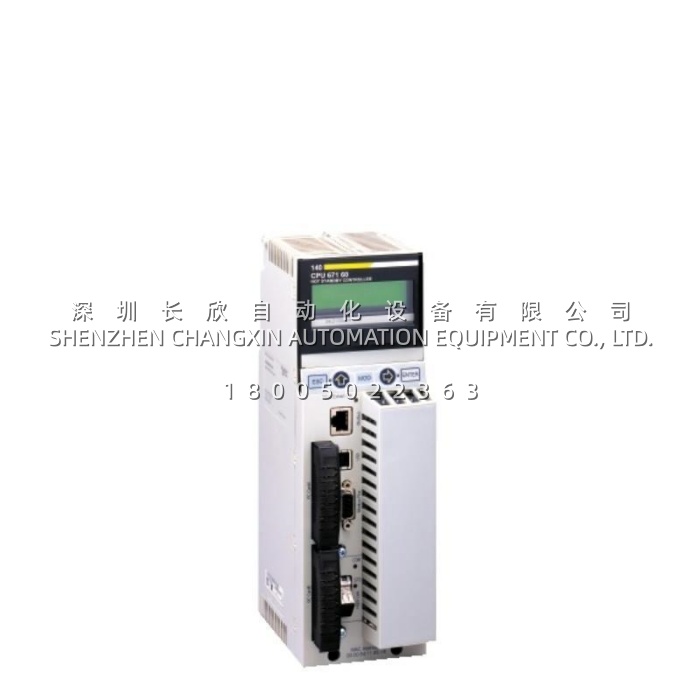
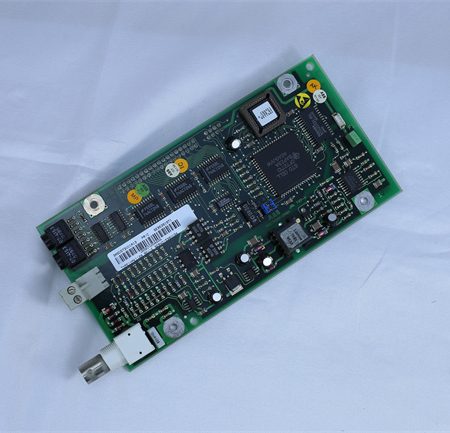
| Product Model | 140CPU67160 (140 CPU 671 60) |
| Manufacturer | Schneider Electric |
| Product Type | Unity Hot Standby Processor with multimode Ethernet |
| Product Range | Modicon Quantum automation platform |
| Clock Frequency | 266 MHz |
| Internal RAM | 1024 kB (512 kB reserved for data) |
| Expandable Memory | Up to 7168 kB program via PCMCIA card; up to 8 MB file storage via PCMCIA card |
| Execution Time per Instruction | 0.0525–0.075 µs Boolean; 0.045–0.06 µs word and fixed-point; 0.4–0.5 µs floating point |
| Throughput | 10.28 Kinst/ms (100 % Boolean); 10.07 Kinst/ms (65 % Boolean / 35 % numerical) |
| System Overhead | 1 ms master task; 0.2 ms fast task |
| Application Structure | 1 cyclic/periodic master task; fast, interrupt, timer and auxiliary tasks forbidden in Hot Standby application |
| Integrated Connection Types | 1 Modbus Plus, 1 Modbus (RS-232/485), 1 USB, 1 optic fibre for Hot Standby |
| Hot Standby Sync Link | MT-RJ multimode fibre optic, interconnecting primary and secondary PLCs up to 4 km |
| Electrical Connections | 1 female SUB-D 9 (Modbus Plus), 1 RJ45 (Modbus bus), 1 MT-RJ fibre, 1 USB |
| Number of Optional Modules | 6 (Ethernet, Modbus, Modbus Plus, Profibus DP, Sy/Max) |
| Maximum Connections | 6 Ethernet TCP/IP local; 6 Modbus Plus local; 6 Profibus DP local; 1 Modbus; 1 USB; AS-Interface support |
| Local Racks Supported | 2 (local I/O forbidden in Hot Standby application) |
| Remote I/O Stations | 31 (2 S908 remote I/O racks); 31 (2 Ethernet Quantum remote I/O racks); 16 (2 Ethernet X80 remote I/O racks) |
| Distributed I/O Stations | 63 stations, 1 rack, across 3 Modbus Plus networks |
| Discrete I/O Capacity | 31,744 inputs / 31,744 outputs remote; 8,000 / 8,000 distributed per Modbus Plus network; unlimited via Ethernet remote I/O (31 drops of 28 slots max) |
| Analogue I/O Capacity | 1,984 inputs / 1,984 outputs remote; 500 / 500 distributed per Modbus Plus network; unlimited via Ethernet remote I/O |
| Application-Specific I/O | Accurate time stamping, counter, high-speed interrupt inputs, serial link |
| Switch Function | Key switch, memory port on/off |
| Bus Current Requirement | 2500 mA at 5 V DC |
| Local Signalling | 1 LED green (Ethernet activity COM); 1 LED red (Ethernet collision) |
| Product Certifications | CE, CSA, GOST, UL, Marine, HazLoc |
| Contractual Warranty | 18 months (manufacturer) |
| Lifecycle Status | Discontinued 31 December 2018; end of standard service 31 December 2026 |
| Recommended Replacement | BMEH584040 redundant processor, Modicon M580 |
Main Features and Advantages
Continuity through synchronisation: The 140CPU67160 is engineered around the principle that a redundant pair must be genuinely identical at the moment of failure. The dedicated MT-RJ multimode fibre link continuously mirrors application memory, system registers and I/O tables between the two processors, so the standby unit is not merely idle capacity but a running copy of the primary. Because the link reaches up to 4 km, the two halves of a pair can be physically separated for the same reasons the rest of the system is — fire zones, blast ratings, or simply distance between control rooms — without compromising switchover behaviour.Scale without add-on complexity: With integrated Modbus Plus, Modbus, USB and fibre ports, the 140CPU67160 handles a great deal of system communication from the processor itself, and where more is needed it accepts up to six optional modules spanning Ethernet, Modbus Plus, Profibus DP and Sy/Max. The result is a controller that can run 31 remote I/O drops and 31,744 discrete points while still acting as the communication hub between field networks and SCADA, which in practice removes several cards from the rack and several failure points from the design.Memory headroom and change control: Internal RAM of 1024 kB covers many applications outright, and PCMCIA expansion to 7168 kB of program plus 8 MB of file storage removes memory as a constraint on larger strategies. A physical key switch controls the memory port, so the difference between a running plant and an unauthorised download is a key held by the right person — a small detail that matters greatly in regulated industries where configuration control is audited.Diagnostics designed into the front panel: Beyond standard status indication, the 140CPU67160 supports accurate time stamping, high-speed interrupt inputs and counter functions, giving event resolution fine enough for sequence-of-events work and post-incident analysis. Combined with the Unity engineering environment’s online change capability, engineers can modify and transfer logic to a synchronised pair without stopping the process — provided the modification discipline is respected, which is why Schneider restricts fast, interrupt and auxiliary tasks in hot standby configurations.
Application Field
The 140CPU67160 belongs wherever the cost of a processor stop exceeds the cost of redundant hardware. In oil and gas, it controls pipeline stations, compressor systems and refinery units where an unplanned stop cascades into flaring, restart penalties and contractual exposure. In power generation it runs boiler and turbine auxiliary control, balance-of-plant sequencing and substation automation, where grid-connected equipment demands continuous supervision.Water and wastewater utilities deploy the 140CPU67160 across large treatment works and distribution networks, using the 4 km fibre reach to place the standby processor in a separate building from the primary — the point being protection against a localised event taking out both halves of a pair. Petrochemical and chemical plants value the same distance for a different reason: separation between the control room and a hazardous area.Metals, cement and pulp and paper operations use the processor where continuous process economics dominate; a kiln or a paper machine stopped mid-campaign costs far more than the controller. Pharmaceutical and food and beverage sites running validated batch processes apply it where continuity is a compliance requirement rather than merely an economic one.Increasingly, however, the dominant use case is sustainment. Thousands of Quantum hot standby pairs remain in service, and the 140CPU67160 is what keeps them running while a migration is planned. With end of standard service set for 31 December 2026, the realistic path for most operators is to hold verified spares now while evaluating the move to Modicon M580 with the BMEH584040, rather than assuming factory support will still be there next year.

Reviews
There are no reviews yet.