
Technical Specifications
| Parameter Name | Parameter Value |
|---|---|
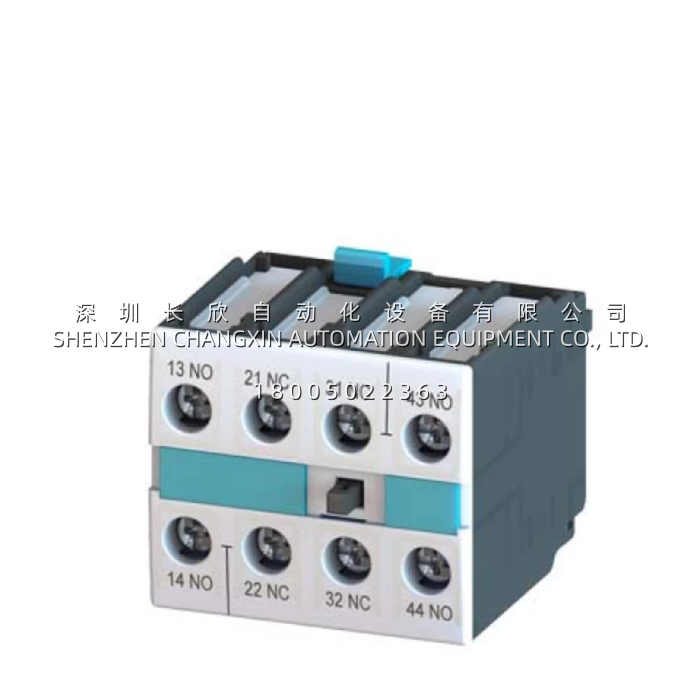
| Product Model | 3RH1921-1HA22 |
| Manufacturer | Siemens AG (SIRIUS Low-Voltage Controls) |
| Product Type | Auxiliary Switch Block (4-pole) |
| Contact Configuration | 2 NO + 2 NC, instantaneous |
| Applicable Standard | EN 50012 |
| Compatible Contactors | Siemens 3RT1 motor contactors & contactor relays, Size S0 – S3 |
| Mounting Type | Front snap-on (snap-fit onto 3RT1 body) |
| Terminal Type | Screw terminal (schraubklemme) |
| Rated Insulation Voltage | 690 V AC |
| Surge Voltage Resistance | 6 kV |
| Mechanical Service Life | ~10,000,000 switching cycles |
| Contact Reliability | 1 fault per 100 million ops (17 V, 1 mA) |
| Front Protection | IP20 |
| Operating Temp | -25 … +60 °C |
| Storage Temp | -55 … +80 °C |
| Dimensions (W × H × D) | 44 × 38 × 51 mm |
| Weight | ~0.08 kg |
| Conductor Cross-section (fine-stranded, with ferrule) | 2×(0.5…1.5 mm²) / 2×(0.75…2.5 mm²) |
| AWG Range | 2×(20…16) / 2×(18…14) |
| Lifecycle Status | Phased-out (Successor: SIRIUS 3RH2 series) |
Main Features and Advantages
The 3RH1921-1HA22 is one of those SIRIUS components where the value is in the ecosystem fit rather than any single headline spec. First, the snap-on front mounting. On a crowded DIN-row of 3RT1 S0–S3 contactors (say a 12-wide starter bank for a water-pump station), there is no rear access—cabinet back is against a wall. The 3RH1921-1HA22 clicks onto the front tongue of the 3RT1 body without tools, and the actuator fork inside the block rides the same moving core that drives the power poles, so NO/NC timing tracks the main contact exactly. That means “contactor picked up” feedback to the PLC arrives within the same millisecond window as the motor mains close—no lag, no separate sensing.Second, the 2 NO + 2 NC split is deliberate for EN 50012 legacy panels. Many MRO electricians still carry a mental map: “S0 contactor gets one 2NO/2NC block max before you hit the 3RH19 stacking limit.” The 3RH1921-1HA22 fills that sweet spot. If a designer needs 4 NO instead, they stack a second block—but for 80 % of DOL starters, 2+2 is the right density, and Siemens priced the 3RH1921-1HA22 accordingly (it’s the volume SKU in the 3RH19 lineup).Third, the 10-million-cycle mechanical life and the 1-fault-per-100M contact reliability figure. Those numbers sound like marketing until you run a packaging-line conveyor where the contactor picks up 200×/day, 300 days/year—that’s 60 k cycles/year, so the 3RH1921-1HA22 is good for 150+ years mechanically. The real wear item is the screw terminals loosening under vibration, not the contacts themselves. Which brings the fourth point: the screw-terminal version (-1HA22) is preferred over the spring-cage (-1FA22) in panels where maintenance crews periodically torque-check during PM—screw terminals are what most plant electricians expect on a 3RT1 row, and mixing spring + screw on the same contactor stack confuses apprentices.Finally, sparing reality: the 3RH1921-1HA22 is phased-out. Siemens’ successor 3RH2 aux blocks have a slightly different front-footprint coding (physically coded to prevent mismating across generations), so you cannot blindly substitute a 3RH2 block onto a 3RT1 body without checking the mechanical key. For plants staying on 3RT1, keeping 3RH1921-1HA22 on the shelf is the only sane move—crossing to 3RH2 means also crossing the contactor to 3RT2, which is a much bigger BOM change.

Reviews
There are no reviews yet.