
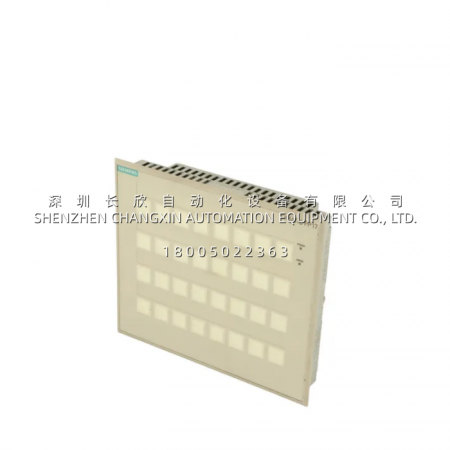
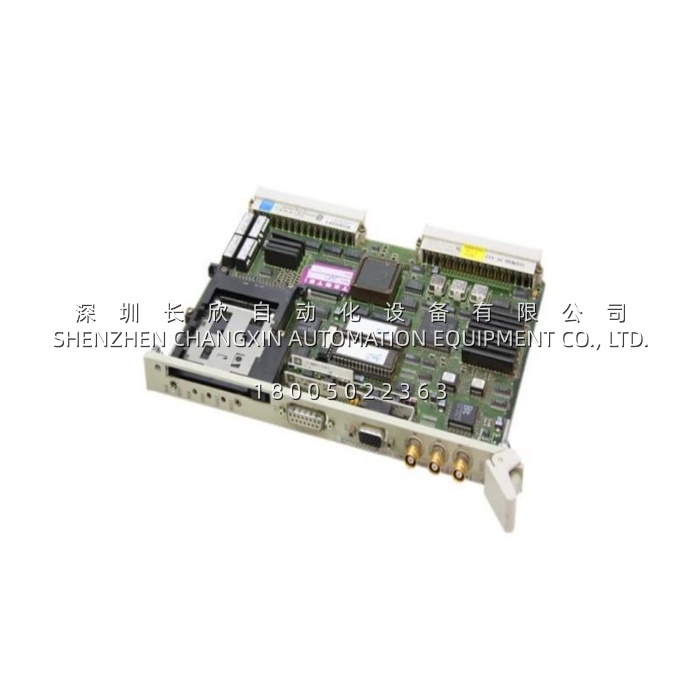
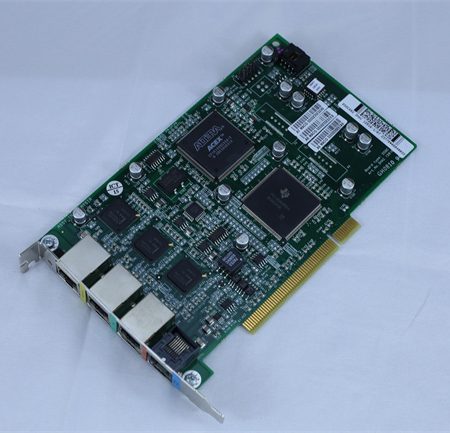
Application ScenariosIn a pharmaceutical blister-packaging line originally commissioned in 1999, the OP17 operator panel controlling the carton-erection servo suddenly lit its backlight but displayed a completely blank graphics layer—the text “AUTO MODE” and the fault banner both vanished, though the PLC (an S5-95U) kept the line running in shadow mode. The production manager faced a classic validated-equipment dilemma: a full HMI upgrade to a modern TP170 or KTP would trigger weeks of requalification under 21 CFR Part 11, and the packaging validation folder alone was 140 pages. The fix turned out to be the Siemens 6AV4012-0AA10-0AB0—the CP528A video sub-board inside the OP17 had developed cold-solder joints on the RGB driver stage after twenty-five years of thermal cycling. Swapping the CP528A (a 10-minute job once the OP17 bezel was off) restored the graphics without touching the S5 program, the ProTool project, or the validation dossier. Three other OP17s on the same site got preemptive CP528A spares allocated that afternoon. For plants sitting on S5-era assets, the 6AV4012-0AA10-0AB0 is less a “module” and more a lifeline.h2
Parameter
| Main Parameters | Value/Description |
|---|---|
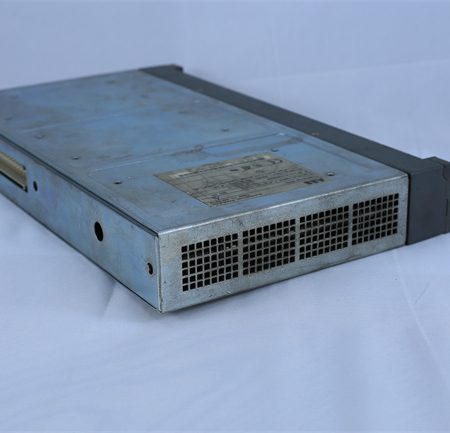
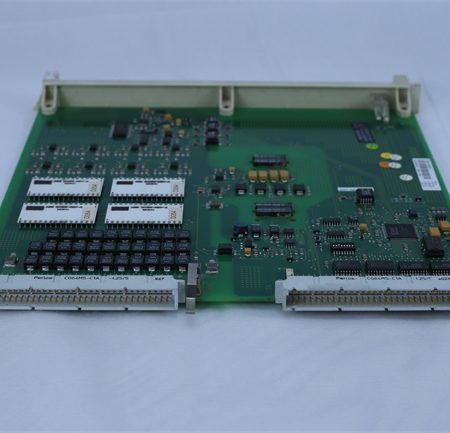
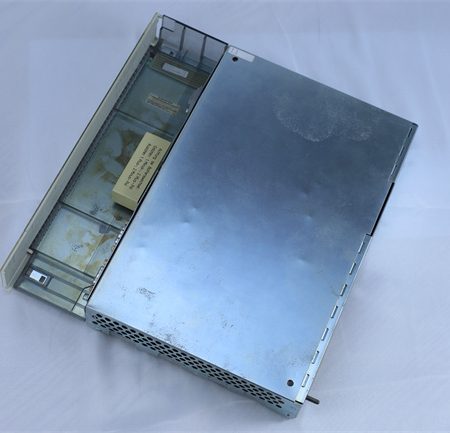
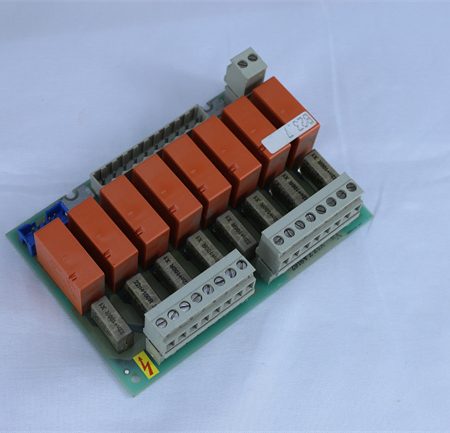
| Product Model | 6AV4012-0AA10-0AB0 (CP528A) |
| Manufacturer | Siemens |
| Product Category | Video / Graphics Processor Module (SIMATIC S5 CP family) |
| Core Function | Analog RGB video graphics processing for PG740/PG760 & OP15/OP17/OP25/OP35 |
| Video Output | Analog RGB, RGsB, 15-pin D-Sub (non-standard VGA pinout) |
| Max Resolution | 640 × 480 |
| H-Sync Frequency | ~15.6 kHz (mode-dependent) |
| V-Sync Frequency | 60 Hz typical |
| Host Interface | PG internal ISA-type expansion slot / OP internal ribbon bus |
| Operating Temp. | 0°C to +40°C |
| Dimensions (L×W×H) | 241 × 182 × 53 mm |
| Weight | ~0.65 kg |
| Product Status | Discontinued – legacy spare only |
h2 Technical Principles and Innovative Values
- Innovation Point 1: RGsB Separated-Sync Architecture. The 6AV4012-0AA10-0AB0 does not output standard VGA. Its 15-pin D-Sub carries analog RGB with separate TTL horizontal sync on pin 7 and vertical sync on pin 8—pinout that differs from VESA VGA (where H-sync is pin 13, V-sync pin 14). This was deliberate in the S5 era: it let the CP528 drive Siemens’ own COROS/OP monitors directly and, with a passive adapter, multi-sync CRTs. Modern LCDs won’t lock unless you use a dedicated RGB-to-VGA converter box that can swallow the ~15.6 kHz line rate—most contemporary VGA displays demand ≥31.5 kHz.
- Innovation Point 2: Dual-Role Silicon, Single SKU. One 6AV4012-0AA10-0AB0 serves two very different hosts. Populated into a PG740/PG760, it’s the programming station’s own graphics card, driving the external monitor so the commissioning engineer sees STEP 5 and ProTool side-by-side. Populated onto the OP15/17/25/OP35 internal bus via ribbon, it becomes the panel’s video engine, rendering character generators and primitive graphics blocks for the STN LCD. That duality is why the spare market treats it as a cross-platform rescue part.
- Innovation Point 3: Fanless, Conformal-Coated Longevity. The CP528A runs silent—no heatsink fan, no moving parts—because its chipset (ISA-era graphics controller + buffer RAM) sips milliwatts by modern standards. The PCB carries the period-typical conformal coat that let S5 cabinets run in 80% RH environments for decades. The failure mode is almost always solder-joint fatigue on the 15-pin D-Sub or the ribbon header after 20+ years of thermal cycling—not silicon death, which is why a replacement 6AV4012-0AA10-0AB0 revives the host every time.

Reviews
There are no reviews yet.