Product Overview
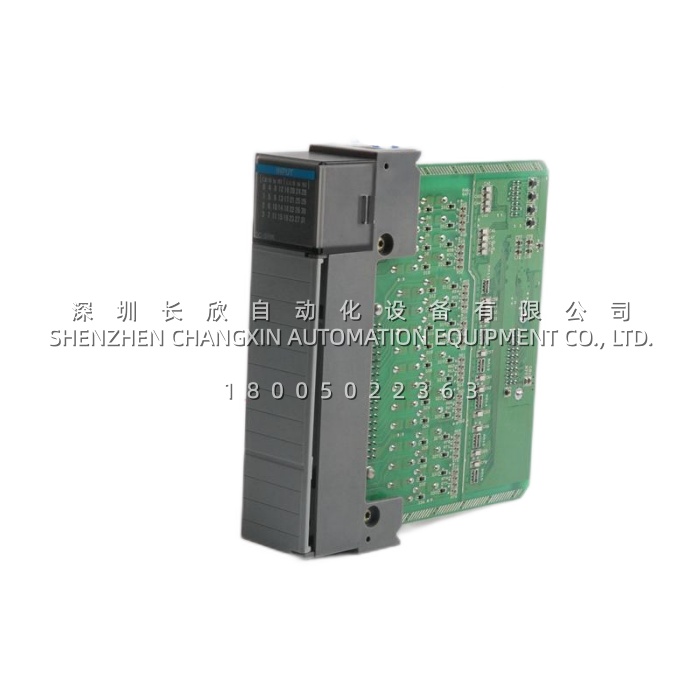
The CTI 2500-RIO-A is a Remote Base Controller (RBC) within Control Technology Inc.’s 2500 series PLC/I/O platform, engineered to sit in the dedicated RBC slot of a CTI 2500 or Siemens SIMATIC 505 I/O base and act as the RS485 communication bridge between that remote I/O base and a host CPU — either a CTI 2500-series CPU or a Siemens 545/555/575 (505-family) CPU. The 2500-RIO-A is not a standalone controller and does not execute user logic; its sole role is to scan the local I/O modules (discrete, analog, specialty) on its own base, package the I/O image into the TI-proprietary RS485 remote I/O protocol, and exchange it with the host CPU over a twisted-pair RS485 daisy chain at up to 2 Mbit/s, with a maximum CPU-to-remote distance of 1000 m. Up to 15 remote bases (each with its own 2500-RIO-A) can hang on a single RS485 channel from one CPU, letting plants distribute I/O across large footprints — material-handling conveyor zones, water-treatment pump skids, batch-mixer satellite stations — without running dozens of home-run cables back to the main CPU rack.Architecturally, the 2500-RIO-A occupies a double-wide slot on the CTI 2500 / Siemens 505 base (distinct from the single-wide I/O module slots), draws 2.5 W from the base’s 5V backplane, and presents two external ports: a 9-pin female D-shell RS485 (to the CPU or upstream/downstream RBC daisy chain) and a 9-pin male D-shell RS232 (for local programming/diagnostics of the CPU via laptop or CTI handheld, tunneling through the RBC). Configuration is hardware-based: a thumbwheel switch sets the RBC station address (1–15, must be unique per RBC on a given CPU channel), four DIP switches (SW1–SW4) set the RS232 baud rate (300/1200/2400/9600/19200), and a “Freeze” jumper selects output behavior on comms loss — either freeze (hold last state) or off (trip all outputs). Three front-panel LEDs display station address, error codes, and link status. The 2500-RIO-A is explicitly marketed as a drop-in, pin- and slot-compatible replacement for the Siemens 505-6851, 505-6851-A, and 505-6851-B RBCs — the same 505-base slot, same 9-pin RS485 pinout, same 5V backplane — so plants running Siemens 505 CPUs with aging 505-6851 stocks can swap to 2500-RIO-A without rewiring the base, the RS485 home-run, or the I/O field cables. CTI formally matured the 2500-RIO-A and replaced it with the 2500-RIO-B, which adds improved redundancy switching and backplane scanning; new designs should specify -B, but the 2500-RIO-A remains the correct sustainment procurement for existing 2500/505 racks already carrying -A.
Technical Specifications
| Parameter Name | Parameter Value |
|---|---|
| Product Model | 2500-RIO-A |
| Manufacturer | CTI (Control Technology Inc.) |
| Product Type | Remote Base Controller (RBC) for CTI 2500 / Siemens SIMATIC 505 I/O Bases |
| Communication Ports | 1 × RS485 (9-pin female D-shell, to CPU / RBC daisy chain); 1 × RS232C (9-pin male D-shell, local programming/diag) |
| Communication Protocol | TI-proprietary RS485 Remote I/O (CTI 2500 / Siemens 505 channel) |
| Communication Rate | Up to 2 Mbit/s (RS485); RS232 port configurable 300 / 1200 / 2400 / 9600 / 19200 bps via DIP SW1–SW4 |
| Max Distance (CPU ↔ Remote Base) | 1000 m (twisted-pair RS485) |
| Max Remote Bases per CPU Channel | 15 |
| Compatible Bases | CTI 2500 series 4/8/11/16-slot; Siemens SIMATIC 505 4/8/11/16-slot; 2500-R11-A & 505-6511 redundant (dual-media) bases |
| Backplane Power Draw | 2.5 W @ 5V DC (double-wide module slot) |
| Comms-Loss Output Behavior | Selectable via Freeze jumper: Freeze (hold last state) or Off (all outputs de-energized) |
| Configuration | Station address thumbwheel (1–15); RS232 baud DIP SW1–SW4; Freeze jumper |
| Indicators | LEDs for station address, error codes, link/run status |
| Operating Temperature | 0°C to +60°C (32°F to 140°F) |
| Storage Temperature | –40°C to +85°C (–40°F to 185°F) |
| Humidity | 5–95% RH, non-condensing |
| Agency Approvals | UL, ULC, FM (Class 1 Div) — pending at publication; CE/UKCA via CTI 2500 platform family |
| Replacement / Successor | Direct replacement for Siemens 505-6851 / 505-6851-A / 505-6851-B; CTI matured 2500-RIO-A → successor 2500-RIO-B |
Main Features and Advantages
Drop-in Siemens 505-6851-A/B replacement with zero rewiring: The primary market for the 2500-RIO-A is sustainment of Siemens 505 plants — the 505-6851 RBC has been out of Siemens active catalog for years, and CTI (which originally co-developed the 505 architecture before Siemens exited) stepped in with the 2500-RIO-A as a pin-, slot-, and protocol-compatible RBC. Same 9-pin RS485 D-shell pinout, same 5V backplane power budget, same double-wide slot occupancy in a 505-6511 or 505-6xx base, same station-address thumbwheel logic. A maintenance tech swaps a faulted 505-6851-A for a 2500-RIO-A: pop the old RBC, set the 2500-RIO-A thumbwheel to the same station number, set SW1–SW4 to match the site’s RS232 baud (if the RS232 port is used for local programming), set the Freeze jumper to match the plant standard (usually Freeze = hold last state for conveyor apps, Off = dump outputs for safety-critical), rack it in, and the 505 CPU re-establishes the RS485 link — no I/O rewiring, no base changeout, no program modification. This “don’t touch the wires” story is why the 2500-RIO-A still moves volume in the secondary/spares market even though CTI matured it.RS485 reach of 1000 m at up to 2 Mbit/s: The TI remote I/O RS485 physical layer on the 2500-RIO-A supports twisted-pair runs up to 1 km between the CPU (or upstream RBC) and the remote base, at the full 2 Mbit/s protocol rate — far longer than the ~100 m practical ceiling of a lot of industrial RS485 implementations, and long enough to put a remote I/O base at a pump skid or a headworks building while the 505 CPU sits in the main MCC 800 m away. The RS485 daisy chain topology also lets multiple 2500-RIO-A units (up to 15) share one CPU channel — e.g., a Siemens 555 CPU with one RS485 port can chain RBC1 (base at headworks, 4-slot, DI for float switches + DO for sump pumps) → RBC2 (base at aeration basin, 8-slot, analog for DO/pH + DO for blower staging) → RBC3 (base at clarifier, 4-slot, DI for RAS/WAS valve limit switches) all on one 2 Mbit/s RS485 homerun, each 2500-RIO-A at a different thumbwheel address (1, 2, 3). The 2 Mbit/s rate keeps I/O scan latency low even with 15 remotes polling on one channel — important on conveyor lines where a stalled zone sensor needs to propagate to the CPU within one scan.Dual-port design: RS485 for the plant link, RS232 for the service laptop: The 2500-RIO-A carries a 9-pin male RS232C port on the front faceplate, baud-configurable via SW1–SW4 (300 bps for legacy handheld programmers up to 19200 for a laptop running CTI programming software). This RS232 port tunnels through the RBC to the CPU — a service tech can land a laptop at the remote base (instead of walking back to the main MCC where the 505 CPU lives) and go online to the 555/575 CPU via the 2500-RIO-A RS232, pull I/O force tables, monitor the remote base’s scan, and even download logic changes, all without disturbing the RS485 link to the CPU. For plants where the 505 CPU is in a locked MCC and the remote bases are out in the process area, this “program-at-the-base” capability saves hours per service call.Freeze jumper for comms-loss output behavior: The 2500-RIO-A has a 2-position Freeze jumper (marked NORMAL / FREEZE or OFF / FREEZE depending on hardware rev) that dictates what happens to all outputs on the local base when the RS485 link to the CPU drops — either “Off” (all outputs de-energized, safe-state for e-stop/kill circuits) or “Freeze” (all outputs hold their last commanded state, useful for conveyors where a sudden output dump would cause product pile-up, or for pump alternation schemes where holding last state avoids a simultaneous start). This is a per-RBC choice, so a plant can set the headworks 2500-RIO-A to Off (sump pumps dump, float logic dead = safe) and the aeration-basin 2500-RIO-A to Freeze (blowers hold last speed, DO loop doesn’t crash) on the same RS485 channel — flexible and application-specific, configured by a jumper flip during commissioning, no software parameter to hunt.Redundant-base compatibility: The 2500-RIO-A can be installed in a 2500-R11-A (CTI) or 505-6511 (Siemens) redundant I/O base — these are dual-media bases that accept two RBCs (primary + shadow) for media-redundant RS485 paths back to the CPU. In this configuration, two 2500-RIO-A modules occupy the two RBC slots in the redundant base, each on a separate RS485 twisted pair to the CPU; if one cable/port fails, the other carries the I/O scan. CTI’s October 2011 product note flagged a specific issue with 2500-RIO-A in redundancy mode on those bases (the “Problem with 2500-RIO-A when used in redundancy mode in 2500-R11-A or 505-6511 I/O base” note), which is part of why CTI matured -A to -B — but for plants already running -A in redundant bases, the note is a known workaround item, not a disqualifier.Matured to 2500-RIO-B: CTI formally moved the 2500-RIO-A to “MATURED” status, active replacement is 2500-RIO-B — same double-wide footprint, same 5V 2.5W, same RS485/RS232 ports, same 1000m/15-remotes/2 Mbit ceiling, but -B improves the redundancy-mode switching logic and backplane scan behavior that -A had issues with in 2500-R11-A/505-6511 redundant bases. For sustainment (replace a dead -A in an existing rack), 2500-RIO-A is fine and often preferred because mixing -A and -B on the same site keeps spares common; for a new remote base being added to an existing 505/2500 plant, CTI steers to -B. Pin/slot compatibility means -B drops into an -A-designed base with no change.