 Description
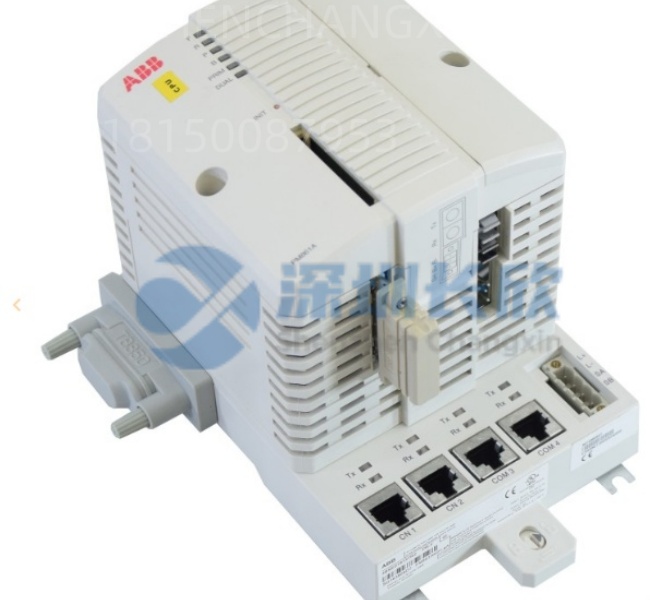
The ABB PM865K01 (order code 3BSE031151R1) is a high-performance, high-integrity programmable controller module from ABB’s renowned AC 800M series. It serves as the central processing unit (CPU) within the System 800xA Distributed Control System (DCS), engineered specifically for mission-critical process automation in industries where safety and reliability are paramount. This controller delivers deterministic real-time control, seamlessly integrates with IEC 61131-3 programming standards, and provides robust support for major industrial communication protocols.
Application Scenarios
At a liquefied natural gas (LNG) export terminal, where an unplanned shutdown could incur losses exceeding one million dollars per hour, engineers faced the critical challenge of ensuring absolute control system availability. They deployed a dual-redundant configuration using the ABB PM865K01 controller to manage the cryogenic loading skids, integrating over 2.000 I/O points and complex safety interlocks. During a major external grid disturbance, a power supply anomaly caused the primary PM865K01 to fault. The synchronized standby unit, continuously mirroring the system state, executed a seamless takeover in less than 100 milliseconds. This “bumpless” transfer occurred with zero process interruption or product loss, while operators received immediate diagnostic alerts via the System 800xA interface. The plant manager later stated, “The PM865K01 redundancy isn’t just a feature; it’s our insurance policy. Its flawless failover protected both our assets and our reputation for reliability.”
Technical Principles and Innovative Values
Innovation Point 1: Seamless State Synchronization for True Zero-Bump Failover. The PM865K01 implements a sophisticated hardware and software synchronization mechanism via a dedicated optical fiber link between primary and standby units. This ensures that all process variables, register states, and application logic are mirrored in real-time. During a failure, the switchover is not just fast (<100 ms) but also “bumpless,” meaning there is no disturbance to the controlled process—a critical requirement for continuous operations in chemical reactors or power generation turbines where even a minor bump can cause significant quality or safety issues.
Innovation Point 2: Unified Engineering Environment within System 800xA. A key differentiator of the PM865K01 is its deep integration with ABB’s System 800xA. Control logic programmed in IEC 61131-3 languages (using Control Builder M), Human-Machine Interface (HMI) graphics, alarm management, and historical data logging are all managed within a single, unified engineering database. This integration slashes engineering effort by up to 30% compared to systems where these functions are handled by separate, loosely coupled tools, reducing configuration errors and simplifying lifecycle management.
Innovation Point 3: Cyber-Resilient Architecture for Modern Industrial Networks. Recognizing the growing threat landscape, the PM865K01 is designed with foundational cybersecurity features. Its architecture supports secure boot processes, role-based access control, and the implementation of firewall rules and Virtual LANs (VLANs) at the controller level. This built-in resilience helps protect critical control logic from unauthorized access and malware, making the PM865K01 a trustworthy component in increasingly connected Industrial Internet of Things (IIoT) environments.
Application Cases and Industry Value
Case Study: Modernization of a Nuclear Power Plant’s Turbine Control and Protection System. A utility company embarked on a life-extension project for its nuclear facility, requiring an upgrade of the aging turbine overspeed protection system to meet modern safety standards. The ABB PM865K01 controller was selected as the core of the new digital protection system due to its SIL 3 certification and proven redundancy. It was configured to execute high-speed algorithms monitoring turbine shaft speed, with trip logic capable of reacting within a single millisecond. The system’s robust design met the stringent environmental qualifications for nuclear applications. Post-commissioning, the new system provided not only enhanced safety but also valuable diagnostic data for predictive maintenance, helping to avoid unplanned outages. The project lead confirmed, “The PM865K01 gave us the deterministic performance and certified safety integrity we needed. It was more than an upgrade; it was a fundamental enhancement to our plant’s safety culture and operational reliability.”
Related Product Combination Solutions
ABB RM860 Redundancy Module: The essential companion module that enables the full hot-standby redundant configuration for the PM865K01. managing the high-speed state synchronization via an optical link.
ABB SM810. SM811. SM812 Safety Modules: These plug-in modules are required to unlock the PM865K01’s SIL 2 and SIL 3 capabilities, providing the certified hardware environment for safety-critical applications per IEC 61508.
ABB S800 I/O Series (e.g., AI825. DI810. DO830): The primary family of high-density, high-availability I/O modules that connect directly to the PM865K01 via the ModuleBus, providing analog and digital signal interfacing for field devices.
ABB CI854 Communication Interface: A Profibus DP/PA master module that allows the PM865K01 to communicate with and manage extensive Profibus device networks.
ABB TB850 CEX-Bus Terminator & TB807 ModuleBus Terminator: Critical termination modules required for proper bus signaling and communication integrity within the AC 800M rack.
ABB TP830 Baseplate: The mounting and connection baseplate that provides power, data bus connectivity, and Ethernet/serial ports for the PM865K01 CPU module.
ABB Control Builder M Engineering Software: The comprehensive IEC 61131-3 programming and configuration environment used to develop, test, and deploy control applications onto the PM865K01.
Installation, Maintenance, and Full-Cycle Support
Installation of the ABB PM865K01 is designed for efficiency within a modular control cabinet. The process begins with mounting the TP830 baseplate onto a standard DIN rail using its slide-and-lock mechanism. After ensuring system power is isolated, the PM865K01 CPU module is carefully aligned and pressed into the baseplate connectors. Field wiring for the 24V DC power supply and any direct I/O connections is then terminated to the appropriate terminals. For redundant setups, the RM860 module and fiber optic synchronization cable must be installed. Critical post-installation steps include verifying all bus terminators (like TB850) are in place and using Control Builder M to load the application software and configure network parameters.
Routine maintenance is minimal due to the controller’s solid-state, fanless design. Primary tasks involve periodic visual inspections for signs of physical damage or corrosion, ensuring adequate ventilation around the cabinet, and verifying that the status LEDs indicate normal operation. The controller’s built-in diagnostics and web server provide detailed health information accessible via engineering tools. The lithium backup battery for the real-time clock should be scheduled for replacement approximately every five years to maintain timekeeping accuracy during power loss. Firmware updates released by ABB should be applied during planned maintenance windows to benefit from security patches and functional enhancements.
We provide comprehensive, lifecycle-oriented support for your ABB PM865K01 controllers and the broader System 800xA ecosystem. Our services begin with expert application engineering to ensure optimal system design and component selection. We supply genuine, factory-new ABB modules with full traceability and certification. Our technical team offers remote and on-site assistance for configuration, troubleshooting, and system integration challenges. Leveraging strategic global inventory partnerships, we ensure rapid availability of critical spare parts to minimize your operational downtime. We are committed to being your long-term partner, offering the expertise and resources needed to maximize the performance, safety, and longevity of your critical automation investments.