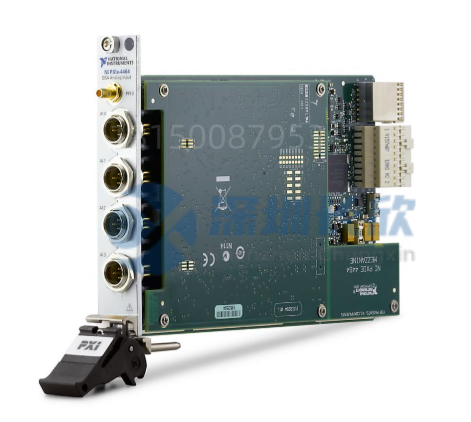
In the world of automated test equipment (ATE), real-time control, and data-intensive measurement systems, the performance, reliability, and modularity of the embedded controller directly dictate system capability and scalability. The National Instruments (NI) PXI-8186—a rugged, fanless embedded controller based on the Intel Celeron M processor—has long served as a foundational computing engine within PXI (PCI eXtensions for Instrumentation) platforms across aerospace, defense, automotive, and industrial R&D environments. Despite being part of NI’s legacy product line, the PXI-8186 remains in active use due to its deterministic performance, compact form factor, and seamless integration with the broader NI software ecosystem. This article explores its architecture, application strengths, real-world deployment scenarios, and why it continues to support mission-critical systems—even as newer controllers emerge.
Purpose-Built for Deterministic Embedded Operation
Unlike commercial off-the-shelf (COTS) PCs, the PXI-8186 is engineered specifically for the PXI platform, which demands tight synchronization, low-latency communication, and mechanical robustness. Housed in a 3U PXI module form factor, it slots directly into a PXI chassis, sharing a common backplane with instrumentation modules such as digitizers, arbitrary waveform generators, and switch matrices.
Key hardware specifications include:
Intel Celeron M 600 MHz or 1.0 GHz processor (depending on variant),
256 MB or 512 MB DDR SDRAM,
Integrated 10/100 Ethernet, GPIB (via add-on), and serial ports,
Fanless design for silent, maintenance-free operation in dust-prone or sealed environments,
Direct MXI-Express or PCI bridge to PXI backplane, enabling high-bandwidth data streaming to and from I/O modules.
Critically, the PXI-8186 runs real-time operating systems such as NI Real-Time OS (based on Phar Lap ETS) or LabVIEW Real-Time, allowing deterministic loop execution down to sub-millisecond latencies—essential for closed-loop control, hardware-in-the-loop (HIL) simulation, and synchronized multi-channel acquisition.
“We’ve had PXI-8186 units running 24/7 in our avionics test rigs for over a decade,” says a test engineer at a European defense contractor. “Zero thermal failures, and timing jitter has never exceeded 50 µs—even under full CPU load.”
Seamless Integration with NI Software and Hardware Ecosystem
The enduring value of the PXI-8186 lies not just in its hardware, but in its deep integration with NI’s software stack, particularly LabVIEW, LabWindows/CVI, and Measurement Studio. This synergy enables rapid development of complex test sequences without low-level driver coding.
Key integration advantages include:
Automatic Hardware Discovery: Upon booting LabVIEW Real-Time, all PXI modules in the chassis are auto-detected and configured.
Timing and Synchronization APIs: Built-in support for PXI Trigger Bus, Star Trigger, and PXI_CLK10 allows microsecond-accurate coordination across dozens of instruments.
Data Streaming Optimization: The integrated PCI interface supports sustained throughput of up to 132 MB/s, sufficient for multi-channel analog capture at moderate sample rates.
Remote Deployment & Monitoring: Engineers can deploy applications remotely via NI MAX (Measurement & Automation Explorer) and monitor CPU, memory, and network usage in real time.
This ecosystem approach drastically reduces development time—turning what might take months in a generic embedded Linux environment into weeks in LabVIEW.
Real-World Applications Across Engineering Domains
Aerospace: Avionics Functional Testing
A major aircraft manufacturer uses PXI-8186-based systems to validate ARINC 429 and MIL-STD-1553 communication buses in flight control units. The controller’s deterministic timing ensures message scheduling adheres to protocol specs, while its fanless design meets clean-room requirements.
Automotive: ECU Validation and Durability Testing
In powertrain labs, the PXI-8186 orchestrates stimulus-response tests on engine control units (ECUs), commanding load banks, signal simulators, and CAN/LIN interfaces. One OEM reported that migrating from rack-mounted PCs to PXI-8186 reduced test cell footprint by 60% and improved uptime by eliminating fan-related failures.
Industrial R&D: Structural Health Monitoring Prototypes
Researchers at a national lab deployed PXI-8186 controllers in field-deployable systems for bridge vibration analysis. Its wide operating temperature range (0°C to 55°C) and shock resistance allowed continuous operation in uncontrolled outdoor environments for months at a time.
Lifecycle Considerations and Modern Relevance
Although NI has since introduced more powerful successors like the PXIe-8880 and PXIe-8840. the PXI-8186 remains relevant for several reasons:
Long-Term Stability: Many legacy ATE systems were qualified and certified with the PXI-8186; replacing the controller would require costly re-validation.
Sufficient Performance for Mid-Tier Tasks: For applications not requiring gigasample-per-second data rates or AI inference, the 8186’s performance is still adequate.
Software Backward Compatibility: LabVIEW versions as recent as 2020 continue to support the PXI-8186. ensuring code portability.
However, users should note limitations: no USB 3.0. limited RAM expandability, and lack of PCIe Gen 2+ bandwidth. For new designs demanding high-speed streaming or FPGA co-processing, newer PXI Express controllers are recommended.
Best Practices for Deployment and Maintenance
To maximize reliability in long-duration deployments:
Use Industrial-Grade Storage: Replace the default DOM (Disk-On-Module) with a high-endurance SLC NAND drive if frequent writes occur.
Enable Watchdog Timers: Configure the real-time OS watchdog to reboot the system automatically after a hang.
Minimize Background Services: Disable unused network protocols and file-sharing features to reduce attack surface and CPU load.
Monitor Thermal Margins: Even though fanless, ensure chassis airflow prevents localized hot spots—especially when adjacent to high-power RF modules.
Expert Insight: “The PXI-8186 isn’t fast by today’s standards, but it’s predictable,” notes an NI-certified architect. “In test systems, repeatability beats raw speed every time.”
Conclusion: A Legacy of Reliability in Embedded Test
The NI PXI-8186 may no longer headline product catalogs, but its legacy endures in thousands of operational test systems worldwide. By delivering deterministic real-time performance, mechanical ruggedness, and deep software integration in a compact PXI form factor, it set a benchmark for embedded instrumentation controllers. For organizations maintaining proven ATE infrastructure—or developing cost-sensitive, mid-performance test solutions—the PXI-8186 remains a dependable, field-validated choice. In engineering, where trust is earned through years of uninterrupted service, this controller has more than paid its dues.