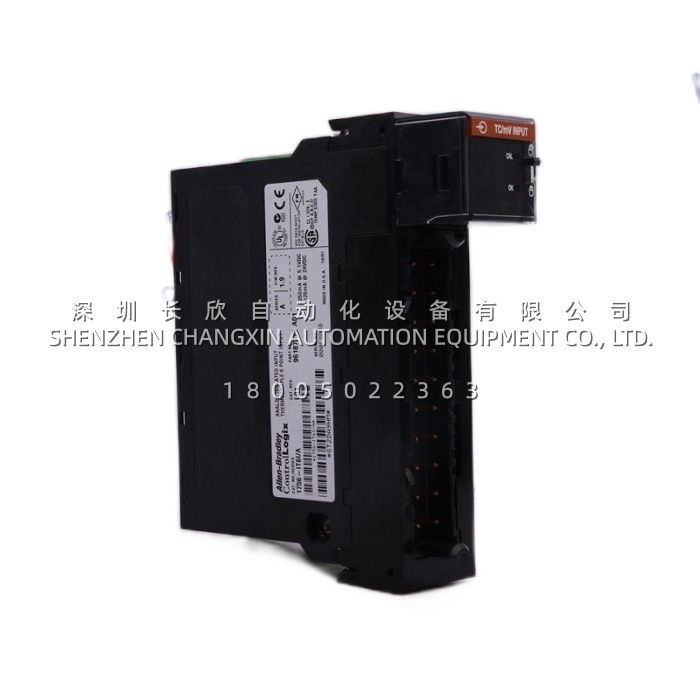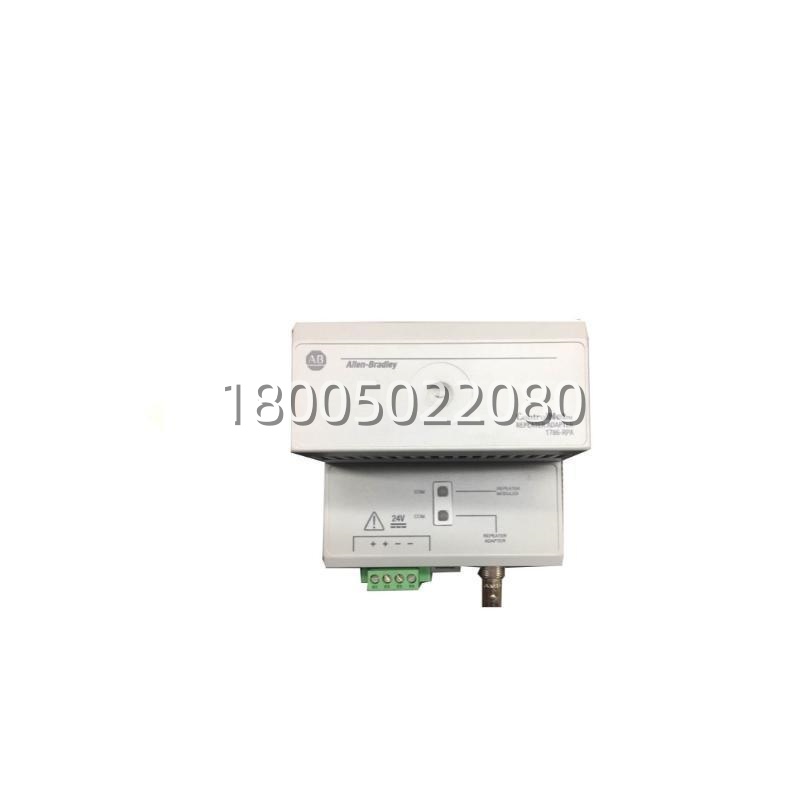
Description:The Allen-Bradley 1786-RPTD is a DC-powered coaxial repeater module designed for the ControlNet (CNET) industrial network. It functions at the physical layer (Layer 1) to regenerate and extend ControlNet signals transmitted over RG-6/U 75-ohm coaxial cable. Unlike standard PLC or I/O modules, it does not process CIP messages but acts as a signal amplifier to overcome cable attenuation, allowing networks to span longer distances and support more nodes. It is commonly used to link separate ControlNet trunk lines in large factory installations.Application Scenarios:In a large automotive assembly plant, a ControlNet network needed to connect a remote paint shop (located 800m away) to the main body shop’s ControlLogix processors. A single 1786-RPTD module was installed in a junction cabinet at the 750m mark. Powered by a local 24V DC supply, it received the degraded signal from the main trunk, regenerated it to full strength, and extended the network another 750m to the paint shop PLC, ensuring real-time I/O data exchange without packet loss.
Parameter:
| Main Parameters | Value/Description |
|---|---|
| Product Model | 1786-RPTD (often listed as 1786-RPTD15 for 15-port systems) |
| Manufacturer | Allen-Bradley (Rockwell Automation) |
| Product Category | ControlNet Coaxial Media Repeater |
| Primary Function | Extend ControlNet coaxial trunk distance; Connect multiple trunk segments |
| Network Media | RG-6/U (75 ohm) Coaxial Cable |
| Port Configuration | 2 x BNC Connectors (In/Out for daisy-chaining trunk lines) |
| Power Supply | 24V DC (Wide-range models support 20-72V DC) |
| Power Consumption | ~100 mA (typical at 24V DC) |
| Status Indicators | PWR (Power), Status/Network Activity |
| Isolation | 500V DC (Channel-to-Backplane) |
| Operating Temperature | 0 to 60 °C |
| Compatibility | ControlNet Coax Networks (1756-CNB, 1784-PCC, etc.) |
Technical Principles and Innovative Values:The 1786-RPTD operates by receiving a Manchester-encoded signal, amplifying it, and retransmitting it with corrected timing and amplitude.
- Innovation Point 1: Deterministic Signal Regeneration: ControlNet relies on precise timing for its scheduled data transfers. The 1786-RPTD is not a simple Ethernet hub; it actively restores the signal’s rise and fall times, which is critical for maintaining the Network Update Time (NUT) and preventing “Scheduled Only” faults in downstream devices.
- Innovation Point 2: Topology Flexibility: While ControlNet is typically a trunk-and-tap bus, the 1786-RPTD allows engineers to create tree or star topologies. This enables a single network to branch out to different areas of a plant (e.g., separate assembly lines) from a central repeater cabinet, providing more flexible physical layout options than a strict daisy-chain.
- Innovation Point 3: DC Power for Hazardous Areas: Unlike the AC-powered 1786-RPT, the RPTD variant’s low-voltage DC input makes it suitable for installation in Class I, Division 2 hazardous environments or areas where only DC control power is available (e.g., from a UPS-backed DC rail).
Application Cases and Industry Value:Case: Mining Conveyor System Network ExtensionA copper mine’s primary crusher was located 1.5 km from the central control room. The initial ControlNet installation using a single trunk line experienced intermittent communication faults due to signal loss over the long distance.
- Application: Two 1786-RPTD modules were deployed. The first was placed at 800m to regenerate the signal, and the second was placed at the crusher motor control center (MCC). This created two healthy trunk segments, each under the 1000m maximum length limit.
- Improvement & Feedback: The mine’s control engineer reported, “The 1786-RPTD modules stabilized the entire network. We no longer had ‘Node Not Found’ errors on the crusher PLC, and the DC power allowed us to use the existing 24V battery backup in the MCC, ensuring network uptime during brief power sags.”