Description:
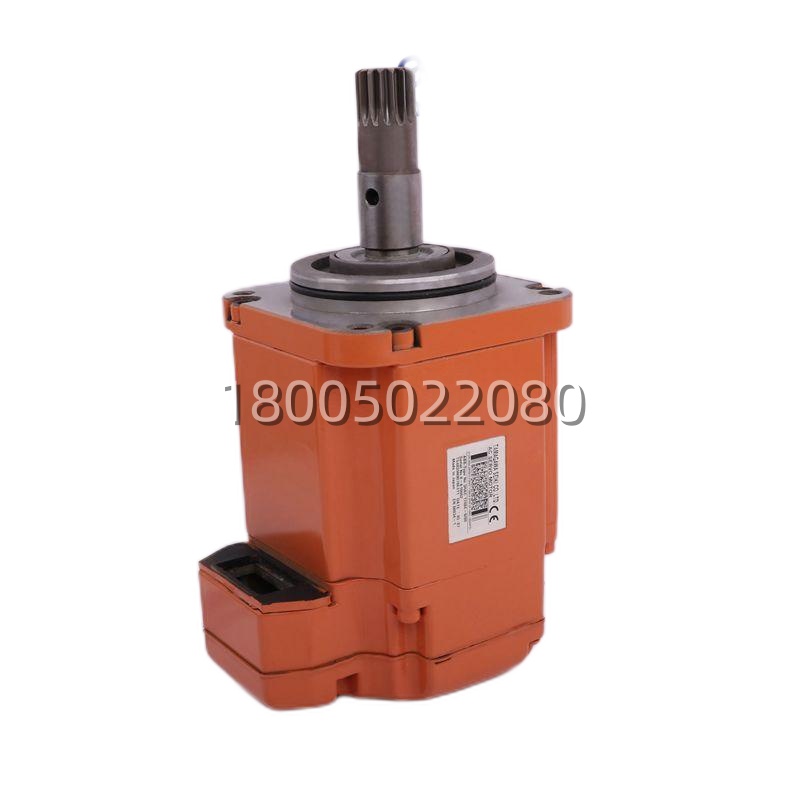
The 3HAC021722-001 is an ABB permanent-magnet AC servo motor with factory-pressed and machined pinion (gear) designed as a direct replacement axis drive motor for ABB articulated industrial robots—commonly the IRB 140, IRB 2400, or similar IRB series manipulators (exact axis assignment varies by robot model / revision). It integrates the servo rotor, stator, brake (typically 24 V DC spring-applied power-off brake), resolver or encoder feedback device, and a hardened steel pinion that meshes with the first-stage reduction gear (cyclo or harmonic drive) inside the robot joint, providing a complete “bolt-on” actuator assembly for a specific robot axis.h2 Application Scenarios:An automotive Tier-1 stamping plant runs a cell of four ABB IRB 2400-10 arc-welding robots. One unit began exhibiting a “Position Feedback Error” on Axis 2 during high-speed repositioning moves; trend logs showed increasing resolver offset deviation and occasional over-current faults on the Axis 2 servo drive (part of the IRC5 cabinet’s drive module). After ruling out cable flex-life failure and gearbox backlash excess via the robot’s calibration routine, the diagnosis pointed to a degrading servo motor—likely worn bearings or a cracked rotor magnet affecting the resolver’s null position. The maintenance team sourced a 3HAC021722-001 motor-with-pinion pre-tested to match the robot’s software version. With the robot in a safe home position and the brake released via the service jog, they unbolted the old motor, disconnected the power & feedback quick-release connector, slid the new unit in (pinion already pressed and keyed), reconnected, and ran a fine-calibration (Calibrate → Update Rev.Counter). Total swap time: 22 minutes. The position-error fault never recurred. The cell lead commented that “having the pinion already mounted and the motor pre-tested meant we didn’t have to press a gear or guess at backlash—it just went back to work.”h2
Parameter:
| Main Parameters | Value/Description |
|---|---|
| Product Model | 3HAC021722-001 (ABB Robot Axis Servo Motor with Pinion) |
| Manufacturer | ABB (Robotics Division) |
| Product Category | AC Permanent-Magnet Servo Motor with Integrated Pinion (for IRB Manipulator Joint) |
| Typical Rated Power | 0.4 – 1.5 kW (depending on axis & IRB model — common for IRB140/2400 small/medium axis motors) |
| Rated Voltage | 3-Phase 200–230 V AC (wye / delta per motor plate) |
| Rated Speed | 3000 rpm (typical for ABB small-frame servo motors) |
| Rated Torque | 1.3 – 4.8 Nm (typical range for this motor family — verify against your robot’s axis load calc) |
| Peak Torque | 3× rated (typical short-duration overload capacity) |
| Brake | 24 V DC spring-applied / power-to-release (holding brake, typically 0.4–0.8 Nm holding torque) |
| Feedback Device | Resolver (standard on 3HAC… motors) or EnDat encoder — factory fitted & pinned |
| Pinion | Hardened steel, press-fitted & pinned to motor shaft — tooth count / module matches robot reduction gear input |
| Connector Type | ABB-standard circular hybrid connector (power + feedback + brake) — keyed, quick-release |
| Degree of Protection | IP54 (typical for IRB arm motors — protected against dust & splashing oil) |
| Cooling | Natural convection (TEFC / TENV style) |
| Mounting Flange | IEC metric flange with dowel holes matching IRB axis housing — includes O-ring / seal where applicable |
| Key Note | Match full ABB code 3HAC021722-001 INCLUDING revision letter (e.g. -001 vs -003) to your robot’s Parts Manual — pinion tooth count & feedback type vary |
| Certifications | CE, cULus, complies with IEC 60034-1 / IEC 61800-5-1 |
h2 Technical Principles and Innovative Values:
- Innovation Point 1 — Factory-Pressed Pinion with Laser-Inspected Runout Tolerance. The 3HAC021722-001 is not a generic servo motor with an accessory gear—the pinion is pressed onto the shaft in a climate-controlled environment, pinned, and inspected for radial runout (< 0.01 mm typical) before shipment. This guarantees correct meshing depth and minimal backlash introduction into the robot’s reduction gear, which is critical for repeatability (< ±0.02 mm on IRB140/2400 class). Field-pressing a pinion risks shaft damage or incorrect seating that degrades robot accuracy.
- Innovation Point 2 — Integrated Resolver Feedback & Brake in a Sealed Armature Package. The motor incorporates a high-resolution brushless resolver (or encoder in later revisions) and a compact 24 V DC holding brake within the same Ø60–Ø80 mm flange envelope. The resolver is mechanically coupled to the rotor and electrically characterized at the factory, eliminating the need for field alignment. The brake automatically holds the axis when control voltage is removed—essential for gravity axes (e.g., Axis 2 / Axis 3 on many IRBs) to prevent load drop on power loss.
- Innovation Point 3 — Plug-and-Play Quick-Change with Hybrid Connector. The 3HAC021722-001 uses ABB’s standard circular hybrid connector that bundles three power phases, brake supply, and resolver/external temperature sensor into one keyed, screw-locking plug. This allows a complete motor swap without individual wire termination, reducing the chance of miswired brake or feedback leads that could cause drive faults or unsafe axis movement. The connector is also indexed to prevent incorrect orientation even in cramped arm interiors.
h2 Application Cases and Industry Value:Case — Electronics Contract Manufacturer IRB140 Axis 6 Motor Replacement: A bench-top IRB140 was used for high-mix PCB screwdriving. After 28,000 hrs the Tool Center Point (TCP) repeatability on Axis 6 degraded—off by 0.15 mm in rotation. A calibration could not correct it; inspection showed the Axis 6 servo motor bearing had radial play exceeding spec, introducing wobble at the wrist. The integrator replaced the motor with a ABB 3HAC021722-001 (correct Axis 6 variant for IRB140), performed a Rev.Counter update and a fine-calibration (with load tool mounted), and recovered original ±0.02 mm repeatability. The plant documented a return to < 50 ppm defect rate on the screwdriving station and noted “the pre-mounted pinion saved us from a gear-press tool we didn’t have on site.”