
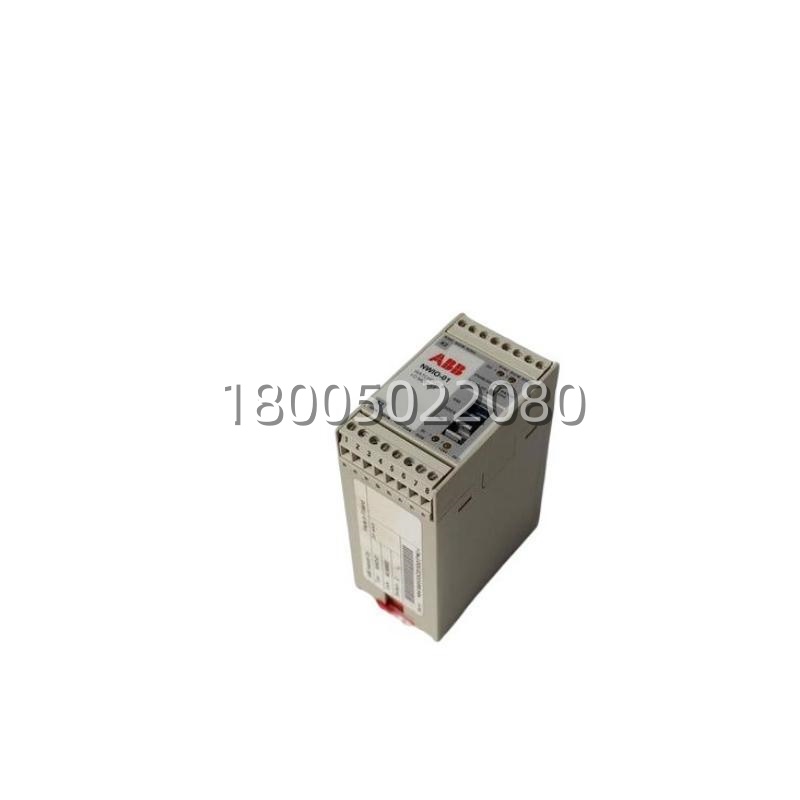
Technical Principles and Innovative Values
- Innovation Point 1 – DDCS Fiber-Optic Decoupling: The ABB NAIO-01 communicates with the drive CPU over ABB’s DDCS (Distributed Digital Control System) plastic optical fiber, providing total galvanic isolation between the noisy power section and sensitive analog measurement circuits—eliminating ground-loop errors common with copper-linked I/O.
- Innovation Point 2 – Software-Configurable Signal Types: Both AI and AO channels are freely assignable in drive parameters to voltage (±10 V, 0–10 V) or current (0/4–20 mA) modes, with independent scaling (offset/gain), min/max clamping, and inversion—no hardware jumpers required beyond the node-address DIP switches.
- Innovation Point 3 – Transparent I/O Mapping to Drive Parameters: The NAIO-01 analog inputs and outputs are mapped directly into the ACS drive’s parameter set (e.g., Group 14/15 for external references or Group 40 for supervision), making them appear indistinguishable from the drive’s onboard I/O—no additional programming or PLC ladder logic needed.
- Innovation Point 4 – Compact Retrofit Without Panel Expansion: Because the ABB NAIO-01 can be DIN-rail mounted inside the existing drive enclosure and draws power from the 24 V DC auxiliary supply, it adds four analog channels with zero incremental panel footprint—ideal for brownfield drive upgrades.
Application Cases and Industry Value
In a municipal water treatment facility, three ABB ACS600 pumps lacked enough analog inputs to accept both local level-transmitter feedback and a SCADA speed trim. Installing a ABB NAIO-01 on each drive’s DDCS link provided the extra 2 AI channels per unit, which were parameterized to read the tank level (4–20 mA) and apply it as a cascaded setpoint via drive Group 11. The result: tighter level control (±15 mm vs. previous ±50 mm), elimination of a standalone PID loop in the SCADA, and zero additional panel cutouts. Facility engineers noted the NAIO-01’s optical isolation was especially valuable given the long, unshielded analog runs from outdoor tanks to the MCC room.
Related Product Combination Solutions
- ABB NIOC-01 / NIOC-02 (3BHT200012R0001) – Standard I/O interface board in ACS600/800; hosts the DDCS fiber link to which the ABB NAIO-01 connects (CH1 or CH2).
- ABB NAMC-03 / NAMC-11 (3BHT200014R000x) – Application & Motor Control Board; master for DDCS option modules including NAIO-01—ensure firmware supports NAIO parameter 98.06.
- ABB NDIO-01 / NDIO-02 (3BHT200008R0001) – Digital I/O extension module (2 DI + 2 RO) that shares the same DDCS architecture; often paired with NAIO-01 on the same fiber ring.
- ABB NTAC-02 (3BHT200013R0001) – Pulse encoder interface module; also DDCS-linked—useful when full option suite (analog + digital + encoder) is needed on one drive.
- ABB AINT-02 / AGDR-02 (3BHE006446R0101) – Inverter control / gate driver boards in ACS800; NAIO-01 is not directly linked but shares the same option-slot ecosystem—verify NIOC presence before ordering.
- ABB RDCO-02 / RDCO-03 (3BHE006232R0101) – DDCS communication option board for NAMC-11; may be required if all DDCS channels are occupied before adding ABB NAIO-01.
Installation, Maintenance, and Full-Cycle Support
Mount the ABB NAIO-01 on a 35 mm DIN rail inside the drive cabinet or option compartment. Connect the 24 V DC auxiliary supply (+24 V to terminal X1-1, 0 V to X1-2) and plug in the plastic optical fiber cables from the NIOC or NAMC board’s DDCS port (typically CH1; if a ring topology is used, insert NAIO-01 in series). Set the 7-way DIP switch inside the module cover to the desired node address—for ACS600 Standard Application, address 4 is the factory-recommended default for the first NAIO module. Power up the drive, navigate to parameter 98.06 (AI/O EXT MODULE 1) and set it to NAIO-01; the drive will poll the module and activate the analog channels. Wire field signals to terminals X2 per the NAIO-01 manual(AI1+/−, AI2+/−, AO1+/−, AO2+/−) using shielded twisted-pair cable, grounding the shield drain only at one end.


