
Description:
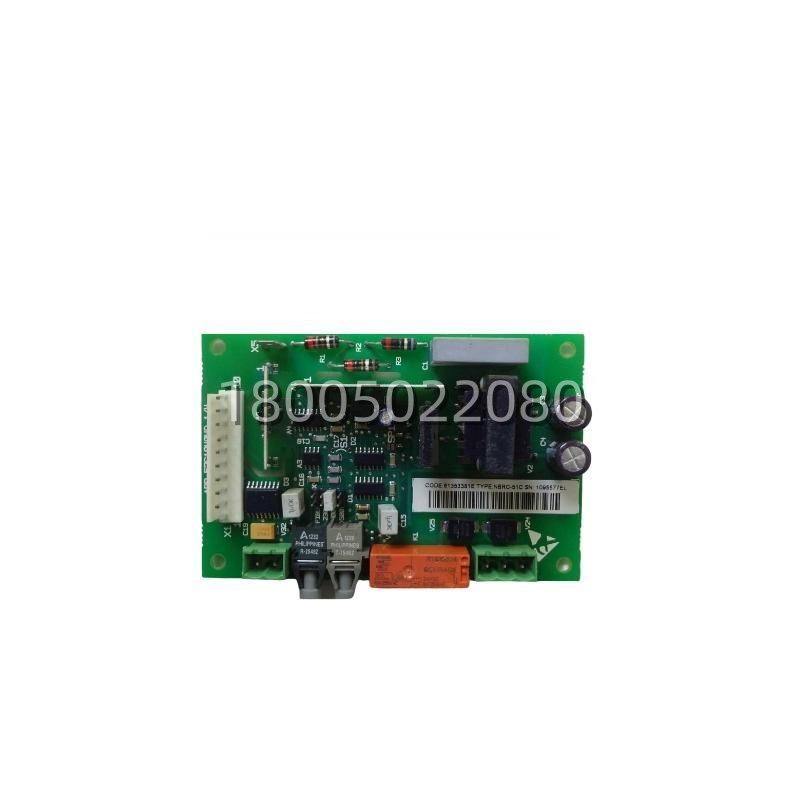
The ABB NBRC-51C is an Inverter Speed Measuring Board / Encoder Interface Card designed for insertion into the option slot (via AMCB or RDCO adapter) of ABB ACS600 and ACS800 series variable frequency drives. It accepts incremental quadrature encoder (A, B, Z / Index) signals — TTL differential (5 V RS-422) or HTL single-ended (12/24 V) — decodes direction and pulse count, and feeds precise speed / position feedback to the drive’s vector-control software for closed-loop flux-vector, winding, or synchronized motion applications. The board can also source the encoder’s operating voltage (5 V / 12 V / 24 V DC) from its onboard regulator.
Application Scenarios:
A plastic film biaxial stretching line used an ABB ACS800-04-0300 in closed-loop flux-vector mode to control its main nip roll. During a product changeover the drive began reporting intermittent “Encoder Signal Loss” (Fault 7110) even though the 1024 PPR TTL encoder tested good with a handheld scope. Investigation revealed the ABB NBRC-51C speed-measuring board inside the drive’s option slot had a failing differential receiver on Channel A — the green A-LED flickered erratically while B and Z were stable. The drive was de-energized, the NBRC-51C was withdrawn from the AMCB-02 adapter, a verified replacement was inserted, the encoder supply was set to 5 V DC via drive parameter 50.xx, and the shielded twisted pair was re-terminated. On power-up the RUN LED lit, the A/B activity LEDs responded to manual shaft rotation, and the nip-roll regained stable speed regulation — no parameter changes, no firmware load. This case shows the NBRC-51C as the critical “front-end” translating precision rotary encoder pulses into usable drive-feedback data, and why a correct spare is essential for any closed-loop ACS800 application.
Parameter:
| Main Parameters | Value/Description |
|---|---|
| Product Model | NBRC-51C (ABB Inverter Speed Measuring / Encoder Interface Board) |
| Manufacturer | ABB |
| Product Category | Speed Measuring Board / Pulse Encoder Interface Card (Drive Option Module) |
| Compatible Drive Series | ABB ACS600, ACS800 (with AMCB-0x / RDCO-x option adapter); select ACSM1 applications |
| Encoder Input Type | Incremental Quadrature (A, B, Z / Index) — TTL (RS-422 differential) and HTL (12–24 V single-ended) |
| Max. Pulse Frequency | 200 kHz (TTL differential); lower for HTL single-ended — supports 1024–2500 PPR up to high RPM |
| Encoder Supply Output | Programmable 5 V DC (TTL), 12 V DC, or 24 V DC (typical max. 200 mA) to power external encoder |
| Input Isolation | Optical isolation between encoder inputs and drive internal logic (≥ 1500 V AC test) |
| Connection | Screw terminals on associated terminal board or direct to edge-connector pigtail: A+/A−, B+/B−, Z+/Z−, 0V, Shield, +Us |
| Status Indication | PWR LED + A / B / Z channel activity LEDs (illuminate on valid pulse edges) |
| Mounting Method | Plugs into ACS800 AMCB / RDCO option adapter; secured by plastic latch |
| Operating Temperature | -20 °C to +60 °C |
| Storage Temperature | -40 °C to +85 °C |
| Protection Class | IP20 (installed inside drive cabinet) |
| Dimensions (approx.) | 105 × 68 × 18 mm (L × W × H, PWA only) |
| Weight (approx.) | 0.06 – 0.09 kg |
Technical Principles and Innovative Values:
- Innovation Point 1 — Dual-Standard TTL/HTL Input with Programmable Encoder Supply. The ABB NBRC-51C auto-adapts (via drive parameter setting) to differential TTL or single-ended HTL encoder signals and can supply the encoder with 5 V, 12 V, or 24 V DC from its onboard current-limited regulator — eliminating the need for an external encoder power supply and simplifying wiring for both modern 5 V quadrature encoders and legacy 24 V PNP pulse tachos.
- Innovation Point 2 — Quadrature Decoding with Direction Sense & Index (Z) Validation. The NBRC-51C decodes A/B phase lead/lag to determine rotation direction and accumulates pulse count in the drive’s position register. The Z (index) pulse is validated and can be used for homing or commutation reference in positioning applications — all processed with microsecond-level latency relative to the drive’s sampling cycle.
- Innovation Point 3 — Optically Isolated Inputs & Auto-Recognition by Drive Firmware. Galvanic isolation on all pulse inputs protects the drive’s low-voltage logic from ground loops and EMI on long encoder cables. On insertion into a compatible ACS800 with AMCB/RDCO adapter, the NBRC-51C is recognized automatically; the existing Parameter Group 50 (Encoder 1) settings apply — no board-level configuration or firmware flashing is required, enabling true “plug-and-play” spare replacement.


